Decoding the Duality: A Couture Analysis of Sacred Narrative and Illusion
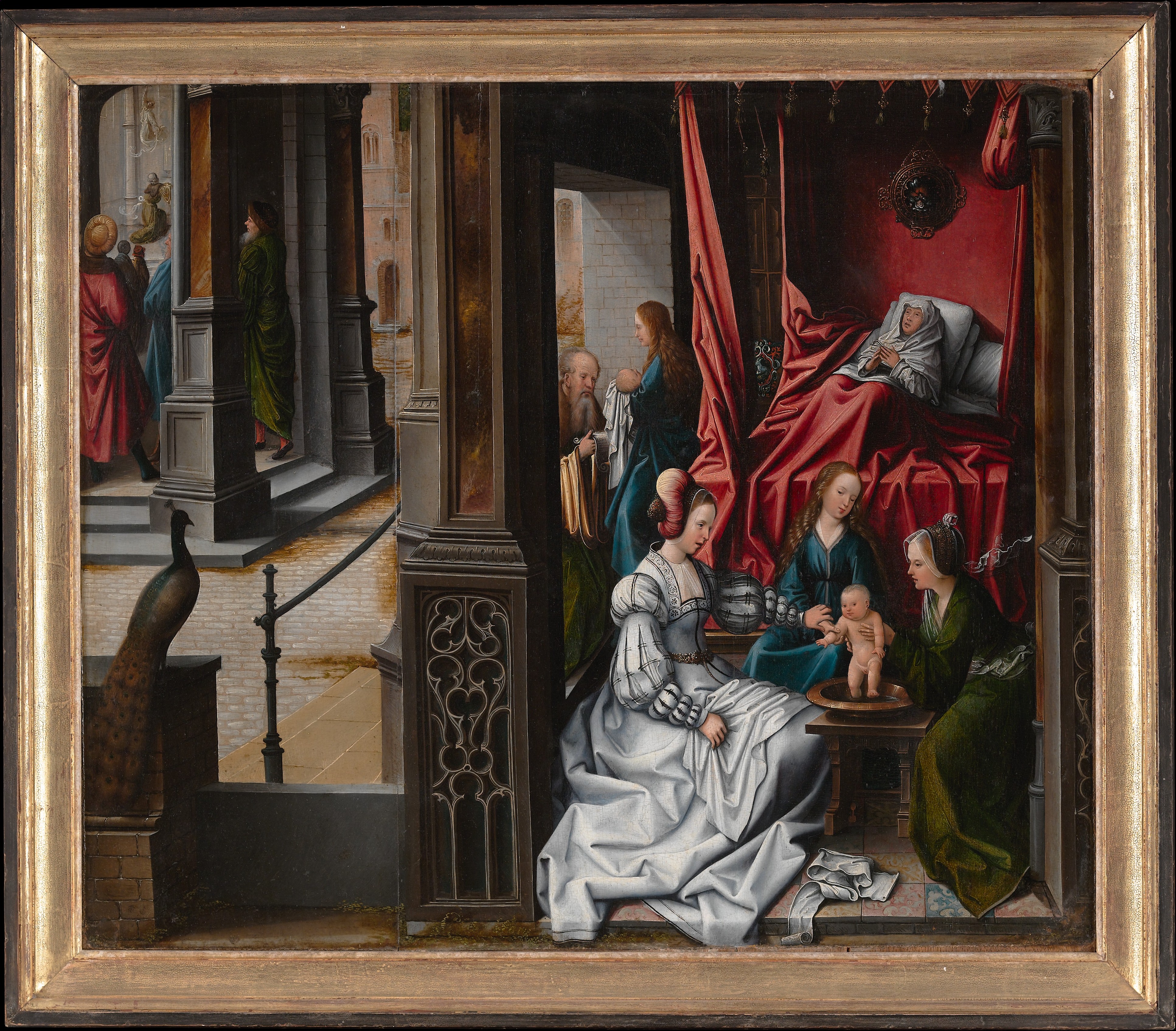
Presented as a standalone study, this diptych panel from the Global Heritage collection presents a profound and visually arresting dichotomy. On one face, the luminous, communal celebration of Saint John the Baptist's birth unfolds. On its reverse, the intimate, stark solitude of "The Man of Sorrows" is rendered in a masterful trompe-l'oeil that challenges the very nature of the panel itself. For Katherine Fashion Lab, this artifact is not merely a religious painting; it is a seminal study in contrast, narrative layering, and material deception—concepts that are directly translatable to the foundational principles of avant-garde couture. The panel serves as a metaphor for the garment itself: a constructed object with a public-facing narrative and a hidden, structural reverse, where the truth of construction and emotion resides.
Obverse: The Couture of Communal Narrative and Luminous Fabrication
The scene of the Baptist's naming is a masterclass in compositional elegance and symbolic fabric play. The figures are arranged not in a mundane chamber, but within an architectural space that functions as a curated stage, its classical elements framing the sacred event. This directly parallels the couture philosophy of considering the body within its spatial context, with garments structured to interact with light and environment. The palette is one of rich, deep tones—umber, olive, and burgundy—against which the brilliant whites and luminous pastels of the central figures' garments explode with significance.
Elizabeth's bedgown and the swaddling cloth of the infant John are not simple drapery; they are studies in the manipulation of light as texture. The artist's handling of oil on wood achieves a softness that mimics finest silk and linen, with folds that capture and radiate light, directing the viewer's eye through the narrative. Each character's attire is a coded uniform: Zechariah's scholarly robes, the attendant's humble dress, the relative's rich fabrics—all communicate status, function, and emotion. This is character-driven costuming at its most sophisticated, where fabric choice, cut, and hue are integral to storytelling, a principle paramount in narrative-driven collections at Katherine Fashion Lab.
Reverse: The Trompe-l'oeil as Structural Revelation
Flipping the panel reveals a conceptual and aesthetic revolution. The Man of Sorrows is presented not as a straightforward painting, but as a painting within a painting, an object within an object. The trompe-l'oeil technique meticulously simulates a frayed, pinned parchment or canvas overlay, its torn edges and cast shadows so convincing they deny the actual wooden support. This is where the panel transitions from narrative art to meta-commentary on artistry and substance.
For the couturier, this reverse is the ultimate metaphor for the inside of a garment—the déshabillé of structure. It represents the hidden world of seams, boning, linings, and labels often concealed from view. The torn parchment illusion parallels the deliberate exposure of internal construction—letting a seam remain visible, celebrating a dart, or using transparent layers to reveal foundational structures. The image of Christ, serene in his suffering, placed within this context of artistic illusion, speaks to the vulnerable truth that underpins crafted beauty. It is the emotional and structural core, the "sorrow" or the intense labor that is essential to, yet hidden by, the final glorious form.
From Pigment to Textile: A Material Translation for Contemporary Couture
The genius of this diptych study lies in its holistic dialogue, offering a complete creative manifesto. Translating this into a couture collection requires a dualistic approach to materiality and construction.
Collection Theme: "Obverse/Reverse"
A collection would explore the tension between public facade and private reality. Obverse garments would embody the Baptism scene: elegant, luminous, and narrative-driven. Imagine gowns with sculpted sleeves referencing Renaissance drapery, embroidered with symbolic iconography (lambs, scrolls, naming tablets) in metallic thread. Fabrics would be light-manipulative: duchess satins, iridescent taffetas, and matte velvets in a palette of celestial blues, saintly whites, and earthy terracotta.
Reverse garments would take their cue from the trompe-l'oeil. Looks would feature "deconstructed" elements: jackets with lining exposed as the outer shell, dresses with intricate seamwork highlighted by piping or contrast stitching. Fabrics would mimic the illusion—printed textiles that replicate torn paper or canvas, laser-cut lace that appears frayed, and sheer overlays that create layered, shadowy depth. The color story would be monastic and material-focused: raw canvas, parchment, lead grey, and blood maroon.
Construction Philosophy: Illusion as Integrity
The technical takeaway is the celebration of construction as a legitimate visual language. This could manifest in: Trompe-l'oeil tailoring, where a jacket appears to be pinned to the body with fabric "tacks" and "threads" made of crystal beading; reversible garments that offer a full "obverse" and "reverse" look; and flat pattern-cutting that creates three-dimensional illusions of folded parchment or peeling layers. The Man of Sorrows image itself could be subtly intarsia-knitted into a jersey dress or rendered in delicate devoré velvet, serving as the emotional signature on the interior of a coat.
In conclusion, this diptych panel is a profound study in the duality of creation. It champions the radiant, public story (the couture spectacle) while insisting on the profound, often concealed truth of its making (the couture craft). For Katherine Fashion Lab, it provides a timeless blueprint: true innovation lies not in choosing between beauty and substance, narrative and structure, but in weaving them into an inseparable, dialogic whole, where each side gives meaning and depth to the other, much like the two faces of this masterful wooden panel.