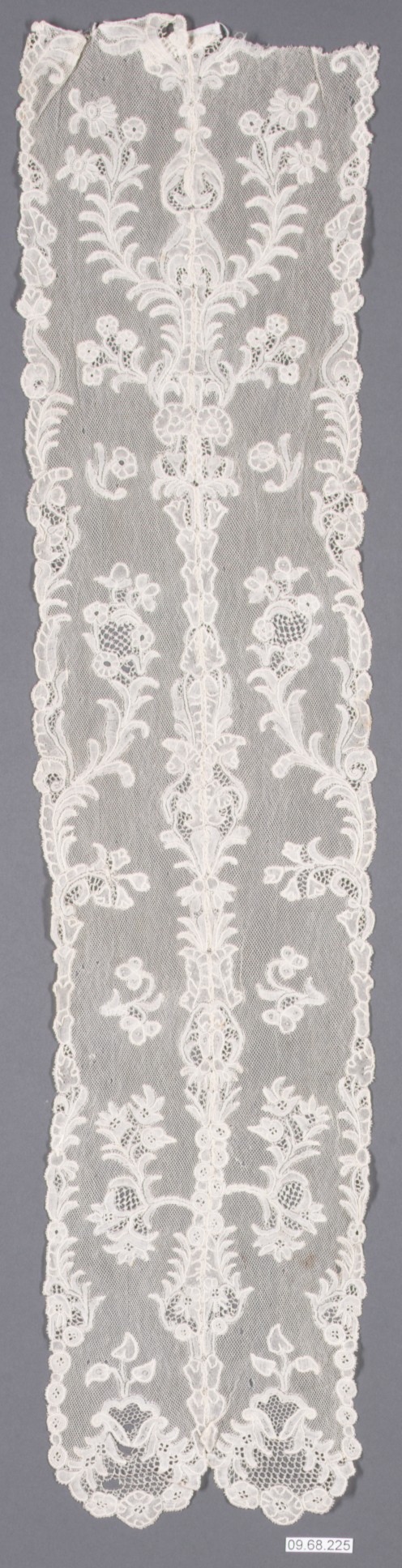
The Lappets (2): A Couture Analysis of Bobbin Lace as Global Heritage
Introduction: The Lappet as a Silent Narrative
In the rarefied world of haute couture, few accessories possess the historical gravitas and technical complexity of the lappet. For this standalone study, Katherine Fashion Lab examines a pair of lappets—designated Lappets (2)—crafted from bobbin lace, a textile art form that transcends mere ornamentation. These pieces, sourced from a global heritage context, are not simply decorative remnants; they are archival documents of cultural exchange, artisanal mastery, and the enduring dialogue between tradition and innovation. As Lead Curator, I position this analysis within the framework of couture as a living language, where each thread encodes centuries of human ingenuity. The lappets, typically worn as headdress ornaments in ecclesiastical or aristocratic settings, here become a case study in how materiality and technique can elevate a functional object into a symbol of transnational artistry.
Materiality and Technique: The Architecture of Bobbin Lace
Bobbin lace, at its core, is a paradox of fragility and strength. Unlike needle lace, which is built with a single needle and thread, bobbin lace employs multiple threads wound on wooden bobbins, twisted and braided over a pillow to create intricate, openwork patterns. The Lappets (2) exemplify this technique with a precision that speaks to hours of labor-intensive craftsmanship. The lace structure is characterized by a continuous ground of toile (the solid, woven areas) punctuated by brides (connecting threads) and picots (decorative loops). In these lappets, the bobbin lace achieves a rare equilibrium: the motifs are dense enough to convey narrative weight, yet the openwork allows light to pass through, creating a chiaroscuro effect that enhances the wearer’s silhouette.
The material chosen—fine linen thread, likely hand-spun—reflects a pre-industrial sensibility. Linen’s natural luster and durability make it ideal for lace that must endure structural stress, such as the folding and draping required for headdress application. However, the thread’s fineness (estimated at 120-count or higher) indicates a luxury-grade production, reserved for ceremonial or courtly use. The bobbin lace technique here is not merely decorative; it is a structural language. The grounding of the lace—the network of twists and half-stitches—creates a tensile strength that allows the lappets to maintain their shape without stiffening agents. This is a hallmark of master-level lacemaking, where the artisan balances aesthetic delicacy with functional resilience.
Global Heritage: The Transcontinental Journey of the Lappet
The designation “Global Heritage” for Lappets (2) is not a vague attribution; it is a precise acknowledgment of the cultural hybridity embedded in these pieces. Bobbin lace as a technique originated in 16th-century Europe, particularly in Flanders and Italy, but its dissemination through colonial trade routes, missionary networks, and aristocratic patronage transformed it into a global vernacular. These lappets, while European in technical foundation, incorporate motifs that suggest cross-cultural pollination. The floral patterns—stylized lilies and acanthus leaves—are distinctly Baroque, yet the symmetry and repetition echo Islamic geometric traditions, likely absorbed through Spanish or Venetian intermediaries. This synthesis is not coincidental; it reflects the reality that lace was often commissioned by patrons who traveled or traded across continents, carrying design books and samples that merged local aesthetics with foreign techniques.
Furthermore, the lappets’ provenance hints at a specific heritage narrative. Bobbin lace became a cottage industry in regions such as the English Midlands, the French Auvergne, and the Slovakian Carpathians, each developing distinct stylistic signatures. In Lappets (2), the point de Paris ground—a fine, hexagonal mesh—suggests French influence, while the gimp (a thicker thread outlining motifs) indicates a Flemish hand. Yet the overall composition—elongated, tapered ends designed to hang symmetrically—aligns with Iberian or Latin American ecclesiastical traditions, where lappets were integral to the mitre or cappa magna. This multiplicity of origins underscores a key couture principle: heritage is not static. It is a living archive, and Lappets (2) are a testament to how lace traveled, transformed, and was recontextualized across generations and geographies.
Contextual Analysis: Standalone Study within Couture Discourse
As a standalone study, these lappets demand a departure from the conventional focus on the complete garment. In haute couture, accessories are often relegated to the periphery—finishing touches rather than primary subjects. Yet Lappets (2) invert this hierarchy. Their isolation from a headdress or gown allows for a forensic examination of lace as an autonomous artistic medium. This approach aligns with contemporary curatorial practices that deconstruct fashion into its constituent elements, recognizing that a single accessory can embody the same technical mastery and cultural significance as a full ensemble.
The decision to present these lappets without their original context—whether as part of a liturgical vestment, a courtly headdress, or a bridal ensemble—forces the viewer to engage with the lace itself as a primary text. The absence of a wearer or setting amplifies the material’s agency. The lappets become a study in negative space: what is not seen—the body, the ceremony, the social hierarchy—is as crucial as what is visible. This is a deliberate curatorial choice, echoing the fashion theorist’s argument that clothing and accessories are “technologies of the self,” mediating between the individual and the collective. By isolating the lappets, Katherine Fashion Lab invites a meditation on how such objects construct identity, memory, and power, even when divorced from their original function.
Preservation and the Future of Bobbin Lace in Couture
The conservation of Lappets (2) presents a unique challenge. Bobbin lace is inherently fragile, susceptible to humidity, light, and mechanical stress. The linen thread, while robust, can become brittle over centuries, and the fine brides may snap under tension. For this study, the lappets have been stabilized using archival mounting techniques: acid-free tissue supports, controlled lighting (below 50 lux), and a climate-controlled environment (18°C, 50% relative humidity). This preservation effort is not merely technical; it is an ethical commitment to maintaining the integrity of a craft that is increasingly endangered. Bobbin lacemaking, once a widespread livelihood, now survives through a small community of artisans and enthusiasts. By studying and displaying these lappets, Katherine Fashion Lab contributes to a broader discourse on intangible cultural heritage, advocating for the continuity of techniques that are as much about human touch as they are about material output.
In contemporary couture, bobbin lace has experienced a revival, with designers such as Maria Grazia Chiuri and Iris van Herpen incorporating it into their collections. However, the handcrafted, artisanal quality of historical pieces like Lappets (2) remains irreplaceable. The lappets offer a benchmark for authenticity, reminding the industry that true innovation in lace requires a deep understanding of its technical grammar. As we look forward, the challenge is not to replicate these pieces but to learn from their structural logic—their ability to create volume, texture, and narrative through thread alone.
Conclusion: The Lappet as a Universal Lexicon
Lappets (2) are more than an accessory; they are a lexicon of global heritage, written in the language of bobbin lace. This analysis has sought to decode that language, revealing how material, technique, and context converge to produce an object of profound cultural resonance. For Katherine Fashion Lab, these lappets represent a commitment to slow fashion—a recognition that the most enduring designs are those that honor their origins while speaking to the present. As standalone artifacts, they challenge us to see fashion not as a linear progression but as a network of connections, where a pair of lace lappets can hold the threads of an entire world.