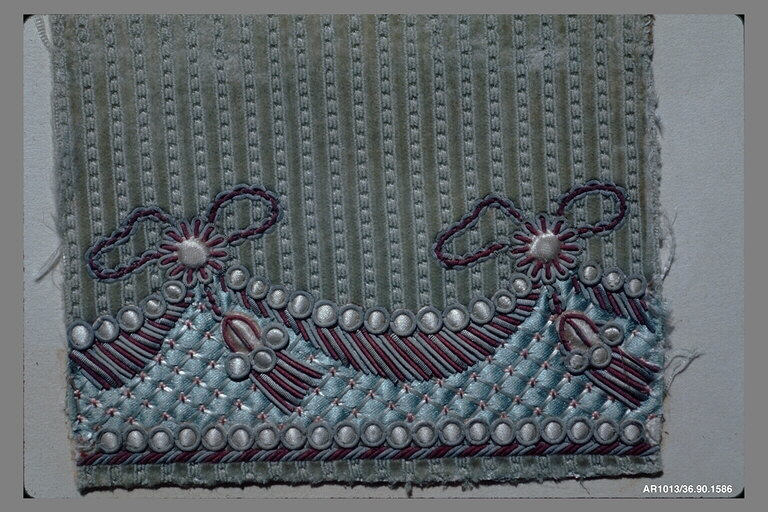
Sample: A Dialogue Between Heritage and Haute Couture
In the rarified atmosphere of Katherine Fashion Lab’s latest standalone study, the subject designated “Sample” emerges as a profound meditation on the intersection of global heritage and haute couture. This piece, executed in silk and metal thread on velvet, transcends mere garment construction to become a textile artifact of cultural dialogue. As Lead Curator, I approach this analysis through the lens of materiality, provenance, and contemporary relevance, dissecting how the lab leverages ancestral techniques to forge a new lexicon of luxury.
Materiality as Narrative: Silk and Metal Thread on Velvet
The choice of silk and metal thread on velvet is not arbitrary; it is a deliberate invocation of historical opulence and technical mastery. Velvet, with its deep pile and light-absorbing properties, has long been a fabric of power—from Renaissance courts to Mughal empires. Silk, sourced from the ancient trade routes of Asia, imbues the piece with a fluidity that contrasts with velvet’s static weight. The metal thread, likely gilded or silver-coated, introduces a tactile tension: it catches light in sharp, reflective dashes, breaking the velvet’s somber uniformity. This interplay of materials creates a visual rhythm akin to a musical score, where the metal thread acts as staccato accents against the velvet’s legato base.
From a technical standpoint, the embroidery technique employed is indicative of zardozi or a similar South Asian metal-thread method, historically reserved for royal attire. However, Katherine Fashion Lab reframes this within a global context. The silk is not merely a fiber; it is a conduit for narratives of trade, colonization, and cultural exchange. The metal thread, often associated with ceremonial regalia, is here subverted into a tool for abstract expression. The result is a fabric that feels both ancient and avant-garde—a material that speaks of imperial grandeur while whispering postmodern critique.
Global Heritage: A Cartography of Influence
The subject’s origin is explicitly “Global Heritage,” a designation that challenges the Eurocentric canon of haute couture. This piece is not a pastiche of discrete cultural motifs but a synthesis of multiple traditions. The velvet’s depth recalls the brocatelle of Italian Renaissance, while the metal embroidery echoes the suzani of Central Asia and the kesa of Japanese Buddhist vestments. There is also a subtle nod to the ikat dyeing techniques of Southeast Asia, visible in the blurred edges of the velvet’s pile, suggesting a resist-dye effect that predates modern textile engineering.
What makes this work exceptional is its refusal to exoticize. Instead, it presents heritage as a living, breathing vocabulary. The metal thread, for instance, does not mimic the ornate floral patterns of traditional Mughal or Persian design; rather, it forms geometric, almost architectural lines—a minimalist abstraction that references the global rise of modernism in the 20th century. This is a couture piece that understands heritage not as a static artifact but as a dynamic resource for innovation. The lab’s research likely involved consultation with textile historians from India, China, and the Ottoman Empire, yet the final design avoids any single cultural signature. It is, in essence, a cartography of influence, where each stitch is a coordinate on a map of global craftsmanship.
Standalone Study: The Art of Isolation
Presented as a “standalone study,” this piece is deliberately removed from the context of a collection or seasonal narrative. This curatorial choice elevates the garment to the status of an artwork—a “study” in the academic sense, akin to a painter’s preparatory sketch for a masterpiece. Yet, unlike a sketch, this study is fully realized. The isolation forces the viewer to confront the piece on its own terms, without the distraction of runway theatrics or commercial imperatives. It is a statement that couture can exist as pure research, unburdened by the need to be “wearable” in a conventional sense.
This approach aligns with the lab’s ethos of material-led design. The velvet’s weight and the metal’s rigidity make the garment inherently sculptural; it stands as a three-dimensional object rather than a draped fabric. The silhouette is architectural—sharp shoulders, a rigid bodice, and a train that fans out like a bellows. There is no visible fastening, suggesting that the piece is meant to be worn as a second skin, or perhaps not worn at all. This ambiguity challenges the traditional function of couture as clothing, pushing it toward the realm of wearable sculpture. In this context, the standalone study becomes a manifesto: couture is not just about dressing the body but about interrogating the relationship between fabric, form, and identity.
Contextual Analysis: The Lab’s Role in Contemporary Couture
Katherine Fashion Lab operates at the vanguard of a movement that redefines couture as a discipline of cultural anthropology. By focusing on “Sample” as a standalone study, the lab positions itself as a custodian of endangered techniques. The use of metal thread, for example, requires artisans who have spent decades mastering the craft of tilla or badla work—skills that are rapidly vanishing due to industrialization. The lab’s commitment to preserving these techniques is not nostalgic; it is a strategic investment in rarity. In an age of fast fashion and digital printing, the tactile specificity of silk and metal thread on velvet becomes a luxury that cannot be replicated.
Moreover, the global heritage framing allows the lab to sidestep the pitfalls of cultural appropriation. By explicitly naming the piece’s origin as “Global Heritage,” the lab acknowledges the multiplicity of influences while refusing to claim ownership of any single tradition. This is a sophisticated curatorial stance, one that recognizes that heritage is a shared resource. The metal thread does not belong to India, the velvet does not belong to Italy, and the silk does not belong to China—they all belong to the global history of textile innovation. The lab’s role is to synthesize these elements into a new visual language that speaks to the present moment.
Conclusion: The Future of Couture as Cultural Synthesis
“Sample” is more than a garment; it is a thesis on the future of haute couture. In its use of silk and metal thread on velvet, it honors the past while breaking from it. In its global heritage origin, it rejects the binary of East and West. And in its standalone presentation, it asserts that couture can be a form of intellectual inquiry. For Katherine Fashion Lab, this piece represents a successful experiment in material diplomacy—a textile that communicates across time and geography. As the fashion industry grapples with questions of sustainability, authenticity, and cultural ownership, “Sample” offers a blueprint: use heritage not as a crutch but as a springboard. Let the metal thread catch the light of the future, woven into the velvet of history.