A Tapestry of Virtue: Deconstructing Katherine Fashion Lab’s “Edenic Codex”
In the rarefied echelons of haute couture, where fabric becomes philosophy and thread transcribes theology, Katherine Fashion Lab’s standalone study, “Edenic Codex,” emerges as a profound meditation on humanity’s primordial narrative. This is not merely a garment; it is a woven exegesis of the Adam and Eve myth, rendered through a global heritage lens and executed with a technical virtuosity that borders on the liturgical. The piece commands attention not for its wearability, but for its intellectual and aesthetic audacity—a canvas that dialogues with centuries of iconography, moral philosophy, and textile artistry.
Narrative Weave: The Garden as Moral Architecture
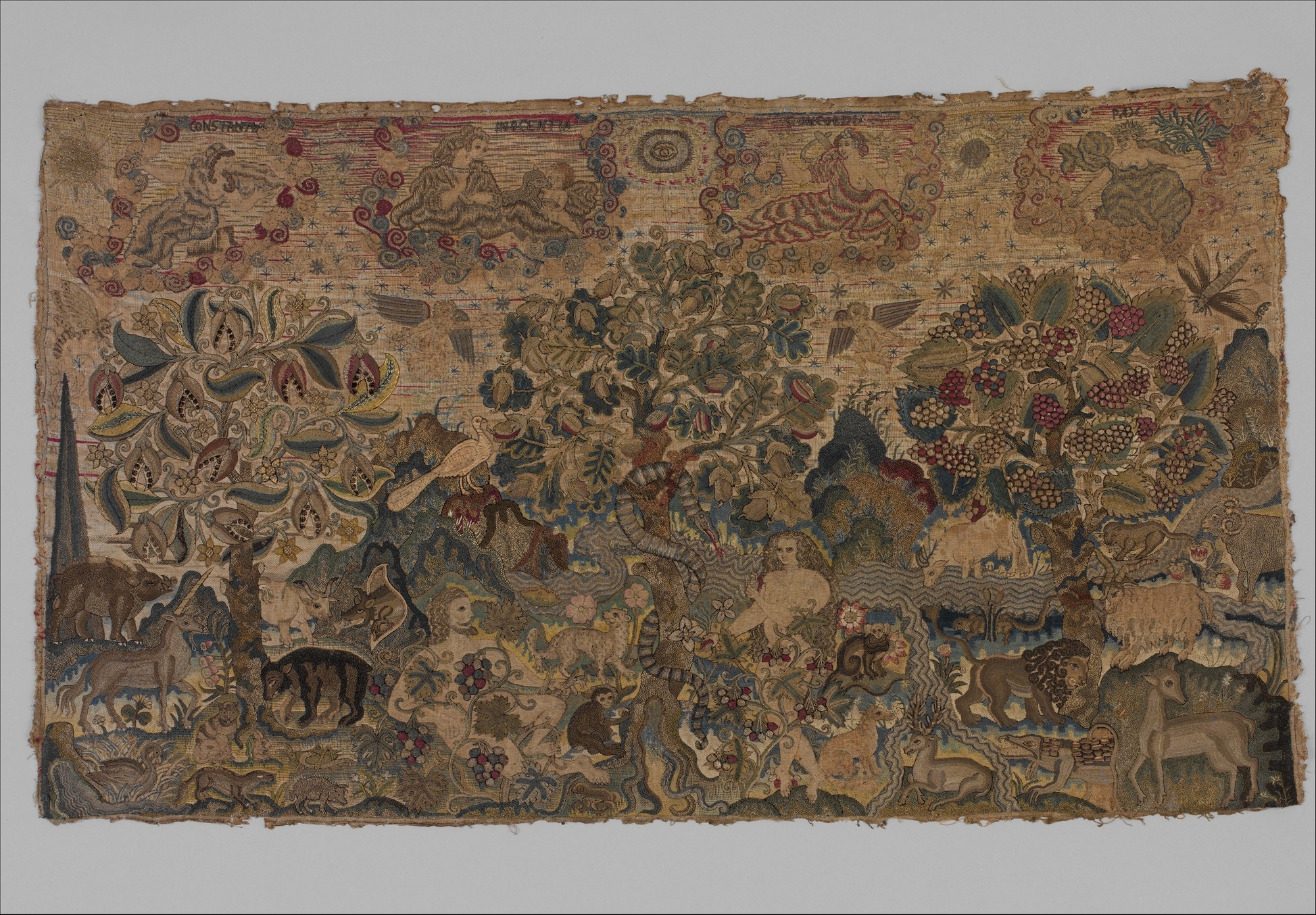
The composition of “Edenic Codex” is a masterclass in narrative layering. The Garden of Eden is not depicted as a lush, verdant backdrop but as a structural canvas of moral architecture. The canvas itself, a robust foundation, is treated as the terra firma of human conscience. Adam and Eve are not passive figures; they are rendered in dynamic, almost kinetic postures, their forms emerging from a lattice of Gobelin and satin stitches. Adam’s hand, reaching toward the Tree of Knowledge, is articulated with a long-and-short stitch that mimics the tensile strength of yearning, while Eve’s profile, framed by couched metal threads, suggests both curiosity and the weight of impending consequence.
The tree at the center is not a botanical specimen but a chromatic axis of virtue. Its trunk is built from a dense, vertical arrangement of tent stitches in deep umber and bronze, symbolizing the rootedness of moral law. The serpent, a sinuous line of glass beads and spangles, coils not as a tempter but as a catalyst—its metallic shimmer reflecting the duality of knowledge as both gift and burden. This is a garden where every stitch carries semantic weight: the cross stitches in the undergrowth represent the intersecting paths of free will and divine order, while the couching stitches that bind the metal threads evoke the unbreakable threads of fate.
Global Heritage: A Syncretic Lexicon of Virtue
Katherine Fashion Lab’s genius lies in its refusal to confine this narrative to a single cultural tradition. The “Global Heritage” origin is not a mere descriptor but an active design principle. The piece draws from Byzantine iconography in the use of gold metal threads, which halo the figures in a sacred, almost hieratic light. Simultaneously, the Gobelin stitches recall the narrative tapestries of medieval Europe, where morality plays were woven into courtly decor. Yet, the glass beads—imported from Venetian traditions—introduce a tactile, nearly three-dimensional quality that invites touch, echoing the Islamic textile traditions of using reflective surfaces to symbolize divine light.
The virtues are not abstract concepts but embodied presences. Prudence is stitched into the careful geometry of Eve’s garment, a grid of satin stitches that suggests measured thought. Fortitude is encoded in the tensile strength of the metal threads that outline Adam’s shoulders. Temperance manifests in the balanced color palette—ochre, verdigris, and ivory—that avoids the garishness of sin. Justice is the compositional symmetry, a central axis that divides the canvas into equal halves of knowledge and innocence. This is a global lexicon of virtue, where the long-and-short stitch (a technique perfected in European embroidery) meets the tent stitch (a staple of Persian rug-making) to create a universal moral language.
Technical Mastery: The Stitch as Theological Statement
The materiality of “Edenic Codex” is its most compelling sermon. The canvas, a humble ground, is transformed into a sacred text through the interplay of stitches. The Gobelin stitch, with its diagonal rhythm, creates a sense of movement—the garden is alive, breathing with the tension of the imminent Fall. The satin stitch, used for the leaves of the Tree of Knowledge, produces a smooth, reflective surface that catches light like polished scripture. In contrast, the cross stitches in the background form a subtle grid, reminiscent of a manuscript’s ruled lines, suggesting that this Eden is a page in a larger cosmic book.
The metal threads are not mere embellishment; they are the logos—the word made material. Couched in parallel lines, they outline the figures with a precision that feels almost calligraphic. The glass beads and spangles are deployed sparingly, like punctuation marks—a single bead on Eve’s eye, a spangle on the serpent’s tongue—drawing the viewer’s gaze to moments of moral crisis. The long-and-short stitch, used for the flesh tones, creates a chiaroscuro effect that humanizes the archetypes, making Adam and Eve not just symbols but sentient beings caught in a moment of existential choice.
Contextual Autonomy: The Standalone Study as a Couture Manifesto
As a standalone study, “Edenic Codex” liberates itself from the constraints of wearability. It is not a garment for the body but a garment for the mind. This context allows Katherine Fashion Lab to push the boundaries of couture as a conceptual art form. The piece does not need to drape, move, or comfort; it must only provoke and illuminate. In this, it succeeds with an almost monastic austerity. The absence of a human form to wear it emphasizes the autonomy of the textile—it is a self-contained universe, a microcosm of the Edenic myth.
This autonomy also permits a deeper engagement with the virtues. In traditional couture, virtues are often reduced to decorative motifs—a cross for faith, a dove for peace. Here, they are structural. The tent stitch that forms the ground is a metaphor for humility—the foundational virtue upon which all others are built. The couching stitches that secure the metal threads represent charity, binding the disparate elements into a cohesive whole. The spangles, catching light at odd angles, symbolize hope—a glimmer of redemption even in the shadow of the Fall.
Conclusion: A Legacy in Thread
“Edenic Codex” is not a fashion piece; it is a theological artifact disguised as couture. Katherine Fashion Lab has achieved what few designers dare: the translation of a foundational myth into a tactile, visual, and intellectual experience. Through a global heritage lens and a technical lexicon that spans cultures and centuries, the piece reimagines the Garden of Eden as a space not of original sin, but of original virtue. The canvas, worked with silk, metal, glass, and spangles, becomes a testament to the enduring power of narrative and the unyielding precision of craft. In this study, the Fall is not a tragedy but a lesson—a stitch in the fabric of human conscience that remains, like the piece itself, eternal and unresolved.