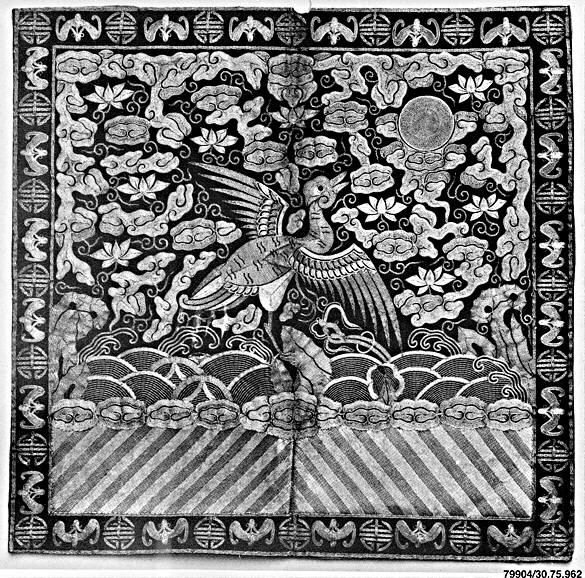
The Semiotics of Flight: Deconstructing the Rank Badge with Wild Goose
In the vast tapestry of Chinese imperial regalia, few artifacts speak as eloquently to the intersection of power, nature, and artistry as the Rank Badge with Wild Goose. This exquisite piece, rendered in silk and metallic thread on a silk ground, transcends its functional origins to become a profound statement of hierarchical elegance. As a standalone study within the Katherine Fashion Lab’s couture analysis, this badge invites a deeper interrogation of how materiality, symbolism, and craftsmanship converge to define not just status, but a philosophy of leadership.
Materiality as Metaphor: Silk, Thread, and the Language of Luxury
The choice of silk as the primary substrate is far from arbitrary. In Chinese culture, silk has long been synonymous with civilization, refinement, and the celestial order. Its natural luster and fluidity mirror the ethereal grace of the wild goose, a bird that embodies both freedom and disciplined migration. The metallic thread, likely composed of gold or silver wrapped around a silk core, introduces a counterpoint of rigidity and permanence. Where silk suggests flow and life, the metallic thread anchors the design in the immutable hierarchies of the Ming and Qing dynasties. This dialectic between the organic and the inorganic, the transient and the eternal, is the badge’s first lesson in couture: luxury is not merely opulence, but the tension between opposing forces.
From a textile engineering perspective, the interplay of these materials demands exceptional skill. The metallic thread is inherently brittle, requiring the embroiderer to manipulate it with precision to avoid kinking or fraying. The silk ground, meanwhile, is delicate and prone to distortion. The resulting piece is a testament to the artisan’s mastery—a balance of tensile strength and aesthetic vulnerability. For the modern couturier, this offers a crucial insight: true luxury is born from constraint. The limitations of the medium—whether thread, fabric, or technique—are not obstacles but catalysts for innovation.
Iconography and the Wild Goose: A Study in Hierarchical Elegance
The wild goose (hong in Mandarin) occupies a unique position in the Chinese bestiary of power. Unlike the dragon, which symbolizes imperial supremacy, or the phoenix, which denotes empress consorts, the goose represents the civil official—specifically, the fourth rank in the Ming dynasty’s bureaucratic hierarchy. This is not a bird of conquest but of order, loyalty, and collective purpose. Geese fly in formation, their V-shaped flights a metaphor for structured governance and mutual support. The badge thus communicates that true authority is not solitary but collaborative, not chaotic but synchronized.
The visual composition of the badge reinforces this ethos. The goose is typically depicted in mid-flight, wings outstretched but not flailing, its trajectory linear and purposeful. Clouds and waves often frame the central motif, anchoring the bird between heaven and earth—a visual articulation of the official’s role as a mediator between celestial mandate and terrestrial duty. The use of metallic thread to outline the feathers and beak imbues the goose with a spectral, almost luminous quality, as if the bird is illuminated by a divine light. This is not mere decoration; it is a theological statement about the source of legitimate authority.
Craftsmanship as Code: The Invisible Grammar of Status
Beyond its symbolic content, the badge operates as a visual code decipherable only to those initiated into the court’s semiotic system. The number of clouds, the direction of the goose’s flight, and even the color of the metallic thread could signify specific nuances of rank or occasion. For instance, a badge intended for winter court robes might use a cooler metallic thread, while summer versions employed warmer tones. This granularity of detail elevates the piece from mere accessory to a system of communication—a language of power spoken through texture and hue.
From a couture analysis perspective, this underscores a critical principle: design is never neutral. Every stitch, every choice of material, every compositional element carries intentionality. The Katherine Fashion Lab’s approach to studying such artifacts emphasizes that the most profound statements of identity are often the most subtle. In an era of fast fashion and loud branding, the Rank Badge with Wild Goose offers a counter-narrative—one where restraint and precision are the ultimate markers of distinction.
Contextualizing the Badge in the Modern Couture Landscape
What can a 15th-century Chinese rank badge teach a contemporary fashion house? At first glance, the connection may seem tenuous. Yet, the principles embedded in this artifact are strikingly relevant. The badge’s use of mixed media—silk and metallic thread—prefigures modern haute couture’s fascination with hybrid textures. Its hierarchical semiotics resonate with today’s luxury branding, where logos and motifs encode status. And its emphasis on craftsmanship as narrative aligns with the slow fashion movement’s call for transparency and intentionality.
Consider, for example, the work of contemporary designers like Guo Pei, whose collections often reference imperial Chinese motifs. Her use of gold embroidery and silk is not mere homage but a strategic deployment of the same visual grammar that governed the rank badge. Similarly, the concept of “flight” as a metaphor for ambition and direction appears in the collections of houses like Dior, where bird motifs recur as symbols of freedom and aspiration. The wild goose, in this light, becomes a timeless archetype—a reminder that fashion, at its best, is a conversation between past and present.
Conclusion: The Badge as a Blueprint for Couture Leadership
The Rank Badge with Wild Goose is far more than a historical curiosity. It is a masterclass in the art of visual persuasion, a treatise on the relationship between material and meaning, and a testament to the enduring power of symbolic craftsmanship. For the Katherine Fashion Lab, it stands as a benchmark for what couture can achieve when it marries technical rigor with philosophical depth. As we continue to explore the boundaries of fabric and form, this small, embroidered square reminds us that the most profound statements of identity are often the most carefully constructed—and that true elegance lies not in shouting one’s status, but in the quiet, deliberate flight of the wild goose across the silk of history.