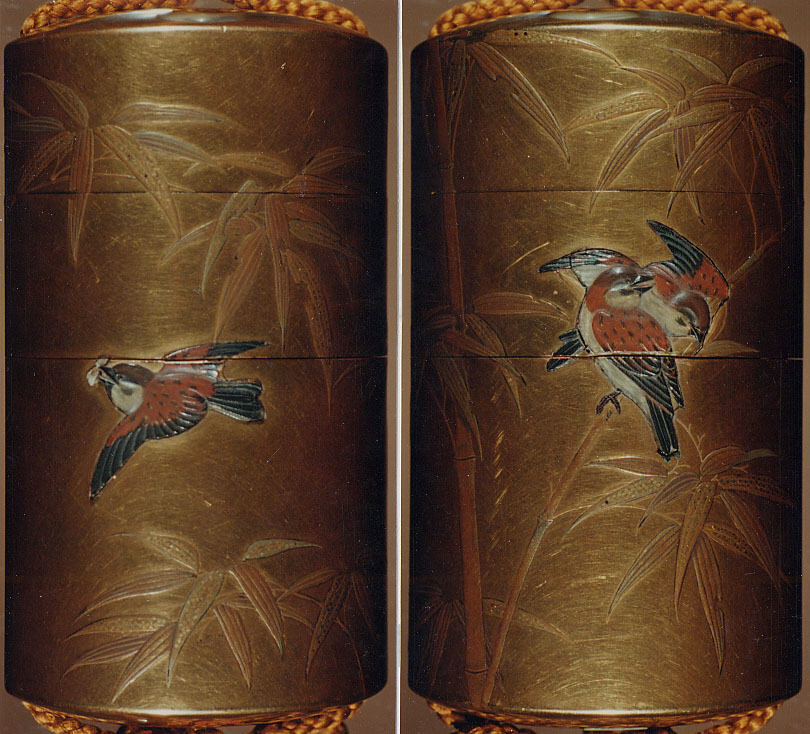
Heritage Analysis: Inrō with Sparrows and Bamboo
Cultural Provenance and Artisanal Mastery
The Inrō with Sparrows and Bamboo originates from Japan’s Edo period (1603–1868), a time when the merchant class flourished and personal adornment became a profound expression of status, spirituality, and aesthetic refinement. This portable container, suspended from the obi (sash) by a netsuke and ojime, served a practical purpose—carrying seals, medicines, or tobacco—but evolved into a luxury object that communicated the wearer’s cultural literacy and social standing. The medium itself is a testament to Japanese lacquer artistry: two cases of lacquered wood, embellished with gold and silver hiramaki-e (low-relief sprinkled-picture), togidashimaki-e (polished-out sprinkled-picture), gold foil cutouts, and colored ivory inlay on a gold lacquer ground. The netsuke, a kagamibuta (mirror-lid) type featuring bamboo with a sparrow, and the ojime, a blue-and-white porcelain bead, complete the ensemble with harmonious materiality.
For Katherine Fashion Lab, this inrō represents a strategic archetype of micro-luxury—an object that balances intimate utility with high-status symbolism. The meticulous layering of materials (lacquer, metal, ivory, porcelain) mirrors a modern luxury brand’s need for multi-sensory richness, where each component reinforces the narrative of craftsmanship. The hiramaki-e technique, requiring months of labor, aligns with the 2026 luxury consumer’s demand for slow, artisanal production and transparent provenance.
Symbolic Power: Sparrows and Bamboo as Cultural Codes
The sparrow and bamboo motif is not merely decorative; it is a deliberate symbolic pairing rooted in Japanese Confucian and Shinto traditions. Bamboo (take) represents resilience, flexibility, and moral integrity—virtues celebrated in the samurai code of bushidō. Its hollow stem symbolizes humility and emptiness, a Zen concept of receptivity to wisdom. The sparrow (suzume) embodies joy, sociability, and protection, often associated with the rice fields and agricultural abundance. Together, sparrows and bamboo evoke a harmonious relationship between nature and human virtue, a common theme in Edo-period kōgei (craft arts).
In high-end luxury strategy, this symbolic power translates into brand storytelling that resonates with contemporary values. The sparrow-bamboo pairing offers a template for communicating sustainability (bamboo’s rapid renewability) and community (sparrows as social creatures). A 2026 luxury brand could adopt this motif to signal ecological mindfulness without sacrificing opulence—using, for example, responsibly sourced bamboo fibers in packaging or sparrow-inspired embroidery on limited-edition garments. The inrō’s symbolic density proves that heritage motifs can be repurposed for modern ethical luxury, provided the original cultural context is honored.
Historical Adornment: The Inrō as a Status System
The inrō was more than a container; it was a mobile gallery of personal taste. Worn visibly at the waist, it invited silent assessment by peers. The quality of lacquer, the complexity of the maki-e, and the rarity of materials (gold foil, ivory inlay) signaled the wearer’s wealth, education, and aesthetic discernment. The netsuke and ojime, though small, were often carved by master artisans, making the entire ensemble a curated collection of micro-artworks.
For Katherine Fashion Lab, this historical adornment system offers a blueprint for personalized luxury in 2026. The inrō’s modularity—separate cases, interchangeable components—prefigures the modern trend toward customizable luxury goods. A high-end fashion house could develop a “modular accessory system” inspired by the inrō, allowing clients to select interchangeable lacquered panels, netsuke-like charms, and ojime-style beads. This approach would foster emotional attachment through co-creation, a key driver of brand loyalty in the post-pandemic luxury market. Moreover, the inrō’s visibility as a status marker suggests that luxury brands should prioritize wearable, statement-making accessories that invite conversation, much like the inrō prompted discourse on artistic mastery.
Spiritual Meaning: Zen and the Art of Adornment
The inrō’s spiritual dimension is rooted in Zen Buddhism and Shinto animism. Lacquerware itself is a meditative craft; each layer of urushi (lacquer) is applied and polished over weeks, reflecting the Zen principle of mushin (no-mind) in repetitive, focused action. The sparrow and bamboo motif further evokes the Zen aesthetic of wabi-sabi—the beauty of imperfection and transience. Bamboo’s slight asymmetry and the sparrow’s fleeting presence remind the wearer of life’s ephemerality, a concept central to Japanese spiritual thought.
In a 2026 luxury strategy, this spiritual meaning can be operationalized through mindful consumption and ritualistic product use. Brands can design objects that encourage slow, deliberate engagement—for example, a perfume bottle that requires a specific opening ritual, or a jewelry box with compartments that unfold like a kōgō (incense container). The inrō’s spiritual depth suggests that luxury in 2026 should not merely be about possession, but about transformative experience. Katherine Fashion Lab could develop a “Zen capsule collection” where each piece is accompanied by a meditation guide or a story of its artisan’s creative process, thereby imbuing the product with emotional and spiritual value that transcends materialism.
2026 High-End Luxury Strategy: Heritage as Competitive Advantage
Integrating the inrō’s heritage into a 2026 luxury strategy requires a three-pronged approach: narrative authenticity, craftsmanship transparency, and cultural collaboration.
Narrative authenticity involves weaving the inrō’s story into brand identity without cultural appropriation. Katherine Fashion Lab can partner with Japanese lacquer masters to create limited-edition accessories that explicitly reference the Edo-period inrō, with documentation of materials and techniques. This aligns with the 2026 luxury consumer’s preference for provenance-rich products that offer educational value.
Craftsmanship transparency demands that brands demystify production. The inrō’s maki-e process—from charcoal polishing to gold dust sprinkling—can be showcased via digital platforms, similar to how heritage watchmakers reveal their movements. This builds trust and justifies premium pricing. For 2026, Katherine Fashion Lab could launch a “Lacquer Lab” experience, where clients witness artisans at work, reinforcing the inrō’s lesson that luxury is time made visible.
Cultural collaboration involves co-creating with Japanese artists to reinterpret the sparrow-bamboo motif for contemporary aesthetics. For instance, a collaboration with a Kyoto-based lacquer studio could produce a series of inrō-inspired clutches or modular belt pouches for the modern wardrobe. The netsuke’s kagamibuta design—a mirror lid—offers a unique branding opportunity: a reflective surface that invites self-examination, symbolizing the wearer’s inner virtue. This could be adapted as a mirrored compact for luxury cosmetics, merging utility with spiritual introspection.
Conclusion: The Inrō as a Strategic Archetype
The Inrō with Sparrows and Bamboo is not a relic but a living blueprint for high-end luxury in 2026. Its symbolic power (resilience, joy), historical adornment (modular status system), and spiritual meaning (Zen mindfulness) offer Katherine Fashion Lab a rich vocabulary for crafting products that are both opulent and meaningful. By honoring the inrō’s heritage through authentic partnerships, transparent craftsmanship, and narrative depth, the brand can position itself at the intersection of tradition and innovation—where luxury becomes a vessel for cultural continuity and personal transformation.