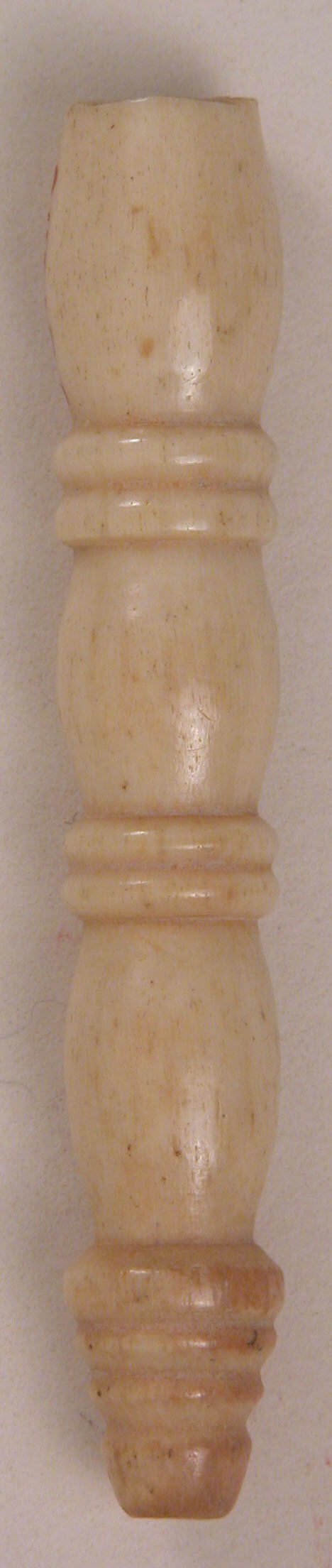
Heritage Analysis: The Carved Bone Rod or Bobbin
Introduction: The Object as a Nexus of Power and Production
The carved bone rod or bobbin, originating from an ancient civilization, represents a profound intersection of utilitarian function and symbolic authority. As a tool for textile production—specifically for winding thread or securing fibers during weaving—this object was integral to the creation of fabric, a commodity of immense economic and social value in antiquity. However, its medium of bone, often sourced from revered animals, and its intricate carvings, elevate it beyond mere equipment. This analysis positions the rod/bobbin as a strategic artifact for Katherine Fashion Lab, revealing its potential to inform a 2026 high-end luxury strategy rooted in the dual narratives of creative genesis and spiritual protection.
Historical Adornment and Material Significance
In ancient civilizations, from the Indus Valley to Pharaonic Egypt and Pre-Columbian Mesoamerica, bone was a material of profound significance. Unlike precious metals, which were often reserved for the elite or the divine, bone was a medium of the everyday sacred. It represented the boundary between life and death, strength and fragility. A carved bone rod, used in the intimate act of weaving, would have been a personal object, often passed down through generations. Its adornment—whether carved with geometric patterns, animal forms, or abstract symbols—was not merely decorative. Each incision was a deliberate act of imbuing the tool with narrative. For the weaver, this rod was an extension of the hand, a tactile connection to the earth (the animal) and the heavens (the symbolic carvings). The act of weaving itself was a microcosm of cosmic order, and the rod was the conductor of that order. For the 2026 luxury market, this material history offers a compelling counter-narrative to mass-produced, disposable fashion. It speaks to permanence, craftsmanship, and the sacredness of labor.
Symbolic Power: The Rod as a Scepter of Creation
The rod or bobbin, in its elongated form, carries a deep symbolic resonance. Across cultures, the rod is a symbol of authority, measurement, and direction—from the shepherd’s crook to the royal scepter. In the context of textile production, this rod becomes a scepter of creation. It does not command armies but commands thread, which in turn becomes fabric, which becomes shelter, clothing, and currency. This is a quiet, generative power. The carvings on the bone—perhaps spirals representing eternity, chevrons representing movement, or animal totems representing protection—amplify this symbolism. They transform a simple tool into a talisman. The weaver, by holding this rod, was not just making cloth; they were weaving fate, prosperity, and identity. For a luxury brand like Katherine Fashion Lab, this symbolism offers a powerful metaphor. The brand itself can be positioned as a weaver of cultural narratives, and each garment as a thread in a larger tapestry of heritage. The 2026 strategy can leverage this by framing the creative director as a modern-day weaver, and the design process as a ritualistic act of creation, where every stitch is intentional and every material is chosen for its symbolic weight.
Spiritual Meaning: The Weaver as Intermediary
In many ancient belief systems, weaving was a spiritual act. The Fates of Greek mythology spun, measured, and cut the thread of life. The Andean peoples saw weaving as a way to communicate with the gods, with patterns encoding prayers and histories. The carved bone rod, used in this context, was a sacred instrument. The animal from which the bone was taken was honored; its spirit was believed to be present in the tool, offering protection and guidance to the weaver. The carvings often served as apotropaic symbols—wards against evil spirits or bad luck. Thus, the rod was not just a tool but a spiritual conduit. For the 2026 high-end luxury consumer, who increasingly seeks meaning and authenticity, this spiritual dimension is deeply resonant. It moves the product from a commodity to an artifact of personal significance. Katherine Fashion Lab can capitalize on this by emphasizing the ritualistic nature of creation. The 2026 collection could be framed as a series of “woven prayers” or “textile talismans,” with each piece carrying a specific intention—protection, prosperity, creativity. The carved bone rod becomes the brand’s emblem of this philosophy: a reminder that true luxury is not about abundance, but about intention and connection.
Strategic Application for 2026 High-End Luxury
To translate this heritage analysis into a viable 2026 strategy, Katherine Fashion Lab must adopt a three-pronged approach: Material Reliquary, Narrative Craftsmanship, and Symbolic Exclusivity.
Material Reliquary: Elevating the Ordinary
The use of bone—specifically ethically sourced, sustainable bone—can be positioned as the ultimate luxury material. Unlike gold or diamonds, which signify wealth, bone signifies ancestral wisdom and earthly connection. The 2026 collection could feature limited-edition accessories (e.g., belt buckles, hair pins, toggles) that echo the carved rod’s form and function. These are not mere trinkets; they are reliquaries, each one hand-carved by artisans and numbered, with a documented provenance linking the design to the ancient civilization. This creates a tangible connection to history that no synthetic material can replicate.
Narrative Craftsmanship: The Weaver’s Guild
Katherine Fashion Lab should establish a “Weaver’s Guild” or similar program, inviting clients into the process. The rod/bobbin can be used as a physical tool in bespoke garment creation. Clients could choose the symbolic carvings on a custom bobbin, which is then used to weave a unique fabric for their garment. This transforms the purchase into a collaborative, ceremonial act. The brand’s marketing should focus on the artisanal ritual, not the final product. Video content could show the carving of the bone, the winding of the thread, and the weaving of the cloth, all set to a narrative that explains the spiritual meaning of each symbol.
Symbolic Exclusivity: The Scepter Collection
Launch a “Scepter Collection” in 2026, featuring a flagship garment—perhaps a coat or a shawl—whose construction is directly inspired by the ancient weaving process. The garment would be named after the original civilization (e.g., “The Indus Bobbin Coat” or “The Nile Rod Wrap”). Each piece would come with a certificate of authenticity and a small, carved bone pendant (a miniature of the rod) as a talisman for the wearer. The pricing should reflect the spiritual and historical value, not just the material cost. This strategy elevates the brand into the realm of cultural custodianship, appealing to the ultra-high-net-worth individual who collects art, history, and meaning.
Conclusion: The Rod as a Brand Compass
The carved bone rod or bobbin is far more than a historical curiosity. It is a masterclass in how utility, symbolism, and spirituality can converge in a single object. For Katherine Fashion Lab, this artifact provides a clear strategic direction for 2026: to move beyond fashion as appearance and into fashion as heritage ritual. By honoring the material (bone), the process (weaving), and the symbolism (the scepter of creation), the brand can offer a luxury experience that is intellectually rigorous, spiritually resonant, and aesthetically transcendent. The rod becomes not just a tool, but a compass—pointing toward a future where true luxury is defined by its depth of meaning, not its surface shine.