The Fragment as a Complete Statement: Deconstructing Heritage in Silk
In the rarefied air of haute couture, where garments often strive for monumental completeness, Katherine Fashion Lab presents a provocative thesis with its latest standalone study: Fragment. This is not a collection, nor a single dress, but a conceptual exploration of how a fragment—a torn swath, a remnant of a larger whole—can be elevated to a complete, autonomous couture statement. By grounding this study in Global Heritage and executing it in silk, the Lab challenges the very definition of luxury, proposing that authenticity lies not in pristine perfection, but in the curated, evocative power of the incomplete.
The Conceptual Framework: Heritage as a Rupture
The term “fragment” typically connotes loss, decay, or a broken artifact. Yet, in the hands of Katherine Fashion Lab, it becomes a deliberate act of preservation. The study draws from a vast repository of Global Heritage, referencing motifs, weaving techniques, and symbolic languages from disparate cultures—a Mughal floral motif from South Asia, a pre-Columbian geometric abstraction from the Andes, a Heian-era kimono silhouette from Japan. These are not seamlessly blended; instead, they exist as distinct, jagged pieces, stitched together with visible, raw edges. The fragment here is a metaphor for the fractured nature of modern identity—a collage of influences that can never be fully reconciled, only artfully juxtaposed.
This approach rejects the homogenization of “world fashion,” where heritage is often flattened into a generic, marketable exoticism. Instead, the Lab insists on the specific, the localized, and the broken. Each fragment retains its original cultural weight, but its placement within a new, fragmented context forces a dialogue between histories. The wearer does not don a single narrative; they inhabit a constellation of narratives, each incomplete, yet collectively forming a new, compelling truth.
Material Alchemy: Silk as the Medium of Memory
The choice of silk is not incidental; it is the philosophical core of this study. Silk, historically a fabric of imperial trade routes, of luxury and fragility, is the perfect vehicle for the fragment. Its natural luster captures light, emphasizing the texture of each tear, each frayed edge. The Lab employs a range of silk weights—from diaphanous chiffon that billows like a ghost of a garment, to heavy duchesse satin that holds the shape of a broken collar or a severed sleeve. The material itself becomes a record of time and touch.
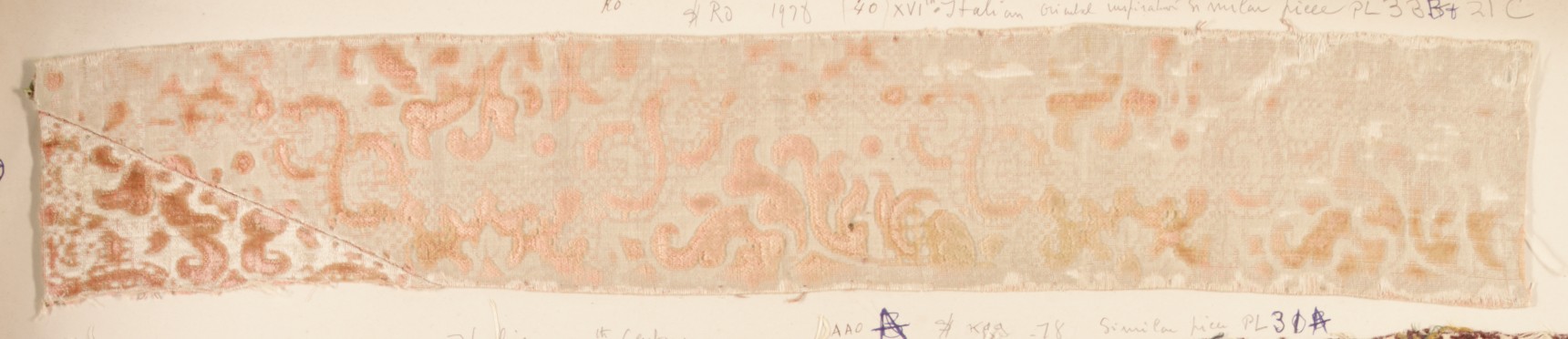
A key technique on display is intentional distress. Unlike the casual rips of denim, these are surgical, respectful cuts. A panel of silk charmeuse might be sliced diagonally, its edges left raw to curl and fray, mimicking the decay of an ancient textile. Another section may be hand-stitched with gold thread, not to repair, but to highlight the break—a kintsugi philosophy applied to fabric. The silk is not destroyed; it is transformed. The Lab’s artisans apply natural dyes derived from indigo, madder, and pomegranate, staining certain fragments while leaving others pristine. This creates a visual hierarchy, where some pieces feel older, more weathered, while others appear fresh, as if torn from a new bolt.
This material alchemy extends to the construction. There are no invisible linings or hidden seams. Every stitch, every patch, every layer is exposed. A bodice might consist of three overlapping silk fragments, each from a different historical source, held together by a lattice of hand-knotted silk thread. The garment breathes, moves, and rustles with the weight of its own history. It is a study in tactility; the wearer and the viewer are invited to see not just a dress, but the process of its becoming—and its potential for further fragmentation.
Silhouette and Form: The Architecture of the Incomplete
The silhouette of this standalone study is deliberately asymmetrical and unresolved. There is no conventional hemline, no structured waist. Instead, the form is built around the fragment as a structural element. A single sleeve may end abruptly at the elbow, its raw edge adorned with a cascade of silk tassels that mimic unraveling threads. The back of a gown might be entirely absent, replaced by a floating panel of silk organza that is only tacked at the shoulders, allowing the skin to show through the gaps.
This is not a garment of comfort or ease; it is a garment of tension. The fragments are held together by delicate silk cords that can be tightened or loosened, allowing the wearer to adjust the degree of exposure. The Lab references the obi of Japanese kimono culture, but reimagined as a broken belt that cinches a cluster of disparate panels. The draping follows no single tradition; it is a hybrid of Western bias-cutting and Eastern wrapping, resulting in a silhouette that is both familiar and alien.
Key pieces within the study include a fragment coat—a long, sweeping duster coat made from a patchwork of silk pieces, each from a different heritage textile. The left side is heavy with Mughal-inspired embroidery, while the right side is stark, almost blank, with a single, raw cut. Another piece is a fragment gown that appears to be a deconstructed sari, with a pallu that does not wrap but instead hangs as a separate, floating panel, tethered by a single silk button. The neckline is often asymmetrical, one side high and collared, the other cut away to the shoulder blade, exposing the collarbone and the silk lining beneath.
Cultural Provenance and Ethical Stitching
Katherine Fashion Lab emphasizes cultural provenance in this study. Each fragment is sourced ethically, often from deadstock or antique markets, with documented origins. A piece of silk brocade from a 19th-century Chinese robe is paired with a remnant of silk velvet from a French Art Deco curtain. The Lab does not claim to own these histories; rather, it acts as a curator, presenting them in a new light. This is a deliberate move away from cultural appropriation toward cultural appreciation through transparency.
The stitching itself becomes a narrative device. The Lab uses visible mending techniques, such as sashiko stitching from Japan, to join fragments. White thread on dark silk creates a stark, geometric pattern that is both functional and decorative. The seams are not hidden; they are celebrated as the points where two histories meet. This approach also addresses sustainability—by using fragments, the Lab reduces waste and gives new life to materials that might otherwise be discarded. The fragment is thus a political statement, a rejection of fast fashion’s obsession with the new and the whole.
The Standalone Study: A Provocation for the Future
As a standalone study, Fragment is not intended for mass production or even for a full runway show. It is a couture artifact, a singular experiment that asks: What if luxury is not about perfection, but about the honest, beautiful representation of what remains? The silk fragments, with their visible histories, their tears, and their repairs, become a mirror for the modern condition—a world that is itself fragmented, yet still capable of profound beauty.
The wearer of a Fragment piece does not simply wear clothing; they wear a manifesto. They declare that heritage is not a static relic to be preserved in a museum, but a living, breathing material that can be broken, reassembled, and reimagined. The silk shimmers, the edges fray, and the fragment stands complete in its incompleteness. This is the future of couture: not the seamless whole, but the curated, honest, and deeply human fragment. Katherine Fashion Lab has not just designed a garment; they have designed a philosophy for a fragmented age.