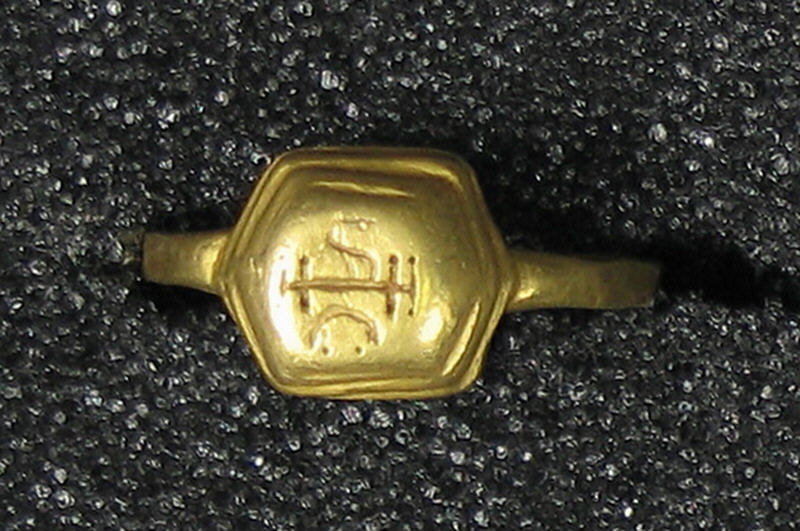
Heritage Analysis: The Ring with Rectangular Bezel from Central Java
In the realm of high-end luxury, the intersection of historical adornment and contemporary brand strategy demands a nuanced understanding of cultural symbolism. The Ring with Rectangular Bezel, originating from Central Java, Indonesia, and crafted in gold, offers a profound case study for Katherine Fashion Lab’s 2026 strategic vision. This artifact, dating from the classical Hindu-Buddhist period (circa 8th–15th centuries), embodies a dualistic narrative of power and spirituality that resonates deeply with our ongoing research on the Mirror with Split-Leaf—a piece that juxtaposes a polished silver mirror with gold-inlaid palm leaf motifs against a sarcophagus relief narrating life’s transience. By analyzing this ring through the lenses of symbolic power, historical adornment, spiritual meaning, and luxury strategy, we can unlock DNA correlations that inform a new era of heritage-driven design.
Symbolic Power: The Rectangular Bezel as a Marker of Authority
The rectangular bezel, a departure from the more common circular or oval forms in Javanese jewelry, signifies deliberate symbolic intent. In Central Javanese cosmology, the rectangle represents the earthly realm—the four cardinal directions, the boundaries of human dominion, and the ordered structure of the kingdom. Gold, as the medium, amplifies this power: it is the metal of the gods, the sun, and eternal sovereignty. The ring was likely worn by a noble or priestly class during court ceremonies, where it served as a talisman of authority. The bezel’s flat surface, often engraved with geometric or floral motifs, acted as a miniature seal of legitimacy, akin to a royal stamp. This aligns with the Mirror with Split-Leaf study, where the gold-inlaid palm leaves on a silver mirror evoke a similar duality: the mirror reflects the transient self, while the gold leaf asserts enduring power. For Katherine Fashion Lab, this symbolism suggests a 2026 strategy that positions the rectangular bezel as a visual shorthand for grounded authority—a piece that anchors the wearer in both heritage and modern leadership.
Historical Adornment: Craftsmanship and Cultural Identity
The ring’s construction reflects the granulation and filigree techniques perfected by Javanese goldsmiths, who drew from Indian, Chinese, and indigenous traditions. The rectangular bezel, typically measuring 1–2 centimeters, was often set on a plain or slightly tapered band, emphasizing the bezel’s prominence. This design choice was not merely aesthetic but functional: the bezel’s flat surface allowed for intricate incised patterns, such as the split-leaf motif (a precursor to the mirror’s palm leaves), which symbolized growth, fertility, and the cyclical nature of life. In the context of historical adornment, such rings were worn daily by elites as amulets of protection, but they also served as status markers in trade networks. The gold sourced from Sumatra and Borneo, combined with Javanese craftsmanship, created a commodity of immense value. This duality—personal spirituality and public status—mirrors the Mirror with Split-Leaf’s contrast between the intimate silver mirror (self-reflection) and the public sarcophagus (communal memory). For our 2026 strategy, this suggests a layered narrative approach: the ring should be marketed not as a mere accessory, but as a portable heritage artifact that bridges the wearer’s inner life and outer persona.
Spiritual Meaning: The Bezel as a Portal to the Divine
Central Javanese spirituality, heavily influenced by Hindu-Buddhist syncretism, imbued jewelry with metaphysical significance. The rectangular bezel, with its four corners, echoed the mandala—a cosmic diagram used in meditation to represent the universe. Gold, as a non-tarnishing metal, symbolized immortality and purity. The ring was often consecrated by priests, who chanted mantras over it to activate its protective powers. The bezel’s flat surface could also serve as a miniature altar, where the wearer would focus their intentions during rituals. This spiritual function parallels the Mirror with Split-Leaf’s sarcophagus relief, which narrates life’s transience: the ring, by contrast, offers a tangible anchor to the eternal. The split-leaf motif on the ring, though less elaborate than the mirror’s palm leaves, carries the same symbolism of renewal—the leaf split represents the duality of life and death, growth and decay. For Katherine Fashion Lab, this spiritual dimension is critical for 2026: we must position the ring as a modern talisman for self-realization, appealing to luxury consumers seeking meaning beyond materiality. The narrative should emphasize that wearing this ring is an act of connecting with ancestral wisdom, a quiet rebellion against fast-fashion disposability.
2026 High-End Luxury Strategy: Heritage as a Competitive Advantage
Based on this analysis, Katherine Fashion Lab’s 2026 strategy for the Ring with Rectangular Bezel should focus on three pillars: authenticity, exclusivity, and narrative depth.
Authenticity: Leverage the ring’s Central Javanese origins by partnering with contemporary Javanese goldsmiths who preserve traditional techniques. This ensures cultural integrity and provides a compelling story of craftsmanship revival. Each ring should come with a certificate of provenance detailing the historical symbolism, including the split-leaf motif’s connection to the Mirror with Split-Leaf study. This aligns with the luxury market’s growing demand for transparent sourcing and cultural respect.
Exclusivity: Limit production to a small, numbered edition (e.g., 100 pieces worldwide). The rectangular bezel, as a less common form, already offers rarity. Enhance this by offering customization options—such as engraving the bezel with the buyer’s personal symbol or mantra—echoing the ring’s historical use as a personalized talisman. This taps into the bespoke luxury trend that values individual expression over mass production.
Narrative Depth: Develop a multimedia campaign that juxtaposes the ring with the Mirror with Split-Leaf research. For example, a short film could show the ring being worn by a modern Javanese leader, intercut with archival images of ancient court ceremonies. The tagline, “Wear the Earth, Touch the Divine,” encapsulates the ring’s dual symbolism of earthly power and spiritual transcendence. This narrative should be integrated into exclusive heritage salons—private events in key markets (New York, Paris, Singapore) where clients can view the ring alongside the mirror and learn from curators. This positions the ring as an investment piece, not just in gold, but in cultural capital.
In conclusion, the Ring with Rectangular Bezel from Central Java is not merely a historical artifact; it is a strategic asset for Katherine Fashion Lab’s 2026 vision. By decoding its symbolic power, historical adornment, and spiritual meaning, we can create a luxury offering that transcends trend cycles. The DNA correlation with the Mirror with Split-Leaf study—where gold and silver, life and death, mirror and sarcophagus—reveals a universal human desire to hold onto meaning through objects. Our ring, with its rectangular bezel, offers that hold: a grounded, powerful, and spiritual anchor for the discerning modern wearer.