The Poetics of Compression: A Couture Analysis of the Small Dwelling in a Dense Grove of Trees
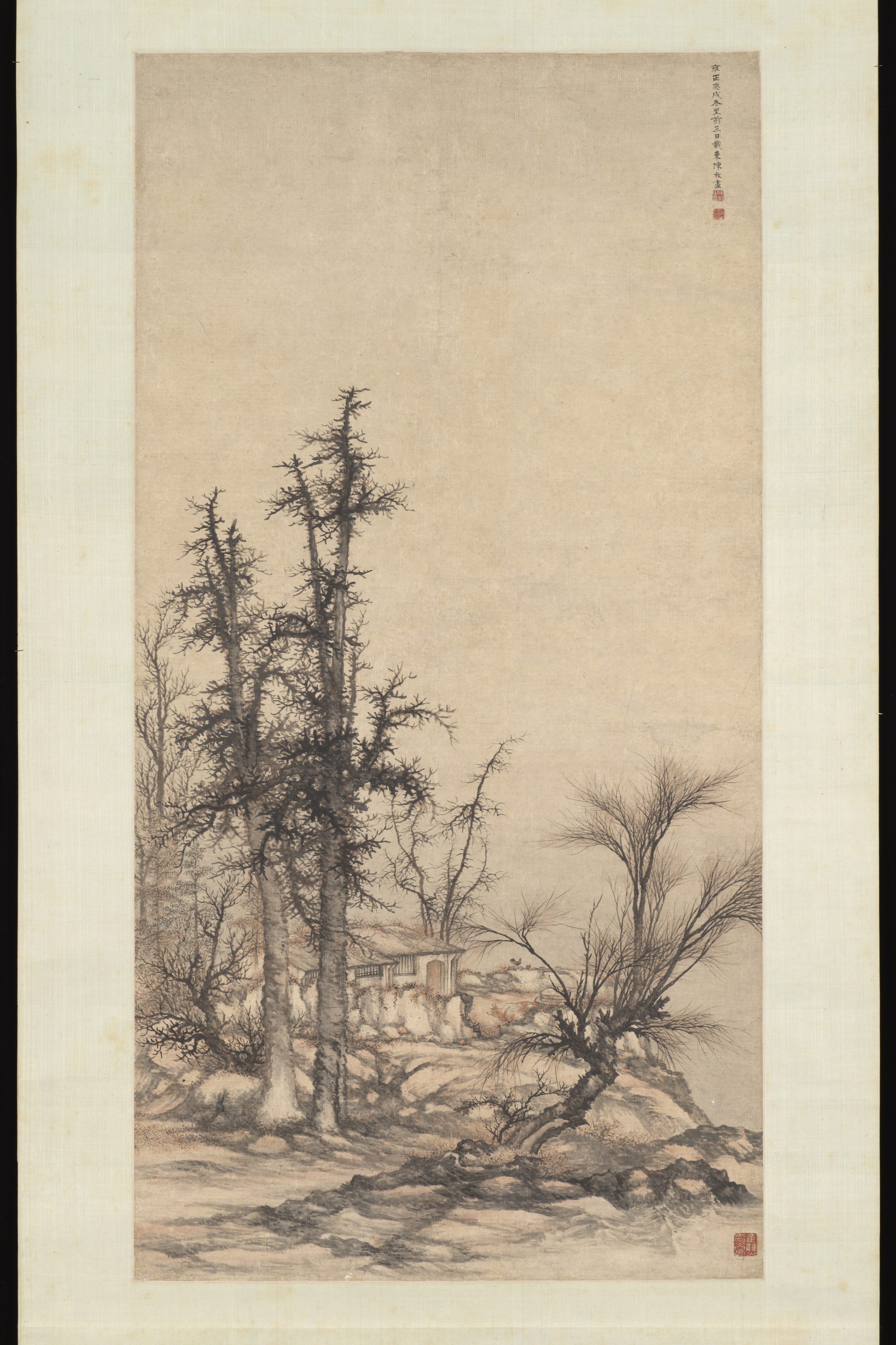
In the rarefied world of haute couture, the most profound inspirations often emerge from the most compressed of spaces. Katherine Fashion Lab’s latest collection, anchored by the singular study of a Small Dwelling in a Dense Grove of Trees, draws its soul from a hanging scroll in ink and color on paper, originating from China. This is not merely a thematic reference; it is a deep structural dialogue with the aesthetic principles of Chinese literati painting, where economy of line yields maximum emotional resonance. The collection, presented as a standalone study, eschews the sprawling narratives of conventional runway shows for a focused, almost monastic interrogation of how architecture, nature, and the human form can coexist in a state of tensile equilibrium.
The Scroll as Silhouette: Verticality and the Suspended Frame
The hanging scroll is a format defined by its verticality—a narrow, elongated plane that demands a different kind of visual reading than the Western horizontal canvas. Katherine Fashion Lab translates this into a radical rethinking of the garment’s silhouette. The initial impression is one of compressed loft. Jackets and coats are cut with extended, almost calligraphic lapels that sweep downward like the ink-washed trunks of ancient pines, while the body of the garment remains narrow, hugging the torso with a disciplined restraint.
The key structural innovation lies in the “suspended frame.” Inspired by the scroll’s wooden roller and the way the paper is held taut from above, the lab has engineered a series of outerwear pieces that feature internal, weight-bearing seams. These seams, often traced with a subtle metallic thread reminiscent of the scroll’s mounting brocade, create a visual “hanging” effect. The shoulders are not padded but rather “hung” from a hidden yoke, allowing the fabric to fall in clean, uninterrupted vertical planes. This technique mimics the way a scroll’s silk borders frame the central painting, establishing a clear, hieratic hierarchy of line over volume.
Ink and Atmosphere: The Palette of Dense Grove
The color story of this study is a masterclass in restraint, drawn directly from the ink and color on paper of the source scroll. There is no vibrant red or imperial gold. Instead, the palette is a symphony of scholar’s ink: deep, liquid blacks that absorb light, shifting into layers of grey wash, and punctuated by the muted green of moss on tree bark. The “color” here is not decorative but atmospheric—a translation of the qiyun (spiritual resonance) that defines classical Chinese landscape painting.
Katherine Fashion Lab employs a proprietary dyeing technique called “wash-gradience,” where a single garment transitions from a dense, almost opaque black at the hem to a translucent, watery grey at the shoulder. This mirrors the scroll’s depiction of a grove where the canopy is dense and the forest floor is dappled with light. Fabrics are chosen for their ability to hold this gradient without bleeding: heavily textured silks for the opaque sections, and gossamer-weight organza for the translucent areas. The effect is one of breathing depth, as if the garment itself is a fragment of the grove’s atmosphere, solidified into form.
Architecture of the Dwelling: The Garment as Enclosure
The titular “small dwelling” is not a literal house but a conceptual space of refuge within the chaos of the grove. In couture terms, this becomes the “dwelling garment.” These are pieces that create a private, interior volume for the wearer. Consider a long, sleeveless tunic cut from a single piece of heavy raw silk, with no side seams. The fabric is folded and stitched only at the shoulders and along the center back, creating a tube of fabric that encloses the body like a scroll case.
The most striking example is the “Grove Cocoon” coat. Its construction is a feat of engineering: the back is composed of overlapping panels of silk and wool, each slightly offset, creating a visual rhythm of tree trunks in perspective. The front, however, is a single, uninterrupted expanse of black ink-wash silk, with a hidden magnetic closure. When closed, the garment becomes a portable shelter, its volume expanding slightly at the elbows and hips to allow for the natural movement of a body navigating a dense path. The sleeves are cut with a “scroll-cuff”—a deep, folded turnover that can be unrolled to reveal a hidden lining of pale green silk, echoing the unexpected flash of a leaf in a shadowed grove.
Texture as Topography: The Grove’s Surface
In the original scroll, the texture of the paper and the brushwork create a physical topography that digital reproduction cannot capture. Katherine Fashion Lab honors this by treating surface texture as a primary narrative element. Fabrics are not merely dyed but “drawn upon.” Using a technique of hand-stitched “brushstroke” embroidery, artisans trace the contours of a tree’s bark or the flow of a stream directly onto the garment. These stitches are not figurative; they are abstract, gestural marks that suggest the movement of a painter’s wrist.
For the “Dense Grove” evening gown, the entire surface is a lattice of these stitches, executed in matte black thread on a black silk base. The effect is a tactile chiaroscuro that shifts with the wearer’s movement, revealing hidden patterns only in certain light. This is a direct reference to the scroll’s use of “splashed ink” (pomo) technique, where the ink is applied with a controlled spontaneity that creates its own logic of depth and shadow.
The Standalone Study: A Manifesto of Focus
By presenting this collection as a standalone study, Katherine Fashion Lab makes a deliberate philosophical statement. In an industry obsessed with volume, speed, and spectacle, this study is a slow, deliberate meditation. It is a rejection of the seasonal churn in favor of a singular, deep inquiry. The garments are not designed to be “worn” in a conventional sense; they are wearable artifacts that ask the wearer to inhabit a state of heightened awareness.
Each piece functions as a framed moment—a scroll that the body carries. The collection does not offer multiple looks for multiple occasions; it offers a single, coherent vision of how a small dwelling in a dense grove can be internalized. The study’s power lies in its insistence that the most profound luxury is not excess, but concentration. It is an invitation to step into the grove, to feel the compression of the trees, and to discover that within that density lies an unexpected, luminous space of personal refuge.
In the end, Small Dwelling in a Dense Grove of Trees is a couture argument for the poetic potential of limitation. Katherine Fashion Lab has not merely translated a painting into fabric; it has distilled the very essence of a Chinese landscape—its verticality, its atmosphere, its architectural intimacy—into a series of garments that are as intellectually rigorous as they are breathtakingly beautiful. This is fashion as a form of concentrated thought, suspended in silk and ink.