The Monastic Dance Robe: A Study in Sacred Movement and Materiality
Historical and Cultural Context
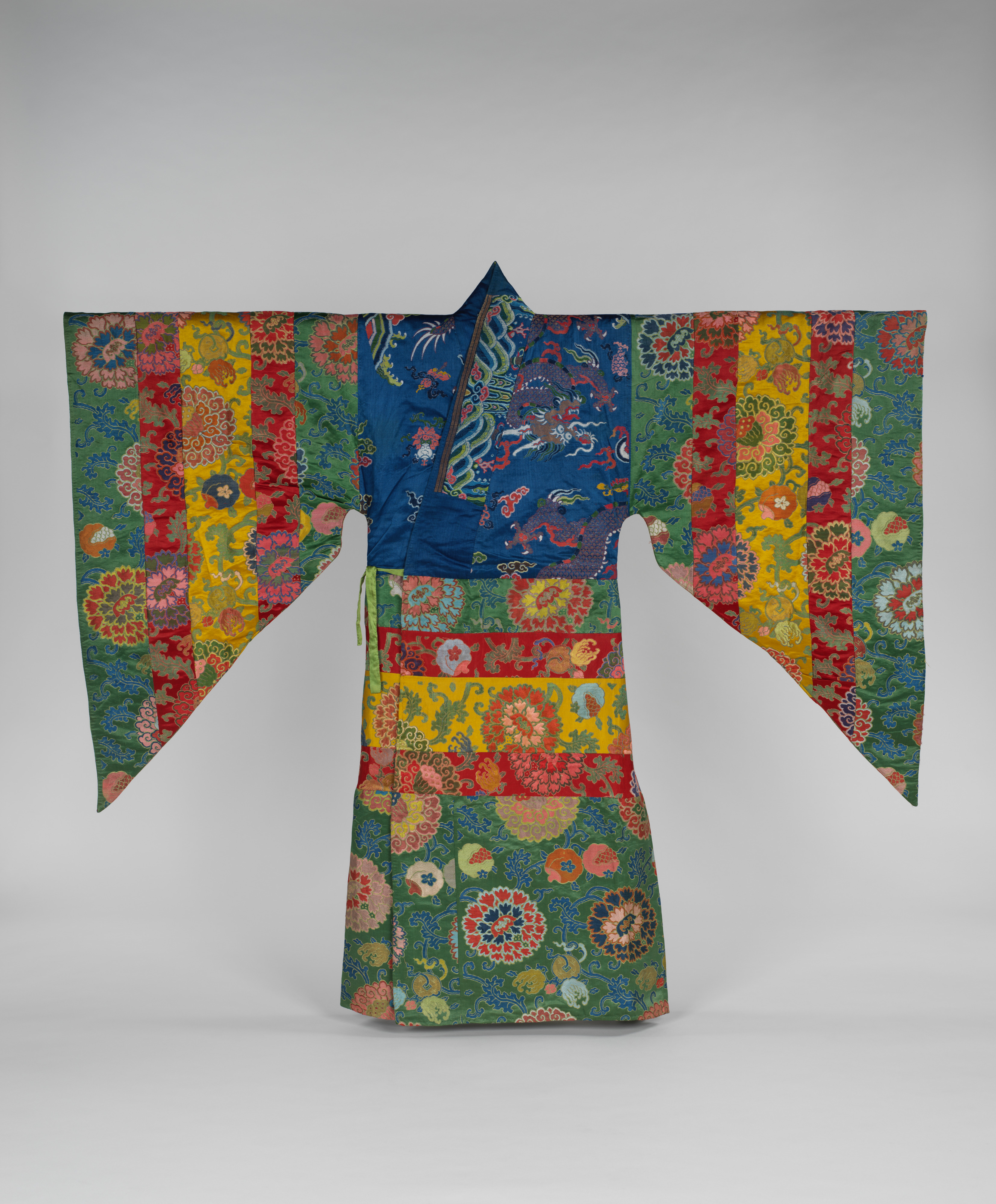
The Monastic Dance Robe from China, executed in plain-weave silk brocaded with silk and metallic thread, represents a pinnacle of liturgical textile artistry. This garment, intended for ceremonial dance within monastic traditions, transcends mere clothing to become a vessel for spiritual expression. In the context of Chinese Buddhist and Daoist rituals, dance robes served as kinetic icons, their movements choreographed to embody the cosmic order. The robe’s origin in China—a civilization with a millennia-long mastery of sericulture and textile symbolism—imbues it with layers of meaning that extend far beyond its physical form. As a standalone study, this piece invites a rigorous examination of how material, technique, and design converge to facilitate a dialogue between the earthly and the divine.
Material and Construction Analysis
The foundation of this robe is a plain-weave silk, a structure that prioritizes durability and a smooth, unadorned ground. This choice is strategic: the understated weave allows the brocaded elements to emerge with pronounced clarity. The brocading technique, employing both silk and metallic threads, introduces a counterpoint of texture and luster. The metallic thread, likely composed of a silk core wrapped in gilded paper or fine metal strips, catches light with each movement of the dancer, creating a visual rhythm that mirrors the cadence of the ritual. The silk brocading threads, dyed in deep indigo, vermilion, and gold, add chromatic depth without overwhelming the garment’s overall harmony.
The construction is equally deliberate. The robe’s silhouette—wide, flowing sleeves and a loose, floor-length body—is designed to maximize the visual impact of motion. Seams are meticulously finished with flat-felled techniques, ensuring that the garment can withstand the rigorous, repetitive motions of dance. The neckline is reinforced with a band of contrasting brocade, a subtle nod to the hierarchical nature of monastic vestments. This attention to structural integrity underscores the robe’s dual role as both functional attire and sacred object.
Symbolism and Iconography
The brocaded motifs on this robe are not arbitrary; they are a lexicon of Buddhist and Daoist iconography. Lotus blossoms and cloud scrolls dominate the design, executed in metallic thread that shimmers against the silk ground. The lotus, a symbol of purity emerging from muddy waters, is a recurring theme in Chinese monastic art, representing the practitioner’s journey toward enlightenment. The cloud scrolls, meanwhile, evoke the celestial realm, suggesting that the dancer is not merely moving through space but traversing the heavens. Interspersed are small swastikas (a pre-Buddhist symbol of auspiciousness in Asia) and endless knots, both of which signify eternity and the interconnectedness of all phenomena.
The placement of these motifs is carefully calibrated. On the back of the robe, a large central lotus medallion anchors the composition, while smaller floral sprays cascade down the sleeves. This asymmetry creates a sense of organic flow, as if the robe itself is alive with spiritual energy. The metallic thread’s reflective quality ensures that the iconography is legible even in the dim light of a temple hall, where candles and incense smoke might obscure other details.
Kinetic and Aesthetic Function
In the context of monastic dance, the robe is not a static artifact but a dynamic participant in the ritual. The plain-weave silk, though sturdy, is also lightweight, allowing the dancer to execute sweeping gestures without restriction. As the arms rise and fall, the brocaded sleeves catch the light, creating a visual echo of the dancer’s movements. The metallic thread’s weight, however, introduces a subtle gravity, ensuring that the robe does not float aimlessly but instead follows a controlled trajectory. This interplay of lightness and heft mirrors the dual nature of the monastic life—a balance between spiritual aspiration and earthly discipline.
The robe’s aesthetic is one of restrained opulence. Unlike secular court robes, which might employ dense goldwork and vibrant satins, this garment prioritizes spiritual resonance over material display. The colors—deep blue, muted gold, and dark red—are drawn from the palette of monastic symbolism: blue for wisdom, gold for enlightenment, red for compassion. The brocading technique, while technically demanding, is executed with a subtlety that avoids ostentation. This restraint is a form of humility, a reminder that the dancer’s body is merely a vehicle for the divine.
Technical Mastery and Craftsmanship
The creation of this robe would have required the collaboration of highly specialized artisans. The plain-weave silk base, while seemingly simple, demands precise tension control to ensure an even surface for brocading. The brocading process itself is a feat of engineering: the weft threads of silk and metal must be inserted at exact intervals, often controlled by a drawloom, to form the intricate patterns. The metallic thread, in particular, presents challenges—it is less pliable than silk and prone to tarnishing if not handled with care. The artisan’s ability to integrate these materials into a cohesive whole speaks to centuries of accumulated knowledge.
Moreover, the robe’s construction reflects an understanding of the garment’s intended use. The sleeves are cut wide but not excessively so, allowing for a full range of motion without compromising the silhouette. The hem is weighted with a narrow band of silk, ensuring that the robe falls gracefully during still moments. Every stitch, every seam, is a testament to the belief that the sacred and the technical are inseparable.
Comparative and Contemporary Relevance
When compared to other Chinese ritual garments, such as the chaofu (court robe) or the kesi (silk tapestry), the Monastic Dance Robe occupies a unique niche. It is less formal than the chaofu, which is laden with rank badges, and more kinetic than the kesi, which is often displayed as a hanging. Its closest parallels might be found in Tibetan chöpa robes or Japanese bugaku costumes, both of which similarly marry dance and spirituality. However, the Chinese robe’s emphasis on brocaded metallic thread sets it apart, highlighting a distinct regional approach to sacred textile art.
For contemporary fashion and textile design, this robe offers a masterclass in the integration of material and movement. Designers seeking to create garments that transcend the merely decorative might look to its example: how a plain weave can serve as a canvas for complex symbolism, how metallic threads can animate a silhouette, and how construction techniques can honor both the dancer’s body and the garment’s ritual purpose. In an era of fast fashion and disposable textiles, the Monastic Dance Robe stands as a quiet but powerful reminder that clothing can be a conduit for the sublime.
Conclusion
The Monastic Dance Robe is more than a historical artifact; it is a living document of Chinese spiritual and artistic practice. Its plain-weave silk ground, brocaded with silk and metallic thread, embodies a philosophy of balance—between the seen and the unseen, the material and the immaterial. As a standalone study, it challenges us to reconsider the boundaries between dress, dance, and devotion. In its folds and shimmering surfaces, we find not just a garment, but a prayer woven into fabric.