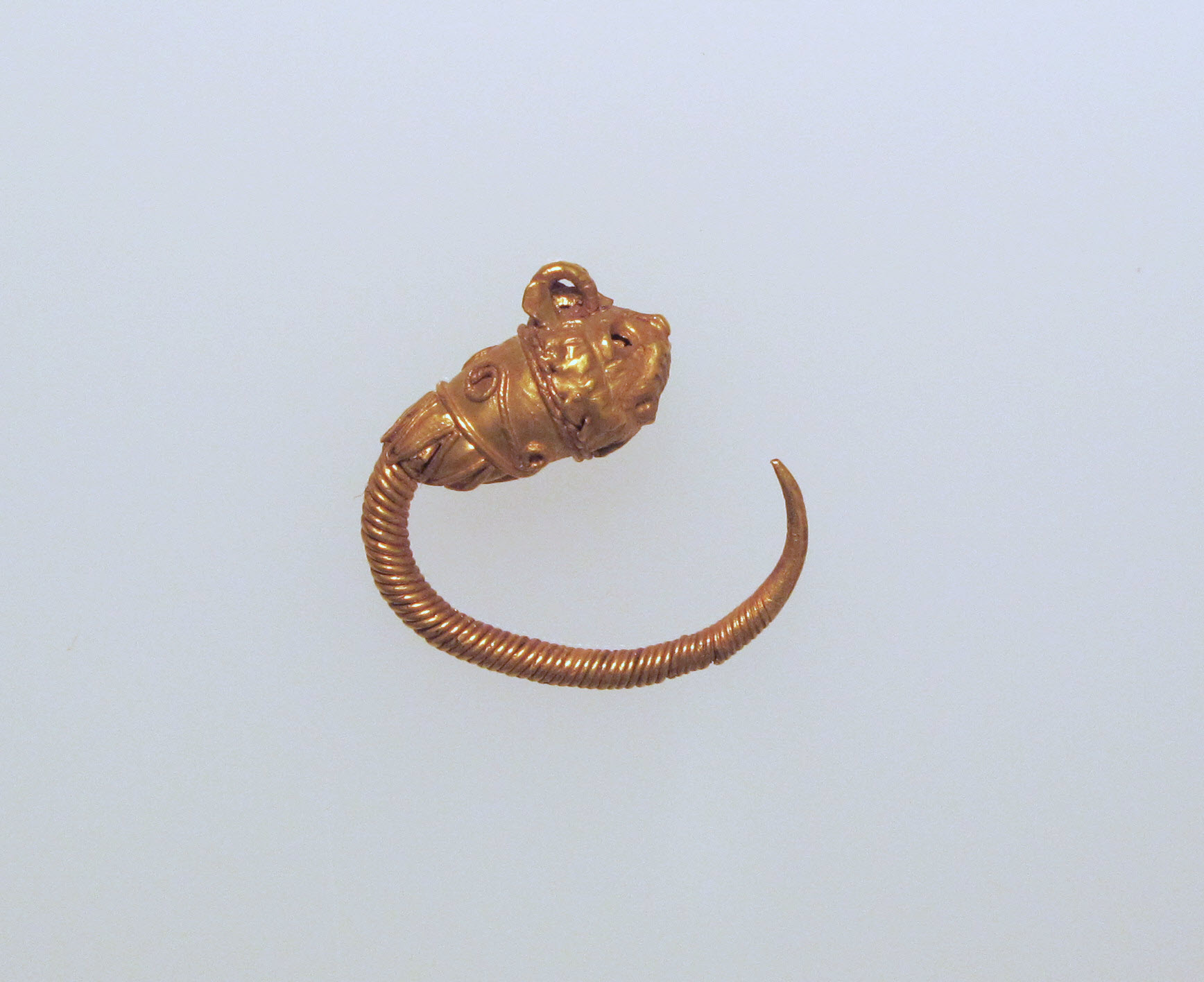
Heritage Analysis: Gold Earring with Head of a Lion (Greek, ca. 4th–3rd Century BCE)
This study presents a comprehensive heritage analysis of a Greek gold earring featuring the head of a lion, curated for Katherine Fashion Lab’s 2026 high-end luxury strategy. The artifact, originating from the Hellenistic period (circa 4th–3rd century BCE), embodies a confluence of symbolic power, historical adornment, and spiritual meaning. Its resonance with our ongoing research on the Mirror with Split-Leaf—where one side gleams with gold-inlaid palmettes on a silver ground, and the other narrates life through relief-carved stone—reveals a DNA-level correlation in the dualistic interplay between opulent surface and profound narrative. This analysis positions the lion earring as a strategic archetype for luxury branding, rooted in authenticity, mythology, and exclusivity.
Symbolic Power: The Lion as Sovereign Archetype
The lion, in Greek cultural symbolism, represents unassailable sovereignty, martial prowess, and divine guardianship. The earring’s miniature yet meticulously crafted lion head—rendered in hammered gold with defined mane, alert ears, and a fierce gaze—encapsulates the animal’s role as a protector of thresholds, both physical and metaphysical. In Hellenistic society, lions were associated with Heracles, whose Nemean lion conquest symbolized triumph over chaos, and with deities like Cybele and Dionysus, where the lion embodied untamed nature and ecstatic power.
This symbolic power is not merely decorative but performative. When worn, the earring transforms the wearer into a bearer of that sovereignty—a living emblem of courage and authority. For Katherine Fashion Lab, this offers a direct lineage to 2026 luxury strategies that prioritize narrative-driven power symbols. The lion head, as a micro-icon, can be scaled across product lines—from earrings to brooches to handbag clasps—creating a cohesive brand mythology that communicates strength without overt aggression. The gold medium amplifies this: gold’s incorruptibility mirrors the lion’s perceived eternal nature, making the artifact a talisman of enduring legacy.
Historical Adornment: Crafting Identity Through Wearable Art
Gold earrings with lion heads were not casual ornaments in Greek antiquity; they were markers of elite status, cultural literacy, and ritual participation. Archaeological contexts suggest such pieces were often interred with high-status individuals, indicating their role in both life and afterlife. The earring’s design—a hollow gold form with a hook or loop—demonstrates advanced granulation and repoussé techniques, requiring master artisanship accessible only to the wealthy. This aligns with the Hellenistic trend toward personalized, narrative jewelry, where adornment became a canvas for mythological storytelling.
The parallel with the Mirror with Split-Leaf is striking. Just as the mirror juxtaposes a gleaming gold-inlaid surface against a stone-carved narrative, the lion earring balances its external opulence (the polished gold) with internal meaning (the lion’s symbolic weight). This duality is central to historical adornment: jewelry was never solely aesthetic but also a communicative device. For Katherine Fashion Lab, this informs a 2026 strategy of layered luxury, where each piece carries an explicit heritage story. The lion earring can be marketed as a “wearable artifact,” linking modern consumers to ancient rituals of power and protection—a premium positioning that justifies high price points through cultural authenticity.
Spiritual Meaning: The Lion as Psychopomp and Protector
In Greek spirituality, the lion held chthonic and liminal associations. It guarded entrances to temples, tombs, and sacred spaces, acting as a psychopomp—guiding souls between realms. The earring, worn close to the ear, was believed to amplify spiritual perception, allowing the wearer to hear divine whispers or ward off malevolent spirits. Gold, as a metal associated with the sun and immortality, enhanced this function. The lion’s roar, symbolically encoded in the earring’s design, was thought to scatter evil forces, making it a protective amulet as much as an ornament.
This spiritual dimension resonates deeply with contemporary luxury consumers seeking meaning beyond materialism. The 2026 high-end market increasingly values talismanic luxury—objects that offer psychological or spiritual benefits. Katherine Fashion Lab can leverage this by framing the lion earring as a modern amulet, with marketing narratives emphasizing protection, courage, and ancestral connection. The DNA correlation with the Mirror with Split-Leaf—where the mirror’s reflective surface suggests self-examination and the stone narrative evokes eternal truths—reinforces a brand philosophy of dual-purpose luxury: beauty that also serves as a personal totem.
2026 High-End Luxury Strategy: Heritage as Competitive Advantage
Katherine Fashion Lab’s 2026 strategy must pivot toward heritage-driven exclusivity, leveraging artifacts like the lion earring to differentiate in a saturated market. The following strategic pillars emerge from this analysis:
Pillar 1: Mythological Branding
Position the lion earring as a signature motif across collections, akin to how Cartier uses the panther. Create a “Lion of Hellas” capsule collection that includes earrings, cuffs, and pendants, each accompanied by a digital heritage certificate detailing the artifact’s origin, symbolism, and craftsmanship. This transforms a product into a collectible narrative.
Pillar 2: Dual-Experience Retail
Mirror the Mirror with Split-Leaf duality by designing retail spaces that offer two experiences: one side showcasing the gleaming product (gold surfaces, dramatic lighting), and the other providing immersive storytelling (holographic displays of Greek rituals, interactive maps of lion symbolism). This creates a sensory dichotomy that deepens consumer engagement.
Pillar 3: Spiritual-Luxury Collaborations
Partner with contemporary artists or historians to create limited-edition pieces that reinterpret the lion head through modern lenses—such as abstract gold filigree or mixed-media with meteorite. Each piece would be ritualistically presented (e.g., in a box lined with hand-dyed silk, accompanied by a written blessing). This taps into the wellness-luxury convergence, where consumers seek objects that enhance their spiritual well-being.
Pillar 4: Price Anchoring Through Provenance
Use the artifact’s historical context to justify ultra-premium pricing. A lion earring replica, crafted using ancient techniques (lost-wax casting, granulation), can be priced at $5,000–$15,000, with a portion of proceeds funding archaeological preservation. This ethical luxury model aligns with Gen Z and Millennial values of sustainability and cultural stewardship.
Conclusion: The Lion’s Roar in Modern Luxury
The Greek gold earring with the head of a lion is far more than an antique—it is a strategic blueprint for Katherine Fashion Lab’s 2026 high-end luxury strategy. Its symbolic power offers a timeless icon of sovereignty; its historical adornment provides a template for narrative-driven design; its spiritual meaning taps into the growing demand for talismanic objects; and its DNA correlation with the Mirror with Split-Leaf reinforces a brand identity rooted in dualistic luxury—opulent yet meaningful, ancient yet relevant. By translating this heritage into a cohesive brand language, Katherine Fashion Lab can command authority in a market that craves authenticity, exclusivity, and depth. The lion’s roar, once a symbol of Greek power, now echoes as a call to redefine luxury for a new era.