The Pepperbox Pistol: An Analysis of Form, Function, and Ornamentation
Introduction: A Convergence of Craft and Mechanism
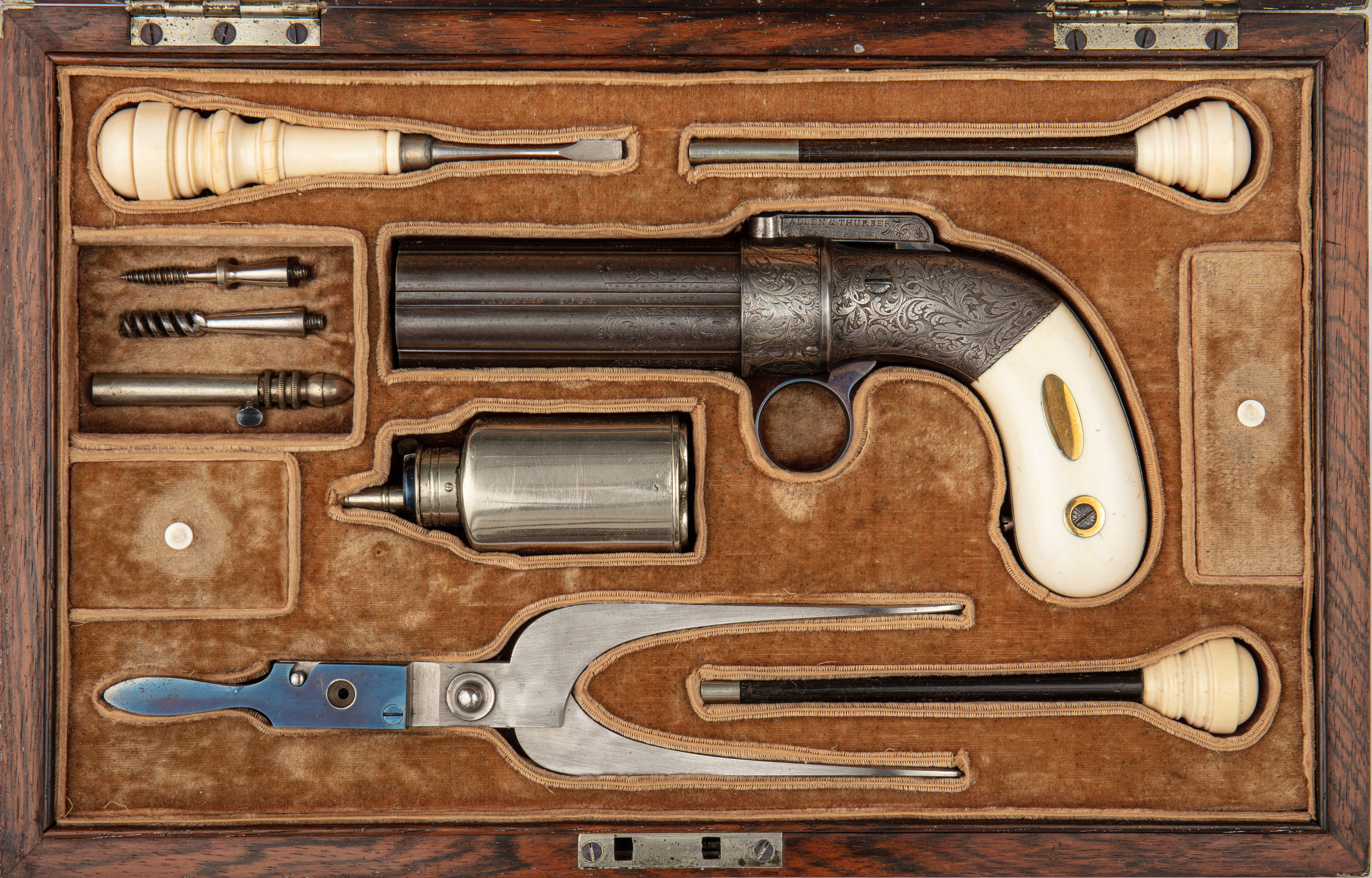
The Cased Six-Barreled Revolving Percussion Pistol, commonly known as the pepperbox, represents a pivotal moment in the evolution of personal firearms. Originating from the industrial heartland of Norwich, Connecticut, this American-made artifact transcends its utilitarian purpose to become a profound study in material culture. At Katherine Fashion Lab, we examine this object not merely as a weapon but as a synthesis of mechanical ingenuity and decorative art. The pepperbox’s construction—a marriage of steel, gold, silver, ivory, rosewood, and velvet—offers a unique lens through which to analyze the interplay between functional design and aesthetic expression in mid-19th-century America. This standalone study dissects the pepperbox’s components, contextualizes its historical significance, and explores how its material choices reflect broader cultural narratives of status, craftsmanship, and the evolving nature of personal defense.
Mechanical Innovation and the Aesthetics of Repetition
The pepperbox’s most striking feature is its six-barreled revolving mechanism, a design that predates the more familiar revolver. Unlike single-shot pistols, this configuration allowed for rapid successive firing, a critical advantage in self-defense. From a design perspective, the clustered barrels create a visual rhythm of repetition—a cylindrical symmetry that is both practical and visually compelling. The barrels, forged from steel, are meticulously aligned, their geometric precision echoing the industrial era’s embrace of standardized production. Yet, the pepperbox escapes the cold anonymity of mass manufacturing through its hand-finished details. The steel is not merely functional; it is a canvas for engraved scrollwork and floral motifs, often gilded with gold inlay. This juxtaposition of brute mechanical force and delicate ornamentation challenges the viewer to reconsider the object’s dual identity: it is both a tool of violence and a testament to the gunsmith’s artistry.
The revolving mechanism itself is a marvel of early engineering. Each barrel rotates into alignment with a single percussion cap, a system that required precise tolerances. The percussion ignition replaced earlier flintlock designs, offering greater reliability in adverse weather. This technological leap is reflected in the pistol’s sleek profile—the absence of external frizzens or pans allows for a cleaner silhouette. The pepperbox’s form thus follows its function, yet the designer’s hand is evident in the balance of proportions: the barrels are neither too long to unbalance the piece nor too short to compromise accuracy. This equilibrium is a lesson in ergonomic design, anticipating modern principles of user-centered engineering.
Material Narratives: Steel, Gold, Silver, and Ivory
The selection of materials in this pepperbox is a deliberate narrative of wealth and refinement. Steel forms the core, its dark, blued finish providing a dramatic backdrop for lighter accents. The bluing process—a controlled oxidation—not only protects against rust but also imparts a deep, lustrous sheen that suggests depth and durability. Against this, gold inlays are applied to the barrels and frame, often depicting hunting scenes or abstract foliage. Gold, as a noble metal, resists tarnish and symbolizes permanence, while its warm hue contrasts with the steel’s coolness, creating a visual tension that draws the eye.
Silver appears on the trigger guard and grip escutcheon, its softer luster complementing the gold. Silver’s historical association with purity and status is amplified here; it is not merely decorative but also functional, as silver alloys are less prone to corrosion than steel. The ivory grips represent the most luxurious element of the piece. Carved from elephant tusk, the ivory is polished to a creamy smoothness, its natural grain visible under close inspection. Ivory’s tactile warmth and organic feel offer a stark contrast to the cold metal, humanizing the object. However, the use of ivory also raises ethical considerations in contemporary analysis, reflecting a period when colonial exploitation and wildlife consumption were unexamined norms. The rosewood case—dense, richly figured, and lined with velvet—completes the ensemble. The case is not merely storage; it is a presentation platform, its velvet interior cushioning the pistol and its accessories (powder flask, bullet mold, cleaning rod) in a tableau of order and luxury.
Ornamentation as Social Currency
The pepperbox’s decorative elements are not arbitrary; they serve as social signifiers. In mid-19th-century America, a cased pistol of this quality was a marker of affluence and taste. The engraving—often executed by specialized artisans—demonstrates a mastery of line and composition. Flowing arabesques and acanthus leaves echo the Rococo Revival style popular in furniture and silverware of the period. This cross-pollination of decorative motifs between firearms and other luxury goods suggests a cohesive aesthetic language among the elite. The gold wash applied to internal parts, though hidden from view, speaks to a philosophy of completeness: even unseen components deserve beauty. This attention to detail elevates the pepperbox from a mere tool to an object of conspicuous consumption, where the owner’s status is affirmed through the craftsmanship of their possessions.
Furthermore, the velvet lining of the case—typically a deep crimson or forest green—adds a layer of theatricality. Velvet, with its plush texture and light-absorbing properties, creates a stage for the pistol, inviting reverence. The act of opening the case becomes a ritual, revealing the gleaming metal against the soft fabric. This presentation underscores the pepperbox’s role as a conversation piece, an object to be displayed and discussed, not merely concealed in a pocket.
Historical Context: Norwich, Connecticut, and the American Arms Trade
Norwich, Connecticut, was a hub of firearms innovation in the 19th century, home to manufacturers like the Norwich Arms Company and numerous independent gunsmiths. The city’s proximity to the Thames River and rail networks facilitated the distribution of arms across the expanding nation. The pepperbox emerged during a period of westward expansion and social instability, where personal protection was a practical necessity. However, its elaborate decoration suggests that it was intended for an urban, affluent clientele—perhaps a gentleman traveler or a merchant seeking both security and status.
The percussion system itself was a response to the limitations of flintlocks, which were prone to misfire in damp conditions. By the 1840s, percussion caps had become standard, and the pepperbox offered a compact, multi-shot alternative to cumbersome single-shot pistols. Yet, its popularity waned with the advent of Samuel Colt’s revolver, which offered a more streamlined cylinder design. The pepperbox thus represents a transitional technology, a brief but brilliant synthesis of old and new. Its cased presentation further indicates that it was not a battlefield weapon but a civilian accessory, often carried by lawyers, politicians, or businessmen in cities like New York or Boston.
Conclusion: The Pepperbox as a Cultural Artifact
In analyzing the cased six-barreled pepperbox, we uncover layers of meaning that extend beyond its ballistic function. It is a microcosm of 19th-century American values: innovation, individualism, and the pursuit of elegance. The interplay of steel, gold, silver, ivory, rosewood, and velvet reveals a culture that prized craftsmanship as a measure of character. For Katherine Fashion Lab, this object serves as a case study in how materiality and design converge to tell stories. The pepperbox is not simply a gun; it is a testament to the human desire to imbue even the most utilitarian objects with beauty and significance. As we continue to explore the intersections of fashion, design, and history, the pepperbox reminds us that every artifact holds a narrative, waiting to be unpacked through the lens of critical analysis.