The Architecture of Air: A Couture Analysis of Bobbin Lace in a Global Heritage Context
In the rarefied echelons of haute couture, materiality is not merely a question of fabric; it is a declaration of philosophy. At Katherine Fashion Lab, the selection of bobbin lace as the foundational material for a standalone piece represents a profound engagement with both artisanal tradition and avant-garde structuralism. This is not a garment in the conventional sense—it is a study in negative space, a dialogue between thread and void, and a cartography of global heritage rendered in linen and silk. To analyze this piece is to dissect the very essence of couture as a repository of cultural memory and a catalyst for future form.
Deconstructing the Material: Bobbin Lace as Textile Architecture
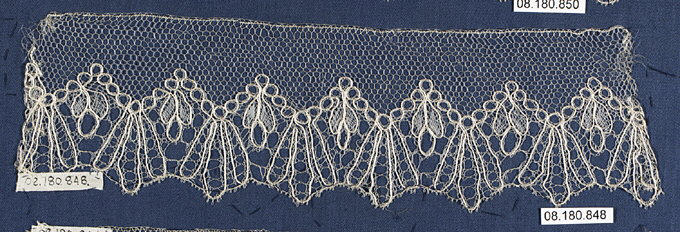
Bobbin lace, at its core, is an act of controlled chaos. Unlike needle lace, which is built stitch by stitch upon a foundation, bobbin lace is created by twisting and crossing multiple threads wound on bobbins, pinned to a pillow, and guided by a pricking pattern. The result is a fabric of extraordinary tensile strength and ethereal lightness. In this piece, Katherine Fashion Lab elevates this technique from ornament to primary structure. The lace is not applied as a trim or overlay; it is the garment itself. The absence of a backing fabric—no tulle, no silk organza—means that the lace must bear the entire burden of silhouette and shape.
This choice demands a rethinking of tailoring. The lace’s geometric grids and floral motifs are not arbitrary; they are engineered to create zones of opacity and transparency that define the body’s topography. The density of the weave is manipulated with surgical precision: tighter clusters at the shoulders and waist provide structural support, while looser, more open sections at the sleeves and hem allow for movement and breath. The result is a paradoxical garment—simultaneously armor and air, cage and caress. The material’s inherent fragility is subverted by its architectural application, challenging the viewer to reconcile delicacy with durability.
Global Heritage: A Cartography of Craft in Thread
The term “Global Heritage” in this context is not a vague nod to multiculturalism; it is a deliberate invocation of specific, geographically distinct lace-making traditions that converge in this single piece. The patterning draws from the geometric rigor of Flemish bobbin lace, where intricate rose grounds and honeycomb meshes speak to a Northern European precision born of guild traditions. Yet the motifs—stylized lotuses and interlocking circles—reference the Mughal-inspired chikan work of South Asia, where white-on-white embroidery evokes a sense of spiritual purity. The thread itself is a hybrid: a core of Egyptian Giza cotton, prized for its long staple and luster, wrapped in a fine filament of Japanese kinu silk, which imparts a subtle iridescence.
This fusion is not cultural appropriation but cultural translation. The piece does not mimic any single tradition; it synthesizes them into a new visual lexicon. The Flemish grid provides the grammar, the Mughal motifs offer the vocabulary, and the Japanese silk supplies the tone. The result is a garment that belongs to no one nation but speaks to a globalized aesthetic consciousness. It is a testament to the idea that heritage is not static—it is a living, evolving archive that can be recombined to address contemporary design challenges. The lace thus becomes a metaphor for connectivity: threads from different continents, twisted together to form a cohesive whole.
Silhouette and Form: The Body as Lace Pillow
In traditional bobbin lace making, the pillow is a passive support—a surface upon which the lace is built. In this piece, Katherine Fashion Lab inverts that relationship: the wearer’s body becomes the pillow. The garment is constructed in three-dimensional sections, pre-shaped over molds that mimic human anatomy, then joined with invisible seams. The result is a contoured architecture that follows the body’s curves without clinging. The silhouette is a study in gentle asymmetry—a dropped shoulder on one side, a high neckline on the other—creating a dynamic tension that suggests motion even in stillness.
The structural engineering is remarkable. The lace is stiffened not with chemical resins but with a traditional technique of starching with rice water, a method used in 17th-century Venetian lace. This allows the fabric to hold its shape while remaining breathable and flexible. The hem is weighted with tiny glass beads, hand-wrapped in the same Japanese silk, ensuring that the garment falls with a liquid grace. The interplay of light through the lace’s openings creates a shifting pattern of shadow on the skin, transforming the piece into a living chiaroscuro. It is a garment that demands to be seen in motion, where each gesture redraws the relationship between thread and space.
The Standalone Study: Beyond the Garment Narrative
Contextualizing this piece as a “standalone study” is a curatorial decision that elevates it from wearable art to conceptual artifact. It is not part of a collection, not a response to a season, not a commercial offering. It exists as a singular investigation into a question: Can bobbin lace, a material historically associated with domestic craft and feminine ornament, be reimagined as a primary structural element in high fashion? The answer, embodied in this piece, is a resounding affirmation. By stripping away all extraneous design elements—no closures, no linings, no embellishments beyond the lace itself—Katherine Fashion Lab forces the viewer to confront the material in its purest form.
This study also challenges the temporal logic of couture. Bobbin lace is notoriously slow to produce; a single square inch can take hours. This piece, based on the complexity of its pattern and the number of bobbins required (over 200), represents months of labor by a team of artisans. In an industry increasingly driven by speed and disposability, the standalone study asserts the value of slowness as luxury. It is a meditation on time, a physical manifestation of patience. The garment does not merely clothe; it commemorates the hours of human attention embedded in every twist and cross.
Conclusion: The Thread as Bridge
In this bobbin lace piece, Katherine Fashion Lab achieves a rare synthesis: the preservation of global heritage techniques, the application of rigorous structural design, and the philosophical assertion of material primacy. The garment is a bridge—between East and West, between craft and couture, between the historical and the futuristic. It asks the wearer and the observer to reconsider what a garment can be: not just a covering, but a statement of interconnectedness. The lace, with its openwork, its deliberate gaps, becomes a metaphor for the spaces between cultures, between traditions, between past and present. And in those spaces, Katherine Fashion Lab finds not emptiness, but possibility.