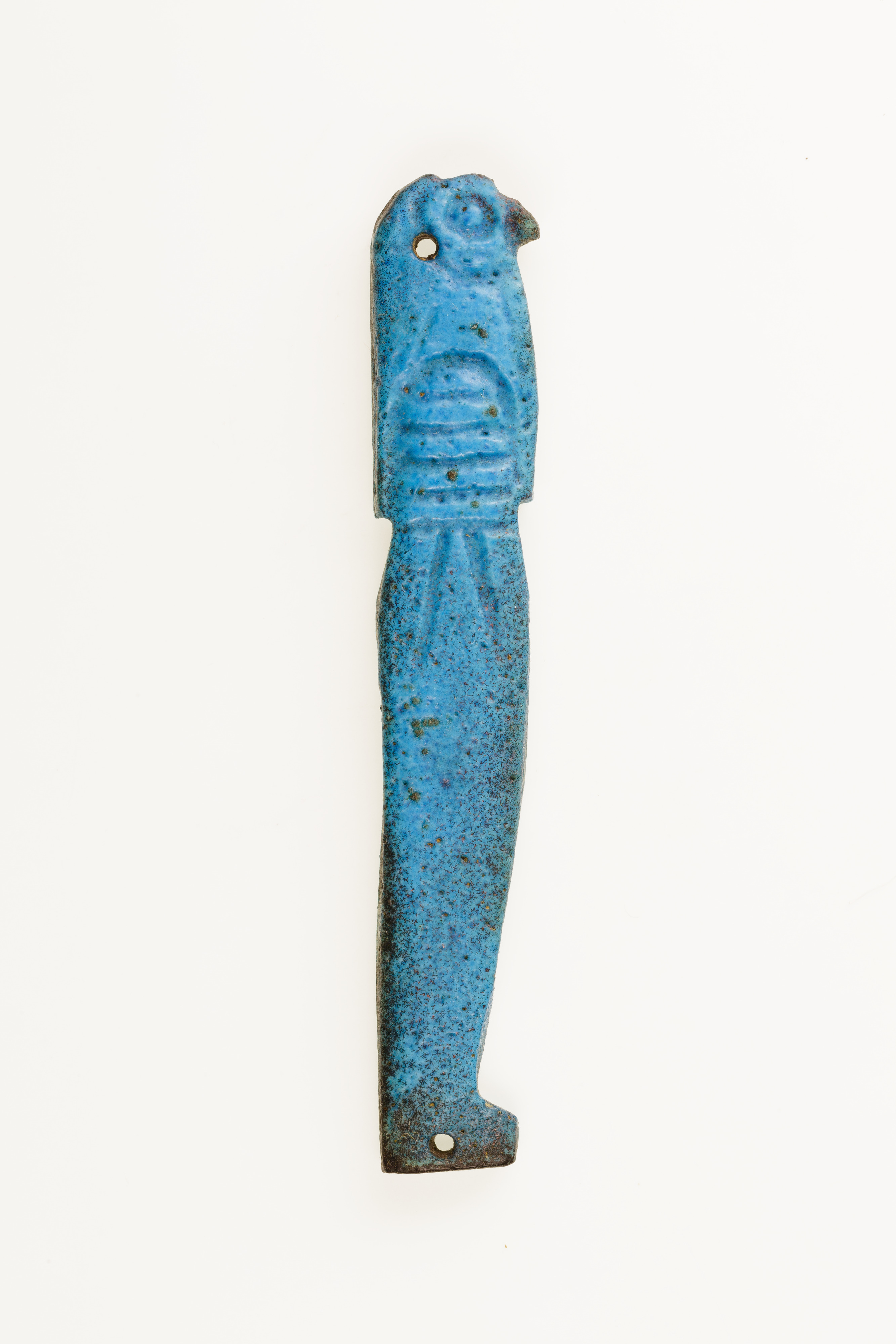
Heritage Analysis: The Son of Horus (Qebehsenuf) from the Bead Net
Introduction to the Artifact and Its Cultural Provenance
The subject of this heritage analysis is a faience bead-net representation of Qebehsenuf, one of the Four Sons of Horus, a deity central to ancient Egyptian funerary tradition. This artifact, originating from the broader corpus of ancient Egyptian burial goods, is crafted from faience—a sintered-quartz ceramic renowned for its lustrous, vitreous finish. The bead-net form, often associated with mummy shrouds or protective coverings, integrates Qebehsenuf as a guardian figure. In the ancient civilization of Egypt, Qebehsenuf was specifically tasked with protecting the intestines of the deceased, symbolizing the falcon-headed god’s role in the afterlife’s preservation and spiritual integrity. This artifact, therefore, is not merely decorative but a functional talisman within a complex cosmological framework.
Symbolic Power and Spiritual Meaning
The symbolic power of Qebehsenuf is deeply rooted in the ancient Egyptian concept of Ma’at—order, balance, and truth. As a Son of Horus, Qebehsenuf embodies the protective and regenerative forces necessary for the soul’s journey through the Duat (underworld). The falcon head, a direct reference to the sky god Horus, signifies vigilance, solar authority, and resurrection. In the bead-net context, each faience bead is a miniature vessel of spiritual energy, woven together to form a protective matrix. The color of faience, typically a vibrant turquoise or green, was associated with rebirth, fertility, and the Nile’s life-giving waters. Thus, the artifact functions as a spiritual armor, ensuring the deceased’s intestines—a vital organ for bodily integrity—are safeguarded against decay and malevolent forces. This interplay of material and symbolism elevates Qebehsenuf from a mere icon to an active participant in the afterlife’s eternal cycle.
Historical Adornment and Craftsmanship
From a historical adornment perspective, the bead-net represents a pinnacle of ancient Egyptian craftsmanship. Faience production required meticulous control of silica, alkali, and copper oxides, fired at low temperatures to achieve its characteristic glaze. The bead-net construction, often sewn onto linen or leather, demanded precision in bead sizing and pattern alignment. Qebehsenuf’s depiction within this net is typically rendered in relief or as a separate amulet, integrated into the overall design. This technique reflects a luxury aesthetic reserved for elite burials, where the cost of materials and labor signified social status and devotion to religious orthodoxy. The bead-net’s shimmering surface, intended to catch torchlight in tomb chambers, created an ethereal effect that reinforced the divine presence. Historically, such adornments were not worn in life but reserved for the eternal realm, underscoring their role as transitional objects bridging the mortal and spiritual worlds.
Strategic Positioning for 2026 High-End Luxury
For Katherine Fashion Lab, the Qebehsenuf bead-net artifact offers a profound opportunity to align with emerging luxury trends in 2026, which prioritize cultural depth, sustainability, and narrative-driven design. The following strategic imperatives are recommended:
1. Cultural Symbolism as Brand Equity:
The falcon-headed Qebehsenuf can be reinterpreted as a motif for protection and legacy in luxury accessories. By embedding this symbol into limited-edition jewelry, handbags, or scarves, Katherine Fashion Lab can appeal to discerning clients seeking meaningful status symbols. The narrative of guardianship—protecting what is precious—resonates with modern consumers who view luxury as an investment in heritage and self-preservation.
2. Material Innovation Inspired by Faience:
Faience’s luminous quality and sustainable production (using natural clays and low-energy firing) align with 2026’s eco-luxury ethos. Katherine Fashion Lab could develop a proprietary composite or glaze that mimics faience’s iridescence, using recycled glass or bio-based ceramics. This material storytelling would differentiate the brand in a crowded market, emphasizing craftsmanship over mass production.
3. Spiritual Adornment for the Modern Elite:
The bead-net’s protective function can be translated into wearable talismans—for example, a modular jewelry line where each bead represents a virtue (protection, vitality, wisdom). This concept taps into the growing demand for functional luxury, where objects serve both aesthetic and spiritual purposes. Marketing campaigns could frame these pieces as “guardians of personal legacy,” appealing to high-net-worth individuals who value mindfulness and exclusivity.
4. Collaborative Curation with Egyptologists:
To ensure authenticity, Katherine Fashion Lab should partner with cultural institutions or scholars to co-create a capsule collection. This collaboration would provide expert validation and access to archival bead-net patterns. A portion of proceeds could fund archaeological preservation, enhancing brand reputation through corporate social responsibility. Such partnerships also mitigate risks of cultural appropriation by framing the initiative as a respectful homage.
5. Experiential Luxury and Digital Storytelling:
In 2026, high-end consumers expect immersive brand experiences. Katherine Fashion Lab could launch a virtual reality (VR) exhibition tracing Qebehsenuf’s journey from tomb to atelier. Clients could explore the bead-net’s spiritual dimensions via an app, with each bead unlocking a chapter of Egyptian mythology. This phygital approach merges heritage with technology, creating a memorable brand touchpoint that justifies premium pricing.
Conclusion: Heritage as a Competitive Advantage
The Qebehsenuf bead-net artifact is a testament to ancient Egypt’s mastery of symbolic adornment and spiritual engineering. For Katherine Fashion Lab, this heritage analysis reveals a clear pathway to differentiate in the 2026 luxury landscape. By honoring the artifact’s protective symbolism, artisanal integrity, and cosmological depth, the brand can craft a narrative that resonates with modern elites seeking authenticity, sustainability, and transcendence. The falcon-headed son of Horus, once a guardian of the dead, can now become a guardian of luxury’s future—a beacon of meaning in an era of fleeting trends. This strategic repositioning not only preserves cultural legacy but also elevates Katherine Fashion Lab as a curator of timeless, soulful luxury.