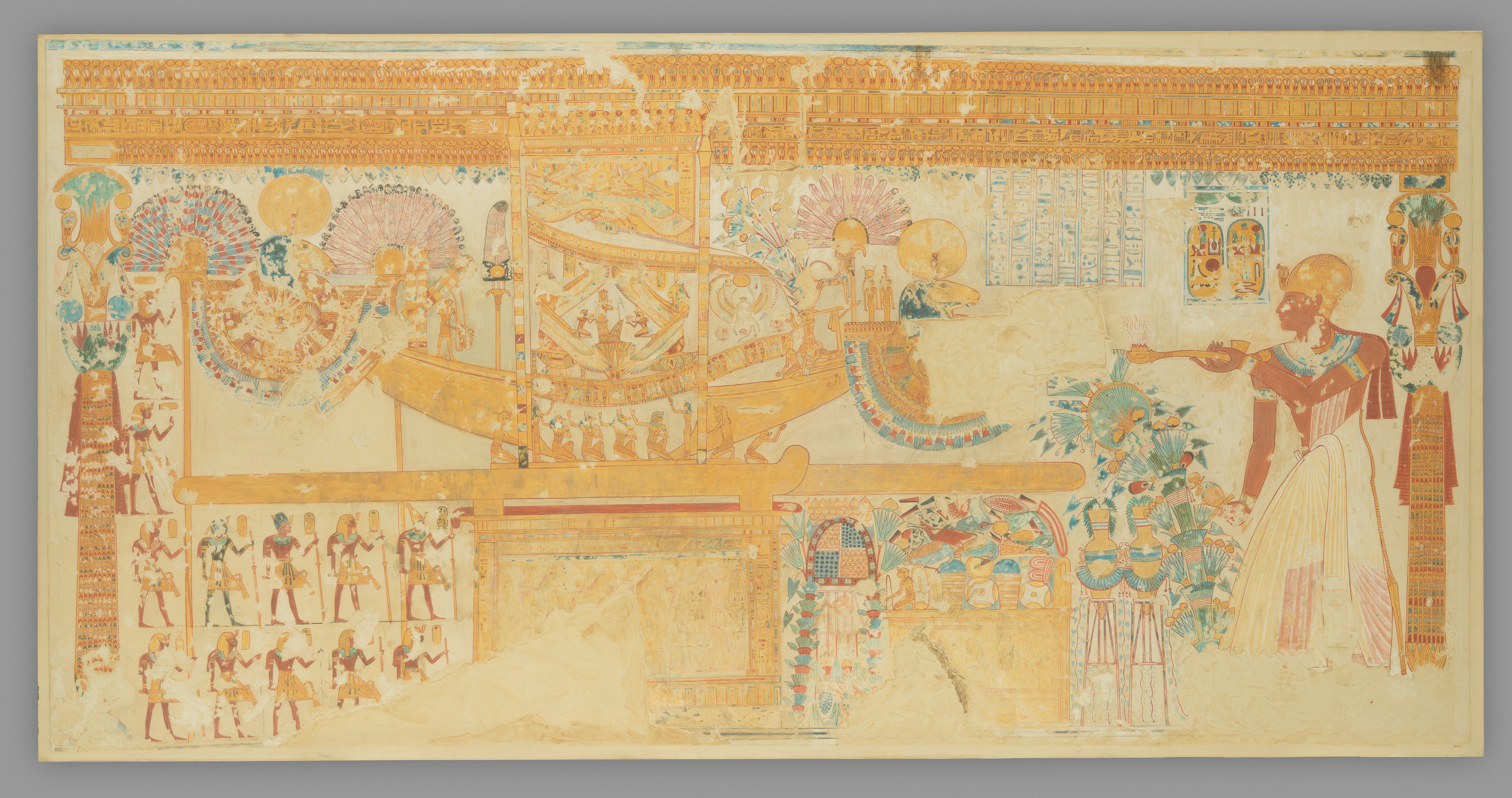
Heritage Analysis: The Painting of Ramesses IX Before the Barque of Amun
Contextual Provenance and Iconographic Significance
The painting of Ramesses IX before the barque of Amun, rendered in tempera on paper from the tomb of Imiseba, represents a pivotal artifact within the corpus of Ancient Egyptian funerary and ritual art. This work, dating to the 20th Dynasty (circa 1126–1108 BCE), depicts the pharaoh in a moment of profound spiritual deference, standing before the sacred barque—a portable shrine carrying the cult statue of the god Amun. As a strategic standalone research subject for Katherine Fashion Lab, this painting offers a rich lexicon of symbolic power, historical adornment, and spiritual meaning that can inform a 2026 high-end luxury strategy. The tempera medium, while a later reproduction, retains the chromatic intensity and hieratic proportions that defined original tomb paintings, making it a valuable source for decoding ancient aesthetic hierarchies.
Symbolic Power: The Pharaoh as Divine Mediator
The composition positions Ramesses IX as both a mortal ruler and a divine intermediary. The pharaoh’s posture—arms raised in adoration or presenting offerings—signals his subservience to Amun, yet his scale and regalia assert his unique authority. In Ancient Egyptian cosmology, the barque of Amun was not merely a vessel but a mobile manifestation of the god’s presence, carried in processions to renew the cosmic order (ma’at). For Katherine Fashion Lab, this duality of submission and supremacy offers a powerful archetype for luxury branding. The 2026 strategy can leverage this tension: a high-end collection that simultaneously evokes humility before heritage and asserts the wearer’s elevated status. Symbolic power here is not static; it is performed through material and gesture. The pharaoh’s gold collar, broad collar (wesekh), and linen kilt are not decorative but semiotic—each element communicates his role as the guarantor of cosmic balance. In luxury terms, this translates to garments and accessories that encode narrative authority, where each stitch, clasp, or motif carries a story of provenance and purpose.
Historical Adornment: Regalia as Cosmic Armor
The adornment depicted in this painting is meticulously codified. Ramesses IX wears the nemes headdress, the false beard, and the uraeus—symbols of kingship that date back to the Old Kingdom. His broad collar, composed of rows of faience, carnelian, and gold, is not merely ornamental but apotropaic, warding off chaos. The barque itself is adorned with falcon-headed prows, lotus motifs, and solar disks, reflecting the fusion of Amun with the sun god Ra. For Katherine Fashion Lab, these elements provide a blueprint for historical adornment that transcends mere aesthetics. In 2026, luxury consumers increasingly seek objects that offer protection, meaning, and lineage. The use of gold, lapis lazuli, and electrum in Ancient Egyptian jewelry can inspire a material strategy that emphasizes rarity and symbolic resonance. Consider a capsule collection that reinterprets the wesekh collar as a modular necklace, where each gemstone corresponds to a virtue (e.g., turquoise for rebirth, carnelian for vitality). The barque’s iconography—scarab beetles, ankh crosses, and was scepters—can be abstracted into geometric patterns for evening wear, marrying historical depth with modern minimalism. This approach positions the brand not as a copyist but as a curator of symbolic heritage.
Spiritual Meaning: The Barque as a Vehicle of Transcendence
Spiritually, the barque of Amun represents the journey of the soul through the underworld and the daily rebirth of the sun. Ramesses IX’s presence before it underscores his role in facilitating this cosmic cycle. The painting’s palette—deep blues, golds, and ochres—evokes the Nile’s life-giving waters and the desert’s eternal sands. For Katherine Fashion Lab, this spiritual dimension offers a profound narrative for 2026 high-end luxury. In an era of ecological anxiety and spiritual seeking, luxury brands that articulate transcendence—through ritual, craftsmanship, and material integrity—will resonate. The barque motif can be adapted into a collection that emphasizes movement and transformation: flowing silk capes that mimic the barque’s sails, or jewelry that incorporates kinetic elements (e.g., rotating scarabs). The spiritual meaning also informs the brand’s ethos: each piece can be presented as an amulet or talisman, imbued with intention through hand-finishing and provenance storytelling. This moves beyond commodity to sacrament, aligning with the luxury consumer’s desire for objects that offer psychological and emotional anchoring.
2026 High-End Luxury Strategy: Synthesis and Application
To operationalize this heritage analysis, Katherine Fashion Lab must adopt a multi-layered strategy that integrates symbolic power, historical adornment, and spiritual meaning. First, Symbolic Power should manifest in brand communications that emphasize the pharaoh’s dual role as servant and sovereign. Campaigns can feature models in poses of reverence, with garments that combine regal structure with fluid lines, suggesting both submission to tradition and command of presence. Second, Historical Adornment should drive material innovation. Collaborate with gemologists and conservators to source ethically mined stones that echo Ancient Egyptian palettes. Use 3D scanning of artifacts to create digital archives for pattern-making, ensuring authenticity in motif reproduction. The barque’s iconography can be laser-cut into leather goods or embroidered onto couture pieces, creating a tactile link to the past. Third, Spiritual Meaning can be embedded in the brand’s retail experience. Flagship stores could incorporate ritual elements: scent diffusers emitting frankincense and myrrh, soundscapes of Nile water, and interactive displays that explain the symbolism of each piece. Limited-edition items could include certificates of provenance, linking the buyer to the artifact’s history. Finally, the 2026 strategy should leverage the tempera medium’s fragility and permanence. Just as the painting preserves a moment of divine encounter, Katherine Fashion Lab can position its products as heirlooms—designed for longevity, repair, and transmission. This aligns with the growing luxury trend of slow fashion and heritage stewardship, where value is measured not by trends but by timelessness.
Conclusion: The Barque as Brand Beacon
The painting of Ramesses IX before the barque of Amun is more than an artistic relic; it is a strategic compass for Katherine Fashion Lab’s 2026 high-end luxury trajectory. By decoding its symbolic power, historical adornment, and spiritual meaning, the brand can create a collection that speaks to the contemporary desire for authenticity, protection, and transcendence. The barque, as a vehicle of the divine, becomes a metaphor for the brand itself—carrying heritage into the future, navigating the currents of modernity with the weight of millennia. In a luxury market saturated with novelty, this deep-rooted narrative offers differentiation rooted in cultural intelligence. The pharaoh’s regalia, the barque’s iconography, and the tempera’s luminosity are not decorative details but strategic assets. Katherine Fashion Lab must act as a modern Imiseba, preserving and reimagining these symbols for a discerning clientele who seek not just clothing, but cosmology.