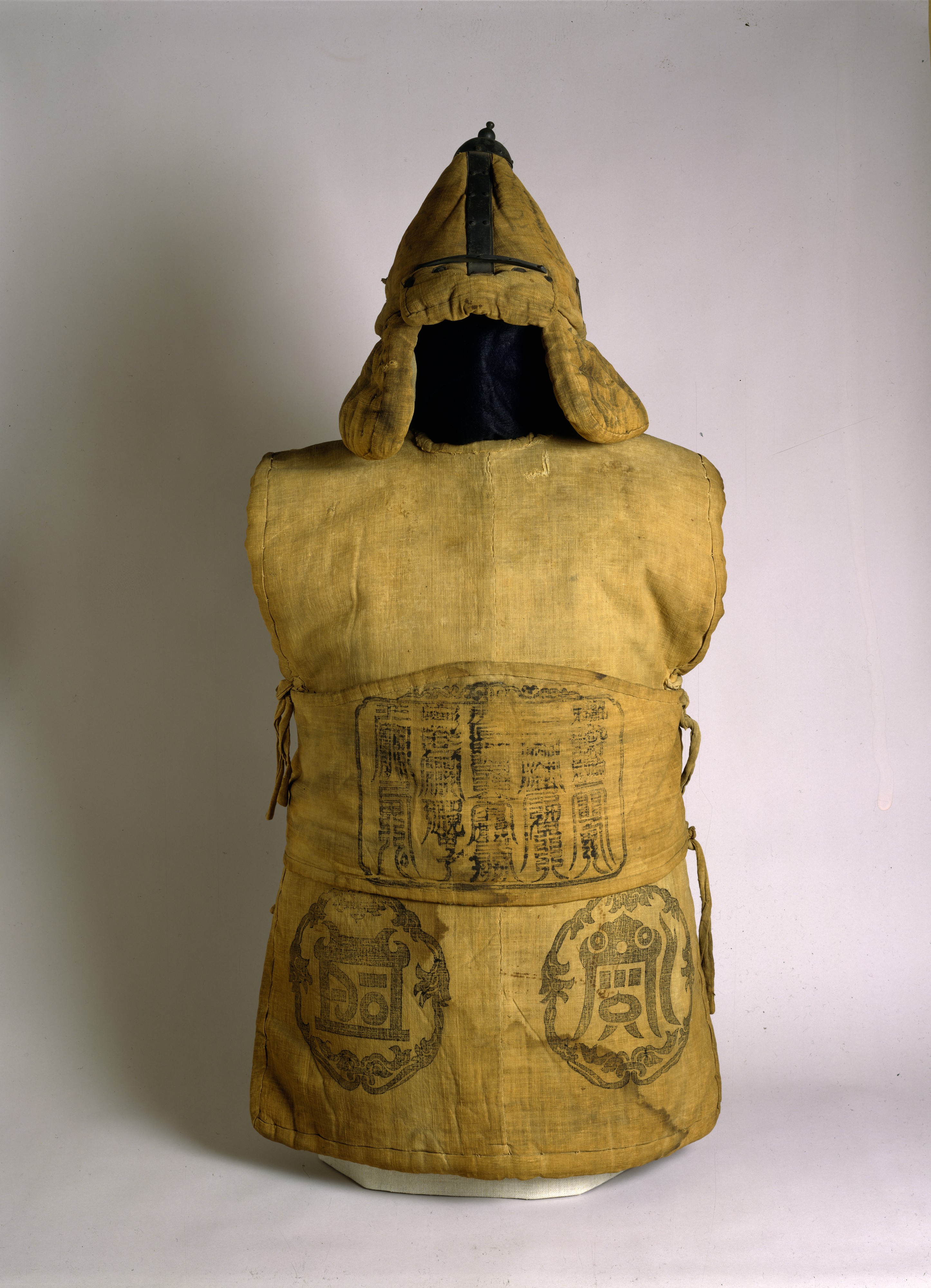
Heritage Analysis: Fabric Armor and Helmet with Buddhist and Taoist Symbols
Introduction: The Convergence of Spirituality and Martial Protection
The subject of this analysis is a rare Korean fabric armor and helmet ensemble, dated approximately to the late Joseon Dynasty (17th–19th centuries). Constructed from cotton, hemp, copper alloy, and iron, this artifact transcends its functional purpose as military equipment. It serves as a profound testament to the syncretic spiritual identity of the Korean warrior class, where Buddhist and Taoist symbols were interwoven into the very fabric of protection. For Katherine Fashion Lab, this piece represents a strategic wellspring for a 2026 high-end luxury strategy, offering a blueprint for integrating spiritual depth, historical narrative, and material craftsmanship into modern adornment.
Materiality and Craft: The Language of Textile Armor
Cotton and hemp form the foundational layers of this armor, chosen for their breathability, durability, and symbolic resonance. In Korean tradition, hemp was associated with purity and resilience, often used in ritual garments. The copper alloy and iron components—rivets, scales, and helmet plates—were not merely functional but were imbued with metaphysical properties. Copper was believed to repel malevolent spirits, while iron symbolized unyielding strength. This deliberate material selection transforms the armor into a spiritual barrier, where the physical defense of the body is inseparable from the protection of the soul.
From a luxury strategy perspective, the use of natural fibers and patinated metals aligns with the 2026 trend toward sustainable heritage materials. High-end consumers increasingly seek objects that tell a story of origin and transformation. The armor’s combination of soft textile and hard metal—a tactile dialogue between vulnerability and strength—offers a powerful design language for hybrid luxury pieces, such as structured jackets with metal filigree or helmets reimagined as sculptural headpieces.
Symbolic Power: Buddhist and Taoist Iconography
The armor’s surface is adorned with a complex lexicon of symbols. Buddhist motifs include the lotus, representing enlightenment arising from impurity; the endless knot, signifying interconnectedness and eternal wisdom; and dharma wheels, denoting the cyclical nature of life and the path to liberation. These symbols were strategically placed over vital organs—the heart, lungs, and spine—to spiritually fortify the wearer against both physical and karmic harm.
Taoist symbols complement this Buddhist foundation. The Bagua (eight trigrams) and Yin-Yang emblem appear on the helmet, channeling cosmic balance and the flow of qi (vital energy). The trigrams were believed to deflect negative forces and align the warrior with the natural order. The integration of these two belief systems reflects Korea’s historical religious syncretism, where Buddhism and Taoism coexisted and enriched each other, particularly among the elite military class.
For Katherine Fashion Lab, this symbolic layering offers a narrative architecture for luxury collections. Each symbol can be deconstructed and recontextualized as a signature emblem—embroidered on linings, etched into hardware, or woven into jacquard patterns. The key is to preserve the spiritual weight of these symbols while translating them into a contemporary visual language. For example, the lotus could be rendered as a minimalist, geometric motif on a silk scarf, while the endless knot becomes a structural detail in a leather handbag’s stitching.
Historical Adornment: The Warrior as a Spiritual Icon
In Joseon Korea, armor was not merely utilitarian; it was a ceremonial object that signified the wearer’s rank, lineage, and moral authority. The inclusion of Buddhist and Taoist symbols elevated the warrior from a mere combatant to a guardian of cosmic order. Historical records indicate that such armor was often blessed by monks before battle, and the symbols were intended to invoke divine protection and moral clarity. The helmet, in particular, was a focal point of spiritual power, often featuring a crest or finial shaped like a lotus bud or a Taoist immortal’s hat.
This concept of adornment as spiritual armor resonates deeply with the modern luxury consumer’s search for meaning. In 2026, high-end fashion is projected to move beyond aesthetic appeal toward functional spirituality—pieces that offer psychological protection, empowerment, or meditative focus. Katherine Fashion Lab can leverage this by designing amuletic accessories: a copper alloy bracelet inscribed with the Bagua, a hemp scarf embroidered with lotus sutras, or a helmet-inspired headpiece that doubles as a meditation aid. The narrative would position each piece as a talisman for the modern warrior—the business executive, the activist, the artist—who faces their own battles.
Spiritual Meaning: The Armor as a Meditative Object
The armor’s spiritual function extended beyond battle. It was also worn during ritual dances, ancestral ceremonies, and royal processions, where the symbols served as focal points for meditation and prayer. The repetitive patterns of the trigrams and lotus petals were designed to induce a calm, focused state, aligning the wearer’s mind with the divine. This dual purpose—protection and meditation—offers a unique product positioning for luxury goods: wearable sanctuaries.
For the 2026 strategy, Katherine Fashion Lab could develop a capsule collection titled “Armor of the Soul,” featuring pieces that are both aesthetically striking and spiritually functional. A tailored jacket might include a hidden pocket for a small prayer scroll, while a helmet-shaped hat could be lined with copper alloy plates for thermal regulation and qi conduction. The marketing narrative would emphasize the ritual of dressing—each piece donned as an act of self-empowerment and spiritual centering.
2026 High-End Luxury Strategy: Translating Heritage into Market Leadership
To position Katherine Fashion Lab at the forefront of 2026 luxury, this heritage analysis informs a three-pronged strategy:
1. Narrative-Driven Product Development: Each collection should be anchored by a historical artifact narrative, such as this armor, with every material and symbol explained in a digital heritage dossier (QR code on the garment tag). This transparency appeals to the educated, ethically conscious consumer who values provenance over trend.
2. Material Innovation with Spiritual Intent: Collaborate with Korean artisans to source organic hemp and cotton, and commission custom copper alloy hardware that ages gracefully. Introduce “spiritual finishes”—such as lotus-embossed leather or trigram-engraved zippers—that add tactile and visual depth. The 2026 luxury consumer will pay a premium for imperfect, handcrafted details that carry cultural authenticity.
3. Experiential Retail and Brand Rituals: Launch the collection with an immersive exhibition that recreates a Joseon warrior’s tent, complete with incense, meditation cushions, and a curator explaining the symbols. Offer personalization services where customers can choose a specific Buddhist or Taoist symbol to be embroidered onto their garment, turning the purchase into a ritual of intention. This transforms the transaction into a spiritual experience, building deep brand loyalty.
Conclusion: Armor as a Living Legacy
The Korean fabric armor and helmet with Buddhist and Taoist symbols is not a relic of the past but a living design philosophy. It teaches that true luxury lies in the intersection of material mastery, spiritual depth, and protective function. For Katherine Fashion Lab, this artifact provides a strategic foundation for 2026: a collection that does not merely clothe the body but fortifies the spirit. By honoring the syncretic wisdom of the Joseon warrior, the brand can lead a new paradigm of high-end fashion—one where every stitch, every symbol, and every metal rivet carries the weight of history and the promise of inner strength.