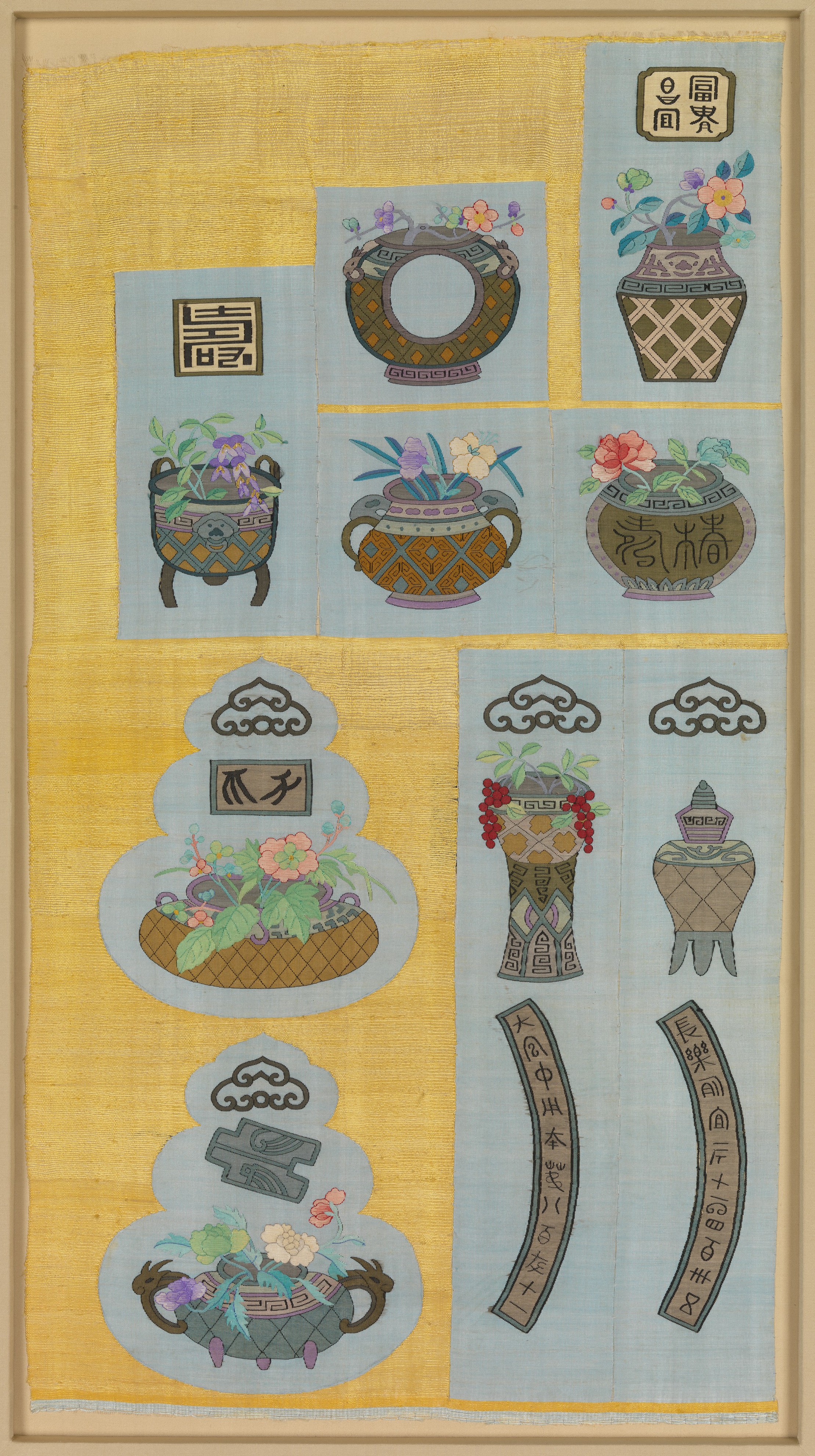
Deconstructing the Lexicon of Luxury: A Curatorial Analysis of the "Hundred Antiques" Panel
In the rarefied atmosphere of haute couture and collectible objet d'art, few artifacts possess the layered narrative depth and technical virtuosity of the Chinese kesi panel with a set of purses themed on the "Hundred Antiques" (Bai Gu Tu). This standalone study, emerging from the ateliers of historical China and crafted in silk and metallic-thread tapestry, presents not merely a decorative ensemble but a sophisticated cipher of cultural capital, scholarly idealism, and consummate craftsmanship. For Katherine Fashion Lab, this piece serves as a paramount case study in how materiality, motif, and meticulous execution converge to create an enduring language of luxury that transcends mere utility.
The Kesi Technique: Where Loom Becomes Brush
To appreciate the panel's significance, one must first understand its foundational medium: kesi, often translated as "cut silk." This is a misnomer that belies its revolutionary nature. Unlike continuous-weft brocades, kesi is a tapestry technique utilizing a plain weave loom but employing discontinuous wefts. This method allows each color area to be woven independently, creating sharp, painterly delineations without a reverse-side float. The result is a textile of astonishing pictorial clarity and a subtle, slit-seamed texture. The introduction of metallic threads—often fine strips of gilded paper wound around a silk core—elevates the work from a skilled craft to a luxury commodity. These threads catch the light dynamically, animating the static panel with a lifelike shimmer, a testament to the artisan's ability to manipulate perception through material innovation. The technical restraint required, with each color change representing a deliberate, time-intensive decision, mirrors the precision of a master engraver or painter, positioning the weaver as an artist in direct dialogue with the most revered cultural forms.
Decoding the "Hundred Antiques" Motif: A Semiotics of Erudition
The theme of the "Hundred Antiques" is far from a random assemblage of valuable objects. It is a carefully curated iconographic program rooted in the literati culture of Ming and Qing Dynasty China. The "antiques" (gu wan) depicted—which may include archaic bronze vessels (ding, zun), ritual jades, scholar's rocks (gongshi), ancient scrolls, inkstones, bronzes, and rare ceramics—are not depicted for their material worth alone. They function as symbolic vessels of historical continuity, moral integrity, and refined taste. Each object carries a specific allusion: a bronze tripod evokes the wisdom of ancient sage-kings; a cracked-ice patterned porcelain bowl references literary elegance; a Ru ware piece signifies unimpeachable quality.
This panel, therefore, operates as a visual library of cultural literacy. Its owner or giver communicated a profound alignment with scholarly values, asserting status not through overt wealth but through discernment and intellectual heritage. In a modern couture context, this translates to a narrative-driven luxury, where value is accreted through story, reference, and symbolic density rather than logo-centric display. The set of accompanying purses transforms this symbolism into a portable, personal gallery, allowing the bearer to literally carry this lexicon of erudition, integrating it into the daily performance of identity.
Structural Analysis: Panel and Purses as Integrated System
The composition of the panel as a standalone study is critical. It suggests it was intended for contemplative appreciation, much like a painting or a rare manuscript. The arrangement of the antiques is likely neither chaotic nor purely symmetrical, but follows a rhythm that balances visual weight, creates dialogues between forms, and leads the viewer’s eye on a journey of discovery. This deliberate composition reflects a fundamental principle of both classical aesthetics and strategic design: the management of attention and the creation of hierarchy.
The derivation of smaller purses from this larger panel introduces a fascinating design economy. It implies a master plan where the larger artwork is deconstructed into wearable, functional derivatives. This could be seen as an early precursor to the modern fashion system of capsule collections or art-to-wear movements. Each purse becomes a unique excerpt from the main text, a fragment containing the essence of the whole. The decision of which antique motif adorned which purse would have been a further exercise in curatorship, perhaps matching the object's symbolism to the purse's intended use or recipient.
Contemporary Relevance: Lessons for the Modern Maison
For a forward-looking institution like Katherine Fashion Lab, this historical artifact offers potent strategic insights. Firstly, it exemplifies deep-brand storytelling long before the term existed. The value proposition is inseparable from a complex, culturally-grounded narrative. Secondly, it demonstrates integrated product ecosystem development. The panel (a statement art piece) and the purses (accessible, functional luxuries) cater to different but interconnected modes of consumption and engagement, broadening audience reach while maintaining thematic coherence.
Most importantly, it champions a luxury paradigm based on knowledge, authenticity, and artisan-led innovation. In an era seeking substance over superficiality, the "Hundred Antiques" panel reminds us that true luxury resonates when it serves as a conduit for cultural intelligence and human ingenuity. The kesi technique, with its painstaking, non-mechanizable process, stands as a defiant benchmark for quality in a world of rapid replication. This study concludes that the most enduring luxury objects are those that successfully encode a world of meaning into their very fibers, inviting endless decryption and, in doing so, achieving timeless relevance. The panel is not just a beautiful object; it is a thesis on the art of meaningful creation.