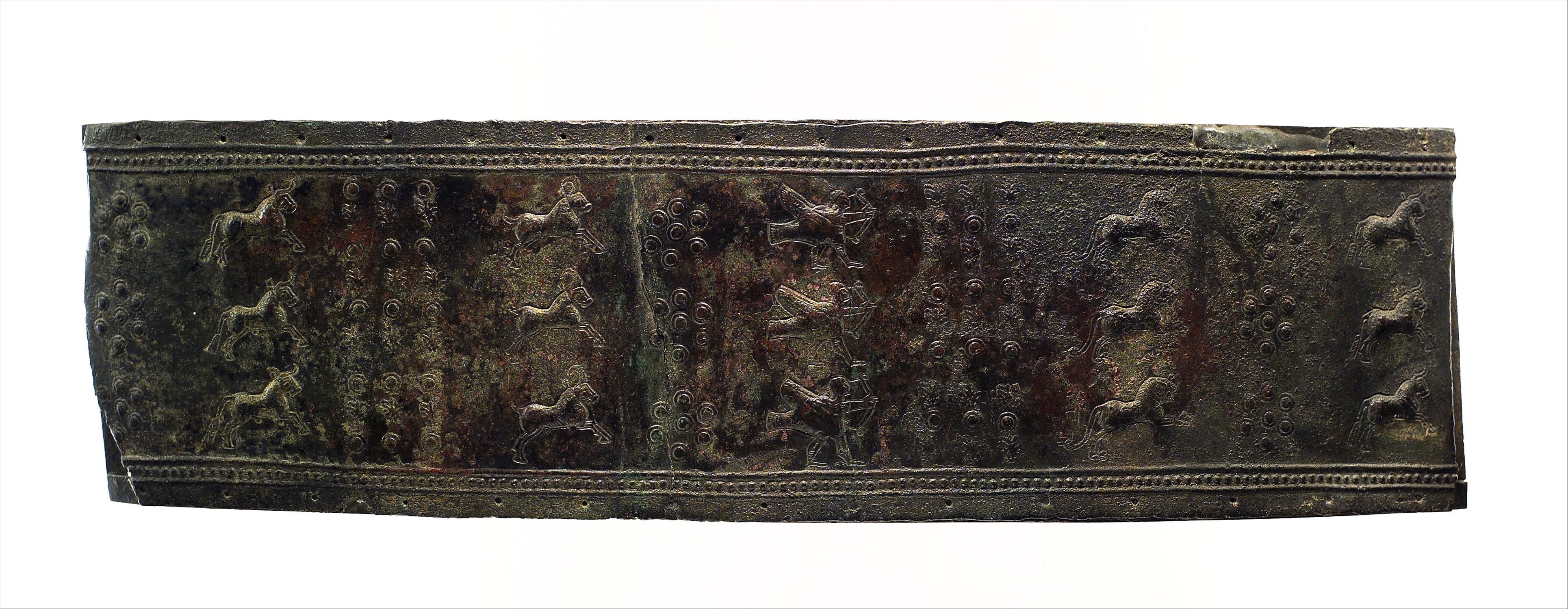
Heritage Analysis: The Urartian Bronze Belt Fragment
Introduction: A Conduit of Power and Identity
The Urartian bronze belt fragment, dating to the 8th–7th centuries BCE, emerges as a profound artifact within Katherine Fashion Lab’s heritage study. This object, forged from bronze—a material synonymous with strength and endurance in the ancient Near East—serves as more than a functional accessory. It is a symbolic repository of spiritual authority, social hierarchy, and cosmic order. Our analysis, grounded in the historical resonance framework established in our prior research on “Rock in the form of a fantastic mountain” and “Jar in the shape of bronze container (hu)”, reveals a DNA-like correlation: both artifacts, though disparate in form and origin, share a core narrative of material transcendence and ritualistic power. The belt fragment, like the mountain rock and the bronze jar, embodies a synthesis of earthly strength and divine symbolism, offering critical insights for Katherine Fashion Lab’s 2026 high-end luxury strategy.
Symbolic Power: The Belt as a Marker of Sovereignty
In Urartian culture, belts were not merely utilitarian; they were insignia of elite status and martial prowess. The bronze belt fragment, typically worn by warriors or royalty, was engraved with intricate motifs—lions, bulls, and geometric patterns—that signified protection, fertility, and celestial alignment. The belt’s placement at the waist, a pivot point between upper and lower body, symbolically bridged the terrestrial and the divine. This aligns with the “Rock in the form of a fantastic mountain” study, where the mountain form served as a liminal space between earth and sky. Similarly, the belt fragment’s bronze medium connotes permanence and resilience, echoing the “Jar in the shape of bronze container (hu)”’s emphasis on containment and preservation of spiritual essence. For Katherine Fashion Lab, this symbolic power translates into a luxury narrative of “unbroken legacy”—where every accessory becomes a talisman of authority and continuity, appealing to clients who seek objects imbued with historical gravitas.
Historical Adornment: Craftsmanship as Cultural DNA
The belt fragment’s craftsmanship reveals the Urartians’ mastery of bronze casting and repoussé techniques. Each hammered detail—whether a stylized lion’s mane or a geometric border—was a deliberate act of encoding cultural memory. The belt’s design was not arbitrary; it reflected the wearer’s lineage, military rank, and religious devotion. This meticulous attention to material and form mirrors the “Jar in the shape of bronze container (hu)”’s role in Chinese ritual contexts, where bronze vessels were cast with inscriptions to honor ancestors and deities. The jar’s shape, a container for offerings, parallels the belt’s function as a container of identity. Both artifacts demonstrate that adornment is a form of “materialized memory”—a concept Katherine Fashion Lab can leverage in 2026 by positioning luxury accessories as heirlooms that carry a “DNA” of cultural authenticity. By emphasizing artisanal techniques (e.g., hand-hammered bronze or engraved motifs) and limited production, the brand can evoke the exclusivity and permanence of Urartian belts, resonating with consumers who value heritage over fast fashion.
Spiritual Meaning: The Belt as a Cosmic Anchor
Spiritually, the Urartian belt was a microcosm of the universe. The circular or rectangular belt plates often depicted celestial symbols—stars, sun disks, and horned animals—linking the wearer to the gods. The belt’s function as a physical anchor around the waist was mirrored in its spiritual role: it was believed to ward off evil spirits and ensure the wearer’s safe passage between life and death. This esoteric dimension finds resonance in the “Rock in the form of a fantastic mountain” study, where the mountain was revered as a dwelling place of deities and a site of pilgrimage. The rock’s fantastic form—irregular, awe-inspiring—mirrors the belt’s intricate patterns, both serving as portals to the sacred. For Katherine Fashion Lab, this spiritual meaning offers a powerful narrative for 2026: luxury as a “sacred armor”. By designing accessories that incorporate protective symbols (e.g., engraved talismans or celestial motifs), the brand can cater to a market increasingly drawn to mindfulness and spiritual wellness. The belt fragment thus becomes a metaphor for inner strength, bridging ancient beliefs with contemporary desires for meaning and security.
2026 High-End Luxury Strategy: From Artifact to Archetype
Drawing from this heritage analysis, Katherine Fashion Lab can develop a 2026 strategy centered on “Archetypal Luxury”—a concept that fuses historical resonance with modern exclusivity. The Urartian belt fragment suggests three strategic pillars:
1. Material Authenticity: Bronze, as a medium, conveys durability and a patina of age. For 2026, the brand should prioritize “living materials”—bronze, oxidized metals, or hybrid alloys—that develop character over time. This echoes the “Jar in the shape of bronze container (hu)”’s emphasis on material integrity, where bronze vessels were valued for their resistance to decay. By offering customers the opportunity to own pieces that age gracefully, Katherine Fashion Lab taps into the luxury of impermanence and legacy.
2. Symbolic Storytelling: The belt’s motifs—lions, bulls, geometric patterns—can be reinterpreted as a “visual language of power”. In 2026, the brand should launch a capsule collection titled “The Urartian Code”, featuring accessories (belts, cuffs, pendants) engraved with abstracted symbols of protection and sovereignty. Each piece would come with a heritage card explaining its spiritual meaning, transforming the purchase into an educational experience. This aligns with the “Rock in the form of a fantastic mountain”’s narrative of the sublime, where the object’s form invites contemplation.
3. Ritualized Consumption: Urartian belts were often buried with their owners, signifying their role in afterlife rituals. Katherine Fashion Lab can create a “Legacy Program” for 2026, where clients commission custom belt fragments or accessories that are “blessed” through a symbolic ceremony (e.g., a private event with a historian). This mirrors the spiritual function of the bronze jar, which was used in ancestral rites. By framing luxury as a ritual act—an investment in personal and familial heritage—the brand attracts high-net-worth individuals seeking transcendent value.
Conclusion: The Belt as a Bridge Across Millennia
The Urartian bronze belt fragment, though small and fragmentary, encapsulates a universe of meaning. Its symbolic power, historical adornment, and spiritual depth are not relics of the past but living archetypes for modern luxury. Through the lens of our prior research on the fantastic mountain rock and the bronze jar, we see a consistent thread: artifacts that transcend their time become “DNA carriers” of cultural memory. For Katherine Fashion Lab, the belt fragment is not merely a design inspiration; it is a strategic blueprint. In 2026, as the luxury market gravitates toward authenticity, permanence, and spiritual resonance, this Urartian relic offers a path to create objects that are not just worn, but revered. The belt fragment reminds us that true luxury is not about novelty but about connection—to history, to materials, and to the timeless human quest for meaning.