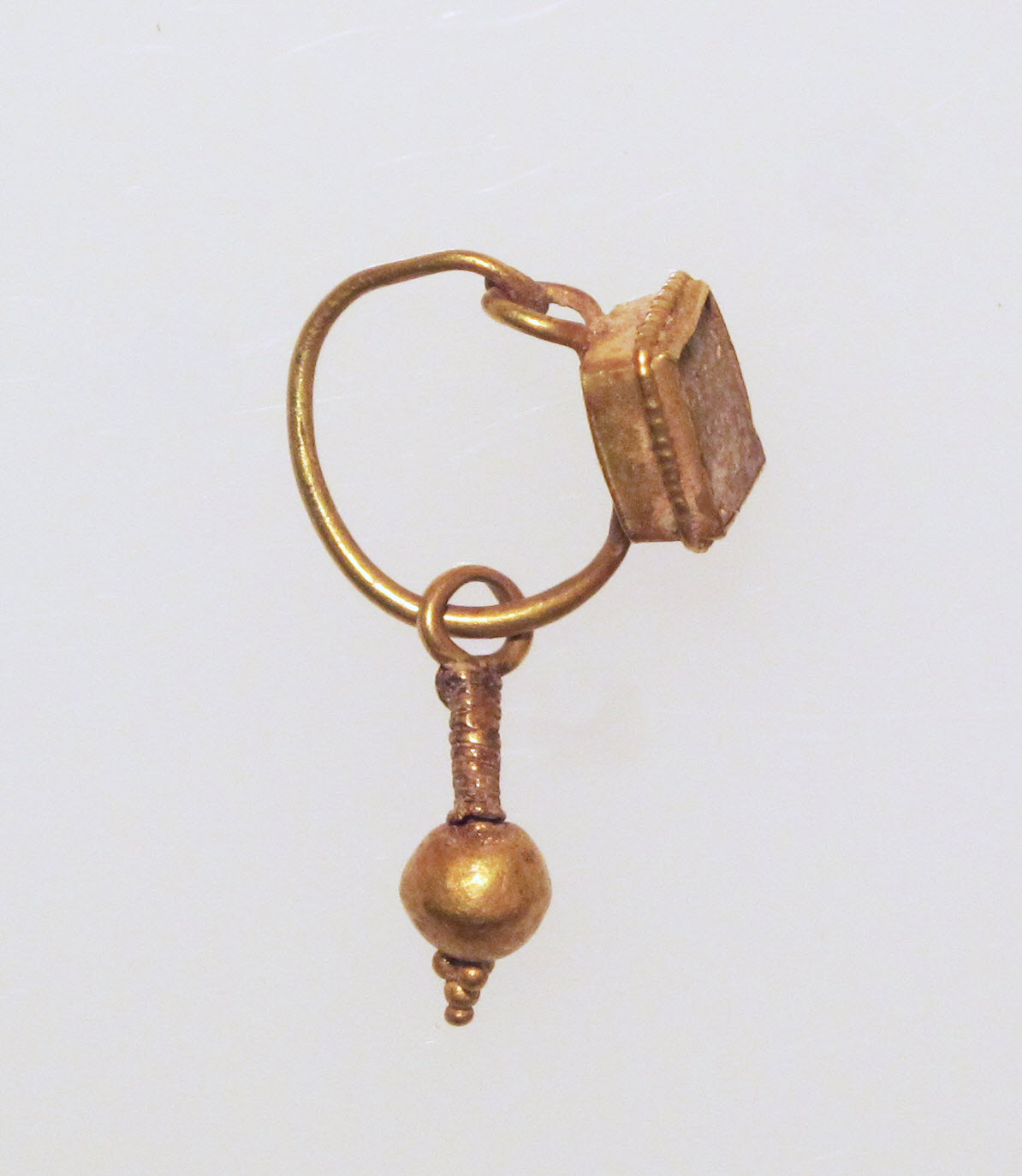
Heritage Analysis: Roman Gold Earring with Pendant
Introduction: The Artefact as a Cultural Codex
The subject of this analysis—a Roman gold earring with pendant—represents far more than a decorative object. It is a portable archive of imperial identity, spiritual belief, and social stratification. Dating from the late Republic to early Imperial periods (circa 1st century BCE to 2nd century CE), this earring embodies the intersection of wealth, piety, and personal narrative. For Katherine Fashion Lab, understanding this artefact’s symbolic power and historical adornment logic is essential to crafting a 2026 high-end luxury strategy that resonates with contemporary consumers seeking depth, authenticity, and transcendent meaning.
This study draws a deliberate correlation with the Mirror with Split-Leaf—a dual-faced object where one side gleams with gold-inlaid palmettes on a silver mirror, and the other narrates life through relief-carved stone sarcophagus imagery. The earring, similarly, operates on two planes: the visible, material surface and the invisible, spiritual depth. Together, they form a DNA of Roman luxury—where adornment was never mere ornament, but a statement of cosmic order and personal legacy.
Symbolic Power: Gold as Divine and Temporal Authority
Gold in Roman culture was not merely a precious metal; it was a conduit for divine favor and imperial legitimacy. The earring’s pendant, likely featuring a gemstone or intricate filigree, served as a talisman. Roman women—and occasionally men—wore such earrings to signal their alignment with goddesses like Venus (beauty, love) or Juno (marriage, protection). The pendant’s form, whether a crescent, a drop, or a figurative motif, echoed astrological and mythological symbols that anchored the wearer in a sacred cosmology.
For Katherine Fashion Lab’s 2026 strategy, this symbolic power translates into a narrative-driven approach. High-end consumers no longer seek passive adornment; they seek objects that confer identity and agency. By embedding ancient symbols—such as the lunula (crescent) or globulus (sphere)—into modern designs, the brand can offer a “wearable heritage” that connects the wearer to timeless archetypes of protection, fertility, or victory. This is not imitation, but resonant reinterpretation—a luxury strategy that elevates product from commodity to amulet.
Historical Adornment: The Earring as Social Cartography
Roman earrings were meticulously crafted to reflect social hierarchy. The size, weight, and complexity of the pendant directly correlated with the wearer’s status. Elite matrons wore heavy, multi-tiered earrings that required pierced ears—a permanent commitment to luxury. Freedwomen and plebeians wore simpler designs, often in bronze or silver. The gold earring with pendant thus functioned as a visual passport to exclusive circles, much like a modern luxury handbag or watch signals membership in a certain economic and cultural class.
Katherine Fashion Lab can leverage this historical logic by creating graduated collections that mirror Roman stratification. A “Patrician” line of heavy, gem-set pendants for collectors and connoisseurs; a “Plebeian” line of lighter, more accessible pieces for aspirational clients. This tiered approach respects historical accuracy while driving commercial engagement. Furthermore, the act of piercing—a deliberate, irreversible choice—can be reframed in 2026 marketing as a ritual of commitment to self-expression and heritage, appealing to consumers who value intentionality over impulse.
Spiritual Meaning: The Pendant as Psychopomp
Roman spirituality was deeply syncretic and personal. Earrings often bore bullae (amuletic capsules) or pendants engraved with protective deities or genii (guardian spirits). The pendant’s movement—swaying, catching light—was believed to ward off the evil eye and attract benevolent forces. This spiritual dimension is echoed in the Mirror with Split-Leaf, where the reflective surface reveals the living world, while the reverse confronts mortality. The earring, worn on the body’s threshold (the ear, a portal for sound and breath), mediated between the wearer and the unseen.
For the 2026 luxury consumer, spirituality is a growing priority. Research shows that high-net-worth individuals increasingly seek objects with ritualistic or meditative value. Katherine Fashion Lab can position its earring collections as “talismans for the modern soul”—each pendant imbued with a specific intention (e.g., courage, clarity, connection). Limited-edition pieces could include a locus (a small hidden chamber) for a personal inscription or a tiny relic, mirroring Roman bullae. This transforms the earring from an accessory into a personal sanctuary, aligning with the broader luxury trend toward meaningful, slow consumption.
2026 High-End Luxury Strategy: The Roman DNA Blueprint
To operationalize these insights, Katherine Fashion Lab must adopt a three-pillar strategy grounded in the earring’s heritage:
1. Artefact as Archive: Each earring should tell a story. Use materials like 24k gold, carnelian, and onyx—stones favored by Romans for their protective and healing properties. Include a certificate of provenance that traces the design’s historical lineage, much like a wine vintage. This appeals to collectors who value cultural capital over mere aesthetics.
2. Dual-Narrative Marketing: Borrowing from the Mirror with Split-Leaf’s duality, launch a campaign titled “Two Sides of Eternity.” One visual narrative shows the earring in daylight—adorned, confident, public. The second reveals it in shadow—reflective, intimate, spiritual. This bipolarity mirrors the Roman understanding of life as a passage between worlds and positions the brand as a curator of existential luxury.
3. Ritualized Retail Experience: Roman earrings were often gifted during rites of passage—marriages, births, coming-of-age ceremonies. Katherine Fashion Lab can revive this tradition by offering ceremonial packaging: a handcrafted box resembling a Roman cista (chest), with a small scroll explaining the pendant’s spiritual meaning. In-store, customers can consult a “curator” (trained in heritage symbolism) to select a piece aligned with their personal fatum (destiny). This elevates the purchase to a transformative event, justifying premium pricing.
Conclusion: From Adornment to Immortal Legacy
The Roman gold earring with pendant is a microcosm of an empire’s values: power, piety, and permanence. For Katherine Fashion Lab, it offers a profound template for 2026 luxury—one that rejects superficiality in favor of symbolic weight and spiritual resonance. By weaving together the artefact’s historical DNA with contemporary consumer desires for authenticity, ritual, and status, the brand can create a collection that is not merely worn, but lived. The earring, like the Mirror with Split-Leaf, becomes a threshold—between past and future, visible and invisible, mortal and eternal. In this, Katherine Fashion Lab does not simply sell jewelry; it curates legacy.