The Annie Robe: Deconstructing Narrative and National Identity in the Duke Cigarette Lithograph
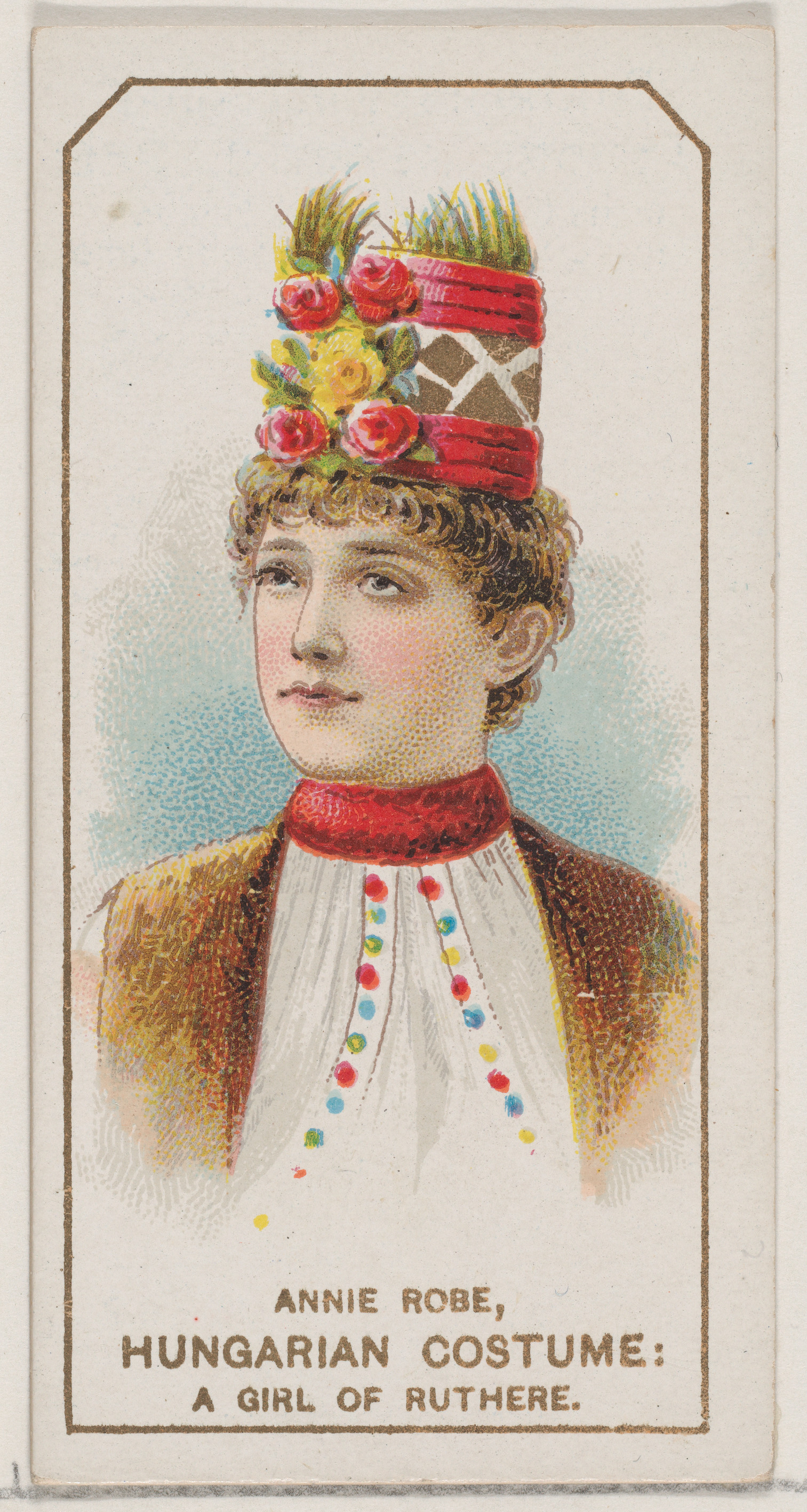
In the vast archive of late 19th-century commercial ephemera, the Duke brand cigarette card series, *Actors and Actresses, Second Series (N71)*, occupies a peculiar intersection of mass production, theatricality, and nascent global cultural curiosity. Among its most compelling subjects is the “Annie Robe in Hungarian Costume of a Girl of Ruthere.” At first glance, this commercial color lithograph appears to be a straightforward, if stylized, ethnographic portrait. Yet, for the contemporary fashion theorist and couture analyst, the image offers a rich, layered text—one that demands a rigorous deconstruction of its sartorial semiotics, its role in constructing a commodified “global heritage,” and its function as a standalone artifact of identity performance.
The lithograph, a product of the Duke tobacco company’s aggressive marketing strategy, was never intended as an academic anthropological record. Instead, it was a tool of brand differentiation, leveraging the burgeoning public fascination with both celebrity and exoticism. The subject, Annie Robe, is not a folkloric subject but a professional performer. This distinction is critical. The “costume” she wears is not a garment of daily life in the Hungarian region of Ruthere (likely a contemporary misspelling or anglicization of a region such as Ruthenia or the Carpathian basin). It is a stage costume, a hyper-stylized signifier designed to be read from a distance, to telegraph “Hungarian-ness” and “folk authenticity” to a Western, urban audience. The garment’s relationship to authentic regional dress is therefore one of deliberate abstraction and condensation.
Sartorial Semiotics: The Elements of the “Ruthere” Costume
A rigorous analysis of the Annie Robe lithograph must begin with the garment’s constituent parts, as reproduced through the commercial color lithograph process. The medium itself imposes a specific aesthetic: flat fields of saturated color, sharp outlines, and a deliberate lack of fine textile texture. This flattening is not a limitation but a feature. It transforms the three-dimensional garment into a two-dimensional emblem, a visual logo for a “folk” identity.
The most dominant element is the bodice. It is typically depicted as a richly embroidered, closely fitted jacket, often in a deep, vibrant hue such as crimson, emerald, or sapphire. This is not a garment of labor but of display. The embroidery, rendered as repetitive geometric and floral motifs, is a code for regional craftsmanship. In the context of the Duke card, this embroidery becomes a signifier of “authenticity” and “value,” suggesting a garment that is painstakingly handmade and therefore precious. The strong, cinched waist, a hallmark of Western Victorian fashion, is also present, suggesting a hybridity. The costume is not a pure ethnographic artifact but a fusion of the performer’s own era’s silhouette with the “exotic” surface decoration. The neckline is often low and square, framing the face and collarbone, a feature that serves both theatrical visibility and a subtle eroticization of the “peasant” subject.
Beneath the bodice, multiple layers of skirts are evident. These are not the narrow, bustled skirts of contemporary European fashion but full, gathered, and often heavily flounced skirts. The lithograph captures this fullness through a cascade of horizontal bands of color and pattern. Each band might represent a different fabric, a different trimming, or a different embroidered insert. This layering is a key signifier of wealth and folk tradition. In actual Hungarian folk costume, the number of petticoats and the breadth of the skirt were direct indicators of the wearer’s status and the occasion. In the lithograph, this complexity is simplified into a graphic rhythm, a visual shorthand for “abundance” and “tradition.” The skirt is often ankle-length, revealing sturdy, decorated boots or shoes, grounding the figure in a sense of rural practicality, even as the overall ensemble is clearly designed for the stage.
Accessories in the lithograph are critical. A large, elaborate headpiece is almost always present. It may be a tiara-like structure adorned with ribbons, beads, and feathers, or a more structured cap with long, trailing streamers. This headdress is the most potent symbol of national or regional identity. It immediately distinguishes the “Girl of Ruthere” from a generic “peasant girl.” The headdress is a crown, a marker of a specific ceremonial or marital status, and in the context of the cigarette card, it is the ultimate visual hook. Similarly, the inclusion of a large, fringed shawl or a heavy, embroidered apron adds another layer of textural and symbolic complexity. The apron, often heavily decorated, is a device that visually centers the figure, drawing the eye to the waist and the hands. It is a signifier of domesticity and productivity, even within the frame of performance.
Global Heritage as Commercial Fabrication
The Duke cigarette card series, including the Annie Robe lithograph, is a prime example of what might be termed “commercialized global heritage.” The company did not commission original research. Instead, it likely sourced its imagery from existing theatrical publicity photographs, illustrated books of national costumes, or studio portraits of performers in “ethnic” dress. The resulting lithograph is a compilation, a second-order representation. The “Hungarian Costume of a Girl of Ruthere” is therefore not a direct window into a specific cultural practice but a Western, commercial, and theatrical interpretation of that practice.
This process of fabrication has profound implications for how we understand the garment. The lithograph’s primary function was to be collected, traded, and displayed. The costume, frozen in a flat, glossy image, becomes a collectible object itself. Its value is not in its material (paper and ink) but in its ability to evoke a fantasy of a pre-industrial, colorful, and authentic world. For the American or British consumer of the 1880s, this image of a Hungarian girl in elaborate folk dress offered a safe, contained form of cultural tourism. It was a taste of the exotic without the discomfort of actual travel or cultural immersion. The “global heritage” on display is thus a carefully curated, sanitized, and aestheticized version of reality, designed to be pleasing, intriguing, and non-threatening.
The standalone nature of the study—a single card, removed from its series—further amplifies this effect. Without the context of the other cards (which might feature French, Japanese, or Scottish costumes), the Annie Robe image stands alone as a complete, self-contained statement. The viewer is not encouraged to compare or contrast but to simply gaze upon a singular, idealized representation. This isolation reinforces the objectification of the subject and the garment. The costume becomes a pure sign, a visual shorthand for “Hungary” that can be consumed in a glance.
Conclusion: The Ghost of the Garment
The Annie Robe lithograph from the Duke cigarette series is far more than a quaint historical artifact. It is a sophisticated exercise in the construction of identity through sartorial means, operating within the constraints of commercial mass production and theatrical spectacle. The “costume of a girl of Ruthere” is a garment that never truly existed in the way it is depicted. It is a hybrid, a synthesis of real folk elements, stagecraft necessities, and commercial aesthetic preferences. Its value for the modern couture analyst lies in this very hybridity. It demonstrates how fashion and dress are always entangled with systems of power, representation, and commodification.
The strong, vibrant colors, the geometric embroidery, the layered skirts, and the elaborate headdress are not simply decorative details. They are the building blocks of a narrative—a narrative of a timeless, authentic, and exotic “other” that was packaged and sold to a mass audience. The lithograph captures the ghost of a garment, a spectral presence that gestures toward a real material culture while simultaneously transforming it into a marketable image. In its flat, two-dimensional form, the Annie Robe endures as a powerful testament to the ways in which fashion, even in its most commercialized and mediated forms, continues to be a primary vehicle for the expression and invention of cultural identity. The card invites us to question not what the costume *was*, but what it was made to *mean*—a question that remains profoundly relevant in our own era of globalized, image-driven fashion.