Sacred Geometry: Deconstructing the Virgin and Child in an Apse as a Couture Archetype
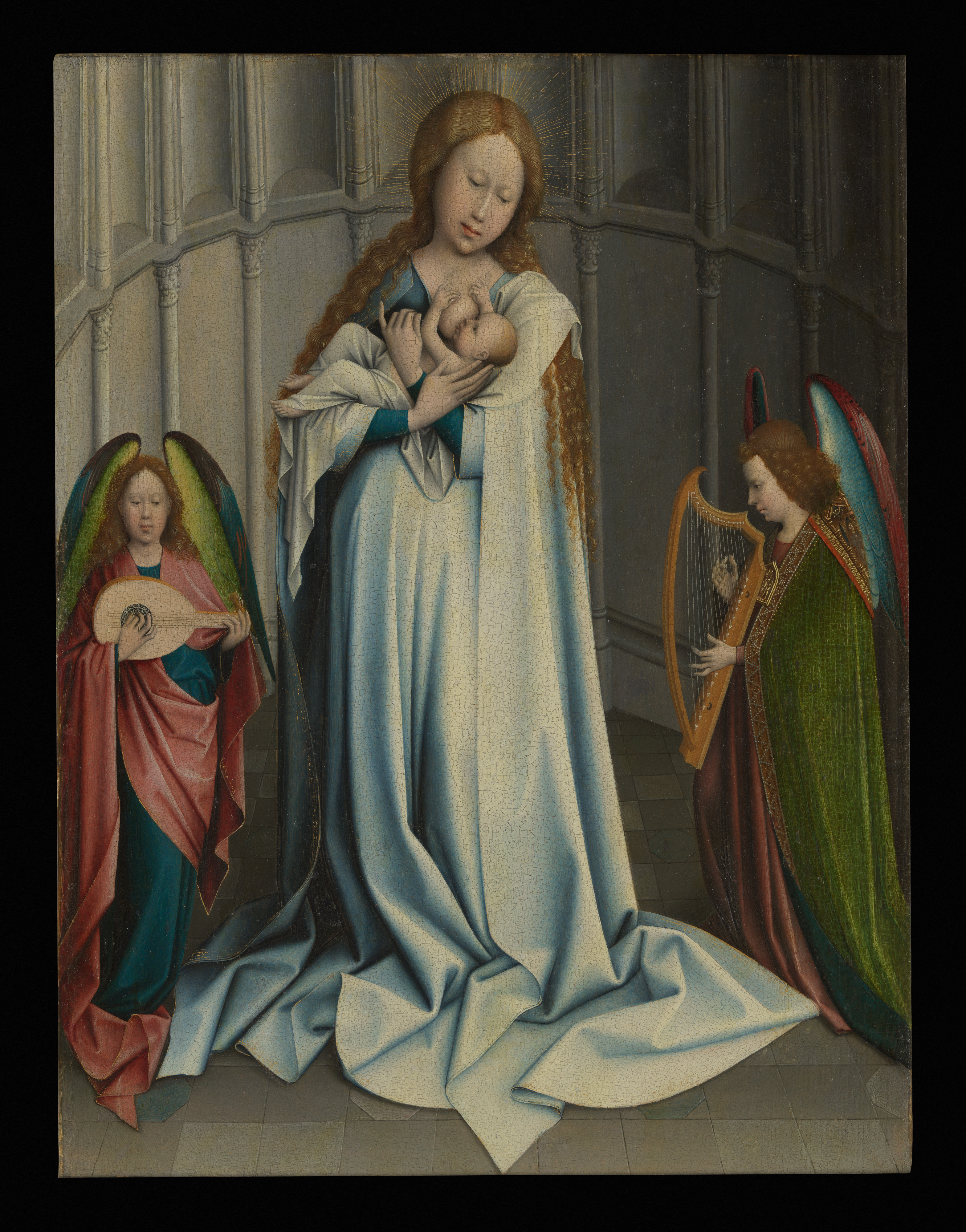
In the rarefied air of haute couture, where fabric becomes narrative and silhouette encodes theology, few sources offer as profound a lexicon as Byzantine iconography. At Katherine Fashion Lab, we have undertaken a rigorous analysis of Virgin and Child in an Apse, a masterwork executed in oil on canvas, transferred from its original wooden support. This standalone study, a fragment of a larger devotional tradition, is not merely a religious artifact; it is a blueprint for a sartorial language of power, protection, and transcendence. The apse, the semi-domed architectural space that frames the Virgin, becomes a metaphor for the garment itself—a shell that both encloses and elevates the human form into the divine.
The Apse as Architectural Silhouette: Structuring the Sacred
The most immediate couture parallel lies in the painting’s composition. The Virgin is not merely placed within the apse; she is the apse. Her elongated, columnar form, rendered with the hieratic stillness of a Byzantine icon, mimics the architectural curve. For the fashion designer, this translates into a study of structural draping and volumetric framing. The gilded halo, a circular mandorla of light, functions as an exaggerated collar or a rigid, back-lit hood—a piece of architectural jewelry that asserts the wearer’s centrality. The deep, lapis lazuli blue of her maphorion (the outer veil) is not a simple fabric; it is a weight-bearing textile, a garment that creates its own gravity. In couture terms, this demands a fabric of immense density and drape—a double-faced satin or a bonded wool crepe that holds a sculpted fold without the need for internal boning.
The transfer from wood to canvas is a crucial technical detail. It speaks to a process of adaptation and preservation, akin to re-cutting a vintage pattern for a modern client. The original wooden support provided rigidity, a fixed geometry. The canvas, however, introduces a subtle pliancy, a memory of the wood’s structure but with a new capacity for movement. This is the couture equivalent of taking a rigid, corseted foundation and translating it into a softly boned, yet equally structured, sheath dress. The garment must retain the iconographic authority of the original while allowing the wearer to breathe, to move, to exist in the present.
The Palette of Devotion: Color as Spiritual Currency
The color palette of Virgin and Child in an Apse is a masterclass in symbolic hierarchy. The Virgin’s maphorion is a deep, almost black, ultramarine—a pigment historically more expensive than gold, derived from crushed lapis lazuli. In couture, this is not a color; it is a value statement. It signifies rarity, depth, and a contemplative austerity. The underlying tunic, a rich, earthy crimson, speaks to her humanity and the blood of the Incarnation. The contrast—a dark, absorbing blue against a warm, pulsating red—creates a chromatic tension that is both serene and dynamic. For a gown, this would translate into a color-blocking strategy where the primary silhouette is a deep, matte navy, with a dramatic, hidden panel of burgundy silk that flashes only with movement, revealing the inner life of the garment.
The gold leaf of the halo and the apse’s decorative band is not mere ornament; it is a structural light source. It functions as a reflective surface that defines the spatial boundaries of the composition. In a couture context, this gold must be applied with the same precision as a metal-thread embroidery or a hand-painted foil. It should not be a flat, printed gold; it must have the irregular, luminous quality of a mosaic, catching light from different angles to create a shifting, living aura around the wearer’s head and shoulders. This is not decoration; it is a halo-effect panel integrated into the garment’s architecture.
The Child as Accessory: Narrative Through Scale and Placement
The Christ Child, held in the Virgin’s left arm, is not a separate figure but a narrative accessory that completes the composition. His small, foreshortened form, often depicted in a blessing gesture, is positioned to create a diagonal line that breaks the verticality of the apse. In fashion, this is the strategic placement of a brooch, a clasp, or a dramatic sleeve. The Child’s weight and position dictate the fall of the Virgin’s maphorion, creating a cascade of folds that resemble a ruched side-drape or a sculptural peplum. The designer must consider how a secondary element—a train, a cape, or a bolero—can disrupt the primary silhouette to create visual interest and narrative depth.
The Child’s nudity, partially covered by a thin, transparent veil, introduces the concept of layering and transparency. This is a couture technique of revelation and concealment. The veil is not a full covering; it is a whisper of fabric that hints at the form beneath. For a modern interpretation, this could be achieved with a chiffon overlay or a laser-cut lace that traces the anatomy without revealing it entirely. The tension between the solid, voluminous maphorion and the delicate, almost invisible veil is the same tension between a structured coat and a sheer bodice—a dialogue between protection and vulnerability.
Standalone Study: The Fragment as a Complete Statement
The designation of this work as a “standalone study” is perhaps its most provocative couture insight. A study implies preparation, a sketch for a larger altarpiece. Yet, it is presented as a complete, self-sufficient image. This is the essence of capsule couture—a single garment, a single silhouette, that contains within it the entire narrative of a collection. The apse does not need the full church; the Virgin does not need a host of angels. The power is concentrated in the isolated form. For Katherine Fashion Lab, this suggests a design philosophy of monolithic simplicity. A gown that is not burdened by excessive trim or multiple layers, but one that derives its complexity from a single, powerful shape—a column of fabric that is both a dress and an architectural space.
The transfer from wood to canvas further underscores this idea of portability and transformation. The sacred image is removed from its fixed, liturgical context and made mobile, adaptable to new environments. This is the couture garment that is not confined to a runway or a gala but can be worn into the world, carrying its own aura of devotion and power. The wearer becomes the living apse, the frame and the figure merged into one.
Conclusion: The Garment as a Portable Sanctuary
Virgin and Child in an Apse is not a source of motifs to be copied; it is a system of design principles. It teaches us that the most profound couture is architectural, that color is a spiritual currency, and that a single, focused composition can hold more power than a crowded tableau. At Katherine Fashion Lab, we translate this into garments that are not worn but inhabited. The deep blue of the maphorion becomes a structured coat with a gilded, architectural collar. The Child’s diagonal creates a dramatic, asymmetrical drape. The apse itself is reimagined as a circular, floor-length cape that frames the wearer like a living icon. This is couture as sacred geometry, where every seam, every fold, every color is a deliberate act of devotion to the form. The garment is not merely clothing; it is a portable sanctuary, a place where the divine and the material meet in a single, transcendent silhouette.