The Calash: An Architectural Silhouette in Silk
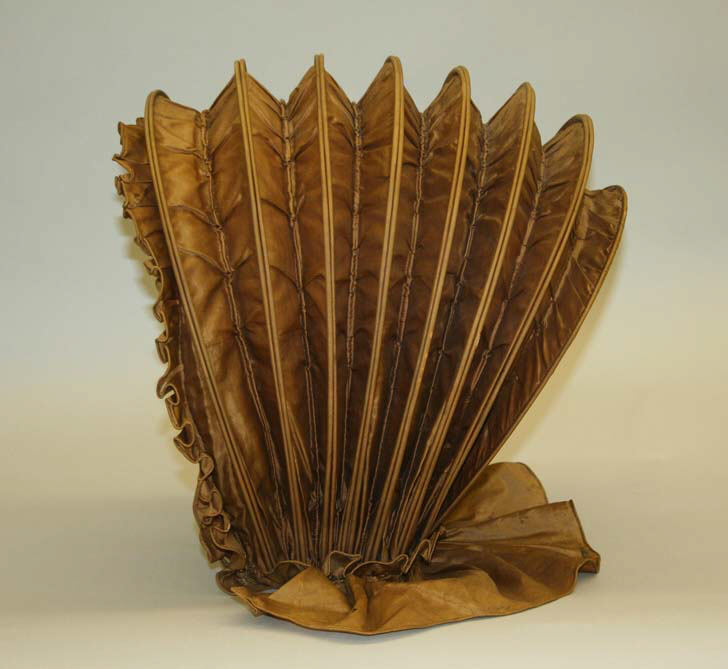
In the annals of fashion history, few accessories embody the intersection of practicality, status, and sculptural artistry as profoundly as the calash. At Katherine Fashion Lab, we approach this remarkable headpiece not merely as a relic of 18th-century travel but as a pivotal case study in the evolution of wearable architecture. The calash—a collapsible, bonnet-like hood most commonly associated with American and European women of the late 1700s—represents a sophisticated response to the demands of mobility, social performance, and material innovation. Constructed from fine silk over a framework of whalebone or cane, the calash transcends its utilitarian origins to become a statement of engineering elegance. This analysis deconstructs the calash’s design philosophy, material choices, and cultural significance, positioning it as a foundational artifact for contemporary couture thinking.
Origins and Cultural Context: Mobility Meets Monumentality
The Calash as a Functional Sculpture
The calash emerged in the mid-18th century, primarily in England and France, and quickly found favor among American colonial elites. Its name derives from the French calèche, a lightweight carriage with a folding hood, which the headpiece directly mimics. This etymological link underscores the calash’s core purpose: to protect elaborate hairstyles—often towering wigs powdered and adorned with feathers—from wind, rain, and the dust of unpaved roads. Yet, the calash was never a purely practical object. Its silhouette, when fully extended, could reach over two feet in height, creating a dramatic, dome-like profile that exaggerated the wearer’s stature. This dual function—as both a shield and a spectacle—positions the calash as a precursor to the modern concept of wearable architecture, where form and function are inextricably bound.
American vs. European Interpretations
While the calash was common on both sides of the Atlantic, subtle distinctions in its construction and usage reveal divergent cultural priorities. European calashes, particularly those from French ateliers, often featured elaborate silk brocades, intricate embroidery, and delicate ribbons, reflecting the courtly obsession with surface ornamentation. The framework was typically more rigid, allowing for sharper, more dramatic folds. In contrast, American calashes—crafted in cities like Boston, Philadelphia, and New York—tended toward simpler, more restrained designs. American women, influenced by a growing ethos of republican simplicity, favored solid-colored silks in muted tones like cream, gray, or black. The American calash’s collapsibility was also prioritized for practicality on long journeys, whereas European versions were sometimes worn as indoor fashion accessories, a testament to the differing rhythms of social life. At Katherine Fashion Lab, we recognize this divergence as a critical lesson in contextual design: a garment’s form is always a negotiation between local materials, social norms, and functional demands.
Materiality and Construction: The Silk Framework
Silk as a Structural Medium
The choice of silk for the calash is neither arbitrary nor purely aesthetic. Silk’s unique combination of tensile strength, lightweight drape, and ability to hold a crease made it ideal for a collapsible structure. The fabric was typically a silk taffeta or silk satin, chosen for its crispness and subtle sheen. The calash’s frame—composed of concentric rings of whalebone, cane, or, in later examples, steel wire—was sewn into channels created by the silk. This allowed the hood to expand into a rigid dome when worn but fold flat into a small, portable bundle when not in use. The engineering challenge was significant: the silk had to be taut enough to maintain the shape without tearing, yet flexible enough to collapse repeatedly. This interplay between rigidity and pliancy is a hallmark of kinetic couture, a concept that Katherine Fashion Lab explores in our modern collections. The calash, in essence, is a pre-industrial example of a transformable garment—a prototype for today’s convertible and modular fashion.
Preservation and Patina
Surviving examples of calashes, housed in institutions such as the Metropolitan Museum of Art and the Museum of Fine Arts, Boston, reveal the material’s vulnerability. Silk is notoriously sensitive to light, humidity, and mechanical stress. The calashes that have endured often display a faded, yellowed patina, with the silk showing signs of creasing and fraying along the folds. This degradation is not a flaw but a narrative of use. Each crease tells a story of a carriage ride, a social call, or a transatlantic voyage. At Katherine Fashion Lab, we view such material evidence as essential to understanding the object’s life cycle. The calash challenges the modern fashion industry’s obsession with pristine, single-use garments, reminding us that true luxury is found in the dialogue between material and time.
Design Analysis: Geometry, Proportion, and Movement
The Silhouette as a Statement
From a design perspective, the calash is a study in controlled volume. Its profile, when worn, creates a near-perfect quarter-sphere that frames the face while obscuring the hair. This geometric precision was intentional: the calash’s shape echoed the fashionable dome-like hairstyles of the period, such as the pouf and the fontange. The calash did not simply cover the hair; it amplified the silhouette, extending the vertical line of the body and creating a visual apex. The front of the calash often featured a deep brim or curtain that could be tied under the chin, adding a soft, asymmetrical counterpoint to the rigid dome. This interplay between hard and soft, geometric and organic, is a recurring theme in couture. The calash’s design teaches us that volume is not merely about size but about spatial relationships—how the object interacts with the wearer’s body and the surrounding environment.
Movement and the Wearable Object
One of the most overlooked aspects of the calash is its dynamic quality. When the wearer turned her head, the calash’s frame would shift slightly, catching the light and creating a play of shadows across the silk. The collapsible mechanism also allowed for a dramatic transformation: a woman could enter a room with the calash fully expanded, then collapse it with a single gesture, revealing her elaborate coiffure. This element of performative reveal is a sophisticated design strategy that anticipates modern runway theatrics. The calash is not a static object; it is a tool for self-presentation, a means of controlling the viewer’s gaze. At Katherine Fashion Lab, we draw inspiration from this kinetic potential, exploring how garments can shift between states—open and closed, exposed and concealed—as part of their narrative.
Conclusion: The Calash as a Couture Prototype
The calash stands as a testament to the ingenuity of 18th-century dressmakers and the enduring power of silk as a structural medium. In its marriage of utility and ornament, its careful negotiation of volume and collapse, and its ability to transform the wearer’s presence, the calash prefigures many of the principles that define contemporary couture. For Katherine Fashion Lab, this analysis reaffirms the value of studying historical artifacts not as curiosities but as design blueprints. The calash challenges us to think beyond the surface, to consider how materials can be engineered for movement, how silhouettes can communicate status, and how garments can encode the rituals of their time. As we continue to innovate in silk construction and transformable design, the calash remains a quiet but powerful guide—a reminder that the most profound fashion statements are often those that fold, unfold, and endure.