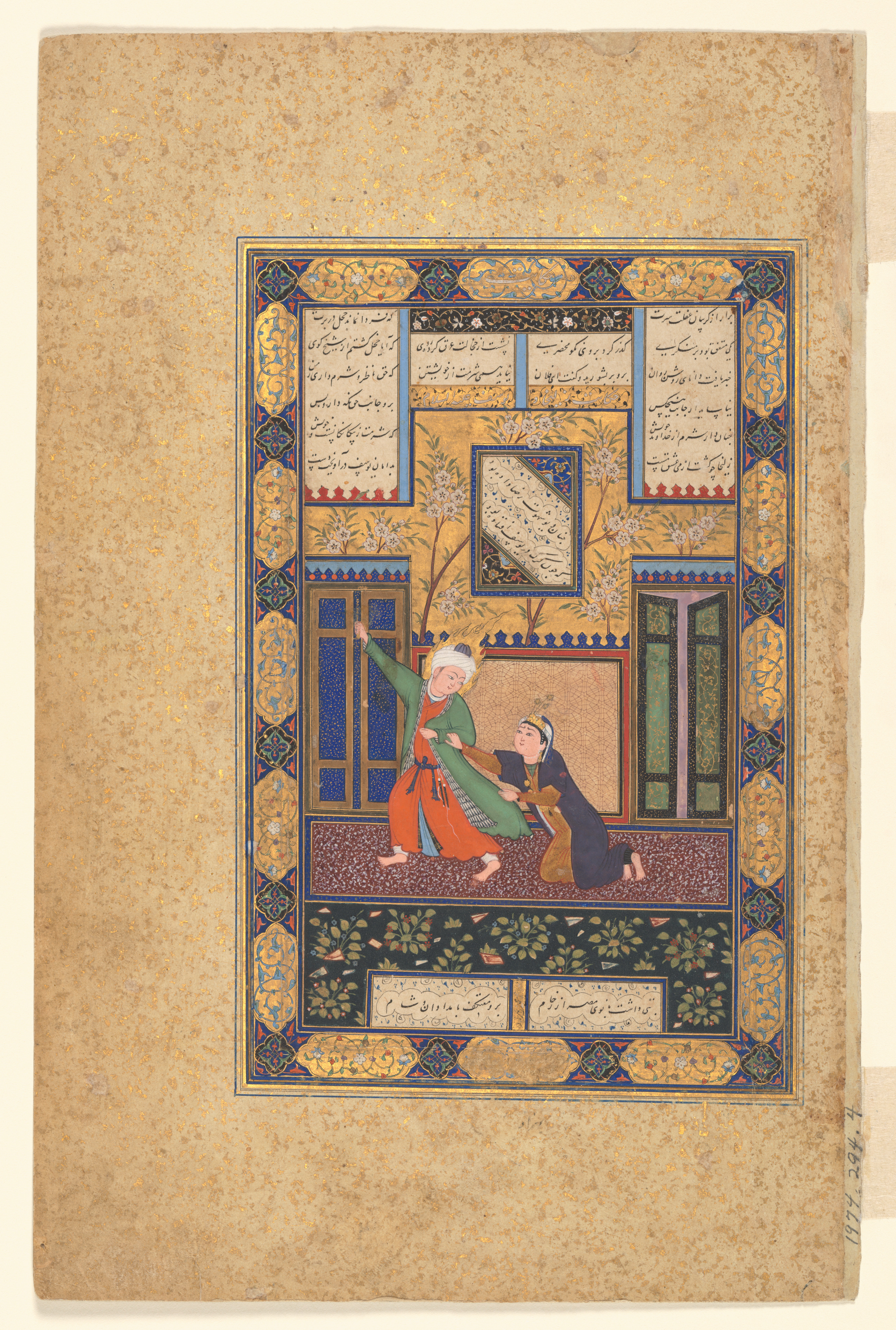
The Tale Unstitched: A Couture Analysis of “Yusuf and Zulaikha,” Folio 51r
Introduction: From Manuscript to Masterpiece
The Bustan of Sa’di, a 13th-century Persian poetic masterpiece, has long been revered for its moral allegories and lyrical beauty. Yet, when we isolate Folio 51r—the poignant scene of “Yusuf and Zulaikha”—from its literary context and examine it as a standalone artifact, we uncover a profound dialogue between narrative and ornamentation. This folio, rendered in ink, opaque watercolor, and gold on paper, transcends its original function as an illustration. It becomes a couture study of how texture, color, and form can articulate desire, power, and spiritual transcendence. For Katherine Fashion Lab, this analysis is not merely art historical; it is a blueprint for translating heritage into haute couture.
The Fabric of the Frame: Composition as Structural Silhouette
The folio’s composition is a masterclass in architectural framing. The scene is enclosed within a double border: an outer band of intricate gold arabesques and an inner margin of cobalt blue with delicate white floral motifs. This framing device mirrors the structured silhouette of a couture gown—a rigid corset that contains and directs the eye. The gold, applied with meticulous precision, acts as metallic thread, stitching the viewer’s gaze toward the central drama. In fashion terms, this is the boning of a bodice: unyielding yet opulent, it shapes the narrative while allowing the internal palette to breathe.
The spatial arrangement is equally deliberate. Yusuf, the object of Zulaikha’s longing, occupies the upper left quadrant, his figure elevated and isolated. Zulaikha, by contrast, is placed lower and to the right, her body angled in a posture of supplication and tension. This diagonal axis creates a dynamic asymmetry that couturiers would recognize as a bias cut—a line that drapes, twists, and exposes emotional seams. The empty space between them is not void but charged negative volume, akin to the gap between a sleeve and a torso in a deconstructed jacket. It whispers of distance, of the unattainable.
Color as Emotion: The Palette of Longing
The color palette of Folio 51r is a chromatic narrative of restraint and excess. Gold leaf dominates, not as mere decoration but as a symbolic fabric—it is the light of divine beauty, the shimmer of Yusuf’s perfection. In couture, gold lamé or metallic brocade would echo this luminosity, but the folio’s gold is applied in flat, unmodulated sheets, suggesting a high-shine satin that reflects rather than absorbs. This is not a texture of comfort; it is a surface of desire.
Zulaikha’s robe is a study in indigo and deep crimson. The indigo, a hue of royalty and melancholy, drapes her form in layers, while the crimson—applied as fine lines on her collar and cuffs—hints at passion restrained. This interplay of cool and warm tones is a color-blocking technique that modern designers use to convey psychological conflict. The opaque watercolor here behaves like matte silk velvet: rich, absorbent, and weighted with emotion. Yusuf’s garments, conversely, are rendered in pale saffron and white, with gold accents that lift the fabric into a realm of purity. His attire is lightweight and ethereal, almost transparent in its spiritual implication—a chiffon to her brocade.
Texture and Technique: The Hand of the Artisan
The materiality of the folio—ink, opaque watercolor, and gold on paper—offers a tactile lexicon for haute couture. The ink outlines are precise, almost calligraphic, defining the seams of the narrative. They are the topstitching of the piece, visible and deliberate. The opaque watercolor is applied in layers, building opacity and depth, much like hand-painted silk or embroidered organza. Each brushstroke is a stitch that cannot be undone.
Most striking is the use of gold. It is not painted but applied as leaf, a process akin to gilding in embroidery. The gold catches light differently depending on the angle, creating a shimmering, living surface. In a couture context, this would translate to metallic threadwork, paillettes, or golden foil appliqué. Yet, the folio’s gold is not uniform; it is cracked and worn in places, revealing the paper beneath. This patina of age is a design element in itself—a distressed finish that speaks to the impermanence of beauty. A contemporary collection might replicate this through hand-stitched tarnished sequins or oxidized metallic lace.
Narrative Drapery: The Body as a Garment
The figures in Folio 51r are not merely clothed; they are draped in narrative. Zulaikha’s posture—her head tilted, her hand reaching toward Yusuf—transforms her robe into a second skin of longing. The folds of her garment are rendered with thick, curving lines that mimic the draping of muslin on a mannequin. These folds are not random; they follow the tension of her body, gathering at the shoulders and pooling at her feet. This is bias-cut draping at its most expressive, where fabric becomes a barometer of emotion.
Yusuf’s drapery, by contrast, is simplified and static. His robe falls in vertical, unbroken lines, suggesting serenity and detachment. The contrast between the two is a lesson in structural design: Zulaikha’s garments are constructed and complex, while Yusuf’s are minimal and serene. This dichotomy mirrors the tension between desire and restraint that defines the tale. For a couturier, this could inspire a collection where asymmetrical, layered pieces (Zulaikha) are juxtaposed with clean, architectural lines (Yusuf).
Ornament as Symbol: The Language of Detail
The folio’s ornamental details are not decorative; they are semiotic markers. The floral motifs in the border—lotuses and palmettes—are symbols of purity and rebirth, echoing Yusuf’s spiritual role. The geometric patterns on Zulaikha’s sash suggest order and control, a counterpoint to her emotional chaos. The gold halos around both figures are circular frames, akin to statement collars in haute couture, that isolate and elevate their faces.
Even the negative space is ornamented. The background is a deep ultramarine, punctuated by gold stars and clouds. This is not a sky but a celestial fabric, a cosmic print that envelops the scene. In fashion, this could be reinterpreted as embroidered tulle or beaded netting, where the background itself becomes a textile of narrative.
Conclusion: Weaving Heritage into Haute Couture
Folio 51r of the Bustan of Sa’di is more than a manuscript illumination; it is a couture manifesto written in gold and pigment. Its analysis reveals a blueprint for translating cultural heritage into wearable art. The asymmetrical composition, the chromatic tension, the tactile layering, and the symbolic ornamentation all offer a rich vocabulary for designers. For Katherine Fashion Lab, this folio is a source of inspiration for a collection that marries Persian opulence with modern minimalism—a line where every stitch tells a story of longing, transcendence, and the eternal interplay of fabric and fate.
In the hands of a master couturier, the ink becomes thread, the watercolor becomes dye, and the gold becomes light. The tale of Yusuf and Zulaikha is not just told; it is woven, draped, and worn.