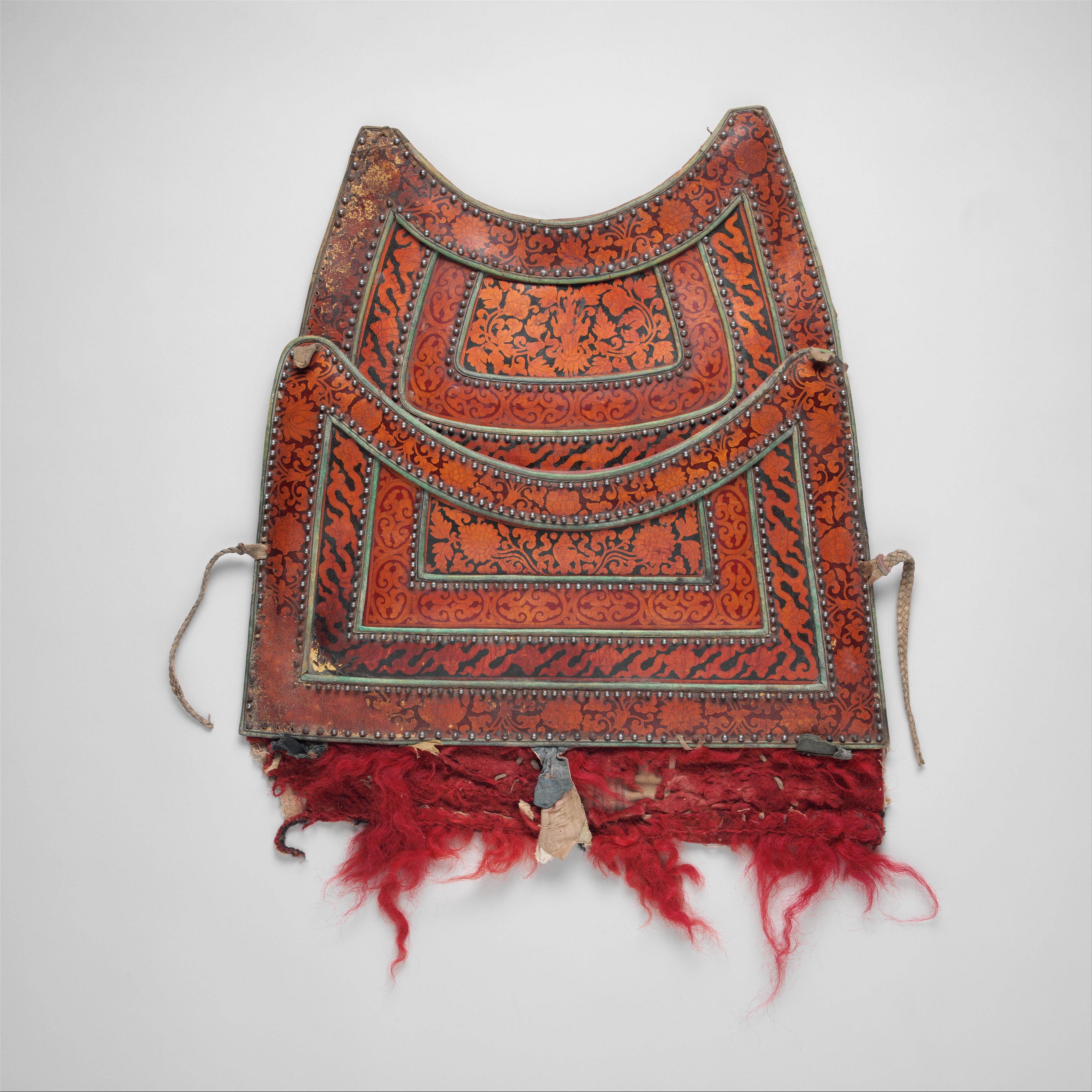
Heritage Analysis: The Tibetan-Mongolian Peytral as a Strategic Archetype for 2026 Luxury
Introduction: The Object as a System of Power
The breast defense, or peytral, from a Tibetan or Mongolian horse armor represents a convergence of martial necessity, spiritual cosmology, and aristocratic display. Crafted from leather, iron, brass or copper alloy, silver, gold, shellac, pigments, textile, and yak hair, this object is far more than a functional piece of equestrian protection. It is a material manifesto of authority, a talisman against metaphysical harm, and a precursor to the kind of multi-sensory, narratively dense luxury that the 2026 high-end market demands. For Katherine Fashion Lab, this artifact offers a strategic blueprint for creating collections that transcend fashion and enter the realm of heritage-driven cultural capital.
Symbolic Power: The Armor as a Statement of Sovereignty
The peytral’s primary symbolic function was to project the power of its rider and, by extension, the rider’s lineage or clan. In Tibetan and Mongolian warrior cultures, the horse was not merely a mount but an extension of the self—a partner in battle and a symbol of nomadic dominance. Adorning the horse with a breast defense made of precious metals and vibrant pigments signaled that the rider commanded resources, skilled artisans, and the favor of the heavens. The use of gold and silver, often applied in repoussé or gilded layers, was not decorative excess but a deliberate assertion of economic and political supremacy. For Katherine Fashion Lab, this translates into a 2026 strategy where luxury is defined not by minimalism but by visible mastery over rare materials and the ability to embed status narratives into every stitch and plate.
Historical Adornment: Craftsmanship as a Competitive Advantage
The peytral’s construction reveals a sophisticated understanding of material hierarchy and preservation. Leather served as a flexible, shock-absorbing base, while iron plates provided structural defense. Brass and copper alloys were chosen for their warm, reflective qualities, which caught sunlight and intimidated opponents. The application of shellac and mineral pigments—often in deep reds, blues, and greens—protected the leather and created a luminous surface that resisted the harsh Central Asian climate. Yak hair, used for fringe or backing, added a tactile, organic element that contrasted with the rigid metalwork. This deliberate juxtaposition of hard and soft, precious and utilitarian, is a lesson in textural storytelling. For the 2026 luxury market, Katherine Fashion Lab can replicate this by combining high-tech performance fabrics with handcrafted metal accents, creating pieces that are both armored and artisanal. The peytral’s layered construction also speaks to the growing consumer demand for visible craftsmanship—objects that reveal their making process and honor the hands that shaped them.
Spiritual Meaning: The Talismanic Dimension of Armor
Beyond the physical, the peytral was a sacred object. Tibetan and Mongolian warriors believed that armor could attract or deflect spiritual forces. The use of gold and silver was not only a display of wealth but also a reference to Buddhist and Bön traditions, where these metals were associated with purity, enlightenment, and the sun. Pigments like vermilion (from cinnabar) and ultramarine (from lapis lazuli) held protective and healing properties. The yak hair, often taken from animals blessed by lamas, was thought to carry the animal’s life force and courage. Thus, the peytral functioned as a portable shrine, a repository of blessings that shielded both horse and rider from malevolent spirits. For Katherine Fashion Lab, this spiritual dimension offers a potent differentiation strategy. In an era where consumers seek meaning beyond materialism, luxury brands can embed ritualistic elements into their products—such as limited-edition pieces blessed by artisans, or collections that incorporate materials with acknowledged cultural and spiritual provenance. This transforms a garment or accessory from a commodity into a talismanic investment.
Strategic Implications for 2026 High-End Luxury
The peytral’s relevance to Katherine Fashion Lab’s 2026 strategy lies in its ability to inform three core pillars: narrative density, material integrity, and experiential resonance.
Narrative Density: The peytral tells a story of conquest, belief, and artistry. In a saturated luxury market, brands that can offer multi-layered stories—historical, spiritual, and technical—will command premium pricing. Katherine Fashion Lab should develop collections that are explicitly tied to archival research, perhaps collaborating with ethnographers or museum curators to create pieces that are scholarly as well as stylish. Each garment could include a digital or physical “heritage passport” detailing its material origins and symbolic meanings.
Material Integrity: The peytral’s use of mixed media—leather, metal, shellac, hair—demonstrates that luxury is not about purity of material but about mastery of combination. For 2026, Katherine Fashion Lab can pioneer a “hybrid luxury” approach: merging traditional leatherwork with aerospace-grade alloys, or using bio-resins infused with natural pigments. This aligns with the growing demand for sustainable yet opulent materials, as consumers become more educated about supply chains and environmental impact.
Experiential Resonance: The peytral was meant to be seen, touched, and even heard (the clink of metal plates). Modern luxury must engage all senses. Katherine Fashion Lab could introduce sensory signatures—subtle sounds from integrated metallic elements, or textures that change with temperature or light. Additionally, the spiritual aspect invites the creation of ritualistic experiences: private viewings where clients learn about the protective symbolism of their purchase, or customization options where they choose materials based on personal or familial talismanic traditions.
Conclusion: From Battlefield to Boutique
The Tibetan-Mongolian peytral is not a relic; it is a strategic artifact that speaks directly to the future of high-end luxury. Its fusion of power, adornment, and spirituality offers Katherine Fashion Lab a template for creating objects that are culturally authoritative, materially innovative, and emotionally resonant. By adopting the peytral’s principles—visible mastery, talismanic depth, and layered storytelling—the lab can position itself at the vanguard of a luxury market that increasingly values heritage as a competitive advantage. In 2026, the most coveted pieces will not be the quietest; they will be the ones that, like the peytral, announce their presence with the confidence of a warrior and the soul of a sage.