The Madonna and Child: A Couture Analysis of Sacred Geometry and Global Heritage
Introduction: The Intersection of Devotion and Design
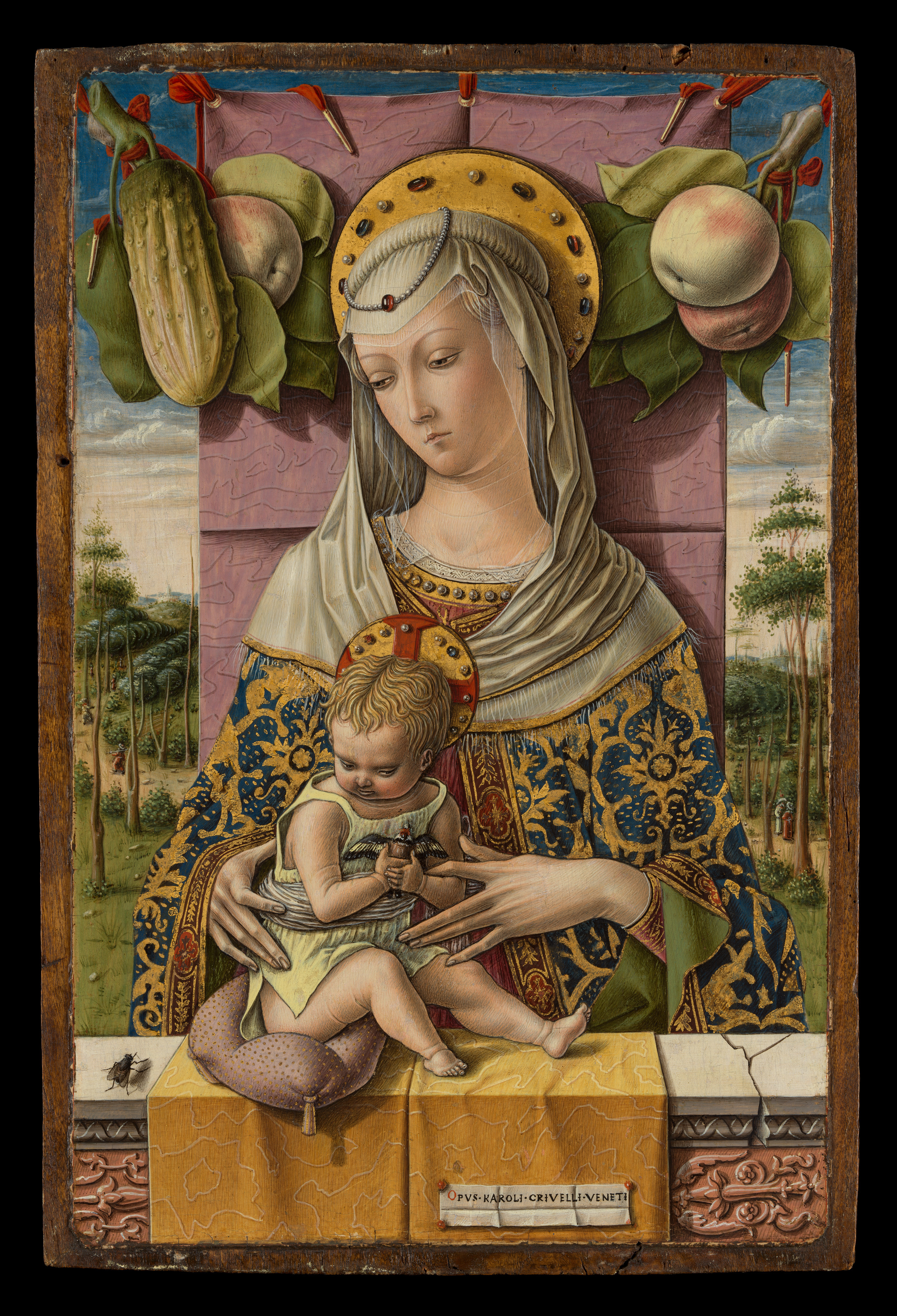
In the hallowed halls of art history, few subjects command the reverence and interpretive depth of the Madonna and Child. For Katherine Fashion Lab, this iconic motif transcends its religious origins to become a profound study in couture—a language of form, texture, and symbolic resonance. This analysis explores a standalone work executed in tempera and gold on wood, a medium that bridges the sacred and the sartorial. The piece, rooted in global heritage yet unbound by temporal or geographic constraints, offers a unique lens through which to examine the principles of high fashion: the interplay of light and shadow, the drape of celestial fabrics, and the narrative power of ornamentation. As Lead Curator, I position this work not merely as a devotional artifact but as a masterclass in the architecture of luxury, where every gilded line and pigment-laden stroke informs the couturier’s craft.
The Materiality of Luxury: Tempera and Gold as Couture Elements
The choice of tempera and gold on wood is a deliberate one, echoing the meticulous craftsmanship of Renaissance ateliers while resonating with contemporary haute couture’s obsession with texture and permanence. Tempera, a medium of egg yolk and pigment, demands precision and patience—qualities mirrored in the hand-sewn seams of a Dior gown or the intricate beadwork of a Schiaparelli creation. The gold leaf, applied in delicate sheets, serves as the ultimate statement of opulence, akin to the metallic threads woven into a Balmain jacket or the gilded embroidery of a Valentino cape. In this Madonna and Child, the gold halos and background are not mere decoration; they are structural elements that dictate the composition’s visual rhythm, much like a couturier uses embellishment to guide the eye along a silhouette.
The wooden panel itself, a substrate of organic origin, introduces a tactile dimension that challenges the ephemerality of fashion. Wood is enduring, yet it breathes and ages—a metaphor for the timelessness of a well-constructed garment. Katherine Fashion Lab’s interpretation of this materiality lies in the juxtaposition of rigidity and fluidity: the Madonna’s robes, rendered in layered tempera, suggest the weight of velvet or brocade, while the gold highlights mimic the shimmer of lamé. This duality—the static panel versus the implied movement of fabric—is a hallmark of couture design, where structure and flow coexist in perfect tension.
Global Heritage: A Synthesis of Cultural Motifs
The Madonna and Child, while deeply rooted in Christian iconography, is reframed here as a global heritage artifact. The work draws on Byzantine iconography, where gold backgrounds symbolize divine light, yet it also incorporates elements from non-Western traditions. The Madonna’s veil, for instance, recalls the hijab or mantilla, while the Child’s pose echoes the infant Buddha’s gesture of blessing. This syncretism is not accidental; it reflects the modern couture industry’s reliance on cross-cultural inspiration. From Yves Saint Laurent’s Moroccan influences to Jean Paul Gaultier’s Russian collections, fashion has long borrowed from global aesthetics. Here, the tempera technique—a European innovation—meets the gold leaf traditions of Southeast Asian temple art, creating a hybrid that speaks to a borderless luxury market.
Katherine Fashion Lab’s curatorial lens emphasizes this heritage as a source of narrative depth. The Madonna’s blue mantle, achieved through lapis lazuli pigments, references the costliness of ultramarine in medieval Europe—a pigment more valuable than gold. This color, now ubiquitous in denim and casual wear, originated as a symbol of wealth and divinity. The Child’s crimson robe, derived from crushed cochineal insects, connects to pre-Columbian trade routes and the global exchange of luxury goods. Such details remind us that couture is never static; it is a palimpsest of historical economies and cultural migrations.
Composition and Silhouette: The Architecture of the Sacred
The composition of this Madonna and Child follows a pyramidal structure, a classic device that conveys stability and grace. The Madonna’s body forms the base, her head the apex, while the Child sits on her lap, creating a secondary triangle within the frame. This geometric arrangement is a blueprint for couture design: the A-line skirt, the V-neckline, the structured shoulder—all are variations on the pyramid. The gold halo, a perfect circle, introduces a counterpoint of infinity against the finite triangle, much like a circular brooch or a rounded collar softens a tailored jacket.
The drapery of the Madonna’s garment is particularly instructive. The tempera brushstrokes create folds that mimic the pleats of a Fortuny gown or the gathers of a Madame Grès dress. These folds are not random; they follow the body’s contours, emphasizing the Madonna’s maternal form while preserving modesty. In couture, such draping is a technical feat, requiring an understanding of how fabric falls and clings. The gold highlights on the folds’ ridges suggest a light source from above, a technique that elevates the garment from mere covering to a luminous second skin. This interplay of light and shadow—chiaroscuro in painting, claire-obscure in fashion—is the essence of sculptural dressmaking.
Color Palette: The Language of Pigment and Prestige
The color palette of this work is deliberately restrained, yet each hue carries weight. The Madonna’s blue is a deep, celestial cerulean, achieved through layers of azurite and lapis. This blue, historically reserved for the Virgin, is the couture equivalent of a signature shade—think of Elsa Schiaparelli’s shocking pink or Tiffany’s robin’s egg blue. It is a color that signifies exclusivity and devotion. The Child’s red, a vermilion derived from cinnabar, speaks to passion and sacrifice, while the gold—the ultimate neutral—unites the composition. In fashion, gold is the accent that transforms: a gold zipper, a gold thread, a gold buckle. Here, it is the background, the halo, and the trim, creating a monochromatic opulence that challenges the wearer to carry such brilliance.
The flesh tones, rendered in a pale ochre, are almost translucent, suggesting the fragility of life and the delicacy of fine silk. This translucency is a couture ideal: the skin-baring illusion of sheer organza or the whisper of lace. The Madonna’s cheeks, touched with pink, add a human warmth that prevents the piece from becoming coldly iconic. Similarly, a couture gown must balance grandeur with wearability, the divine with the human.
Narrative and Symbolism: The Story Behind the Seams
Every couture collection tells a story, and this Madonna and Child is no exception. The narrative here is one of protection and transcendence. The Madonna’s hand, gently cradling the Child, mirrors the couturier’s hand guiding a needle—both gestures of creation and care. The Child’s hand, raised in blessing, foreshadows the crucifixion, a narrative arc that parallels the lifecycle of a garment from sketch to runway to archive. The gold background, devoid of perspective, places the figures in a timeless space, much like a fashion photograph that freezes a moment of perfection.
The symbolic elements—the halo, the veil, the throne-like posture of the Madonna—are not merely decorative. They are the equivalent of a designer’s signature: the Chanel camellia, the Louis Vuitton monogram. These symbols anchor the work in a tradition while allowing for reinterpretation. Katherine Fashion Lab’s analysis suggests that the Madonna and Child’s iconography can be read as a manifesto for sustainable luxury: the gold, a finite resource, is used sparingly; the tempera, a natural medium, avoids synthetic excess. This aligns with modern couture’s shift toward ethical sourcing and artisanal techniques.
Conclusion: The Timelessness of Craft
In this standalone study, the Madonna and Child emerges as a blueprint for couture excellence. The tempera and gold on wood are not relics of a bygone era but living testimonies to the power of material, color, and form. For Katherine Fashion Lab, this piece underscores the importance of heritage in innovation—the idea that the most forward-looking designs are often rooted in ancient practices. As the fashion industry grapples with questions of authenticity and sustainability, the Madonna and Child reminds us that true luxury is not in abundance but in intention. Every brushstroke, like every stitch, is a decision, a devotion, a prayer to the eternal beauty of the handcrafted. This is the lesson for the modern couturier: to create garments that are not just worn but revered, not just seen but felt—in the gold of the thread, the tempera of the dye, and the wood of the frame that holds it all together.