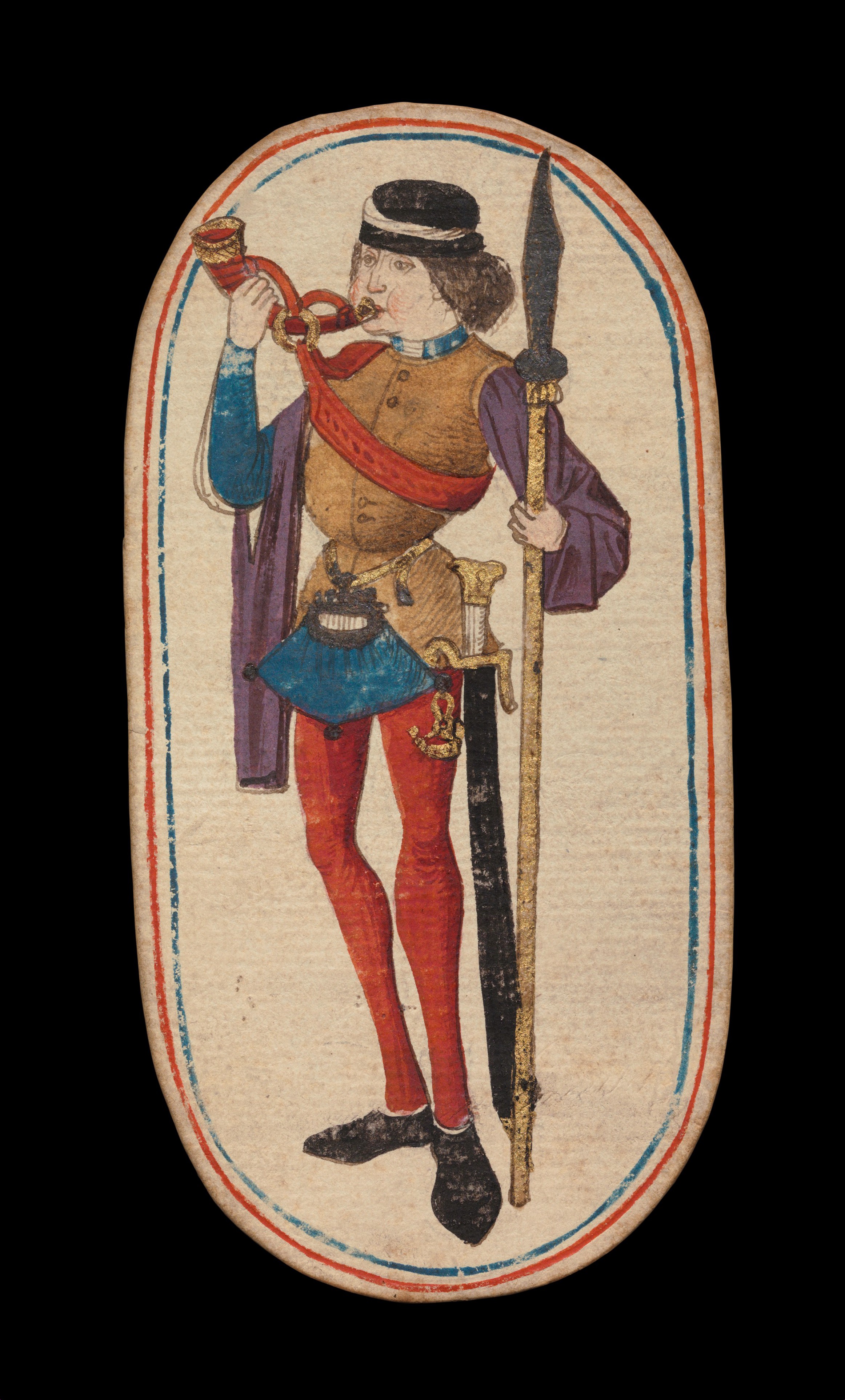
The Knave of Horns: A Couture Analysis of Materiality and Power in the South Netherlandish Playing Card
In the rarefied intersection of art history and haute couture, the Knave of Horns from the celebrated Cloisters Playing Cards emerges as a profound study in materiality, status, and narrative construction. Created in the late 15th century in the South Netherlandish region—a crucible of early Renaissance luxury and trade—this singular card transcends its function as a gaming implement. For Katherine Fashion Lab, it represents a masterclass in the sartorial language of power, where every layer of pasteboard, every stroke of opaque paint, and every fleck of applied silver and gold whispers a story of courtly ambition and symbolic defiance.
Materiality as a Declaration of Worth
The physical composition of the Knave of Horns is itself a couture statement. Unlike the ephemeral, mass-produced cards of later centuries, this artifact is constructed from four layers of pasteboard—a deliberate choice that imbues the object with heft, durability, and an almost architectural presence. In contemporary fashion terms, this layering mirrors the structural complexity of a bespoke doublet or a corseted bodice, where multiple fabrics and interlinings are employed to create a silhouette that commands attention. The pasteboard’s thickness is not merely functional; it is a declaration of intentionality, suggesting that the card was meant to be handled, admired, and preserved, much like a couture garment destined for a noble’s wardrobe.
The application of pen and ink provides the foundational sketch, a delicate yet precise underdrawing that recalls the initial toile of a dressmaker. This is where the artist’s hand is most visible, where the knave’s posture—a slight turn of the torso, a hand resting on the hip—is first articulated. The ink’s permanence speaks to the irreversibility of design in high fashion, where each cut of the scissors or pin of the fabric is a commitment to a specific vision. Over this, opaque paint is layered, creating fields of vibrant color that define the knave’s tunic, hose, and cap. The opacity is crucial: it hides the underlying structure while asserting a new surface reality, much like a couture gown’s outer fabric conceals the boning and stitching that gives it form.
The Alchemy of Glazes, Silver, and Gold
The true alchemy of this piece, however, lies in the glazes, applied silver, and gold. The glazes—translucent washes that modify the underlying hues—introduce a chameleonic quality to the card. Under candlelight or daylight, the colors shift, creating a dynamic visual experience that anticipates the modern runway’s play with light and shadow. This technique is analogous to the use of iridescent fabrics or layered tulle in haute couture, where the garment’s appearance changes with the viewer’s perspective and the environment.
The applied silver and gold are the ultimate signifiers of luxury. In the South Netherlandish context, these metals were not merely decorative; they were currency of status, used to denote wealth, divine favor, and social hierarchy. The silver, now likely tarnished, would have originally flashed with a cool, lunar brilliance, while the gold would have glowed with a warm, imperial radiance. Together, they create a binary of light—a visual tension that mirrors the knave’s own ambiguous role as both servant and symbol of authority. In Katherine Fashion Lab’s analysis, this metallic application is a precursor to the gold-threaded brocades and silver-embroidered silks that would dominate courtly fashion for centuries. The knave’s attire, though rendered on a small scale, echoes the sumptuary laws of the era, where only the highest ranks could wear such materials. Thus, the card itself becomes a microcosm of the social fabric of the Burgundian court.
Iconography and the Couture Narrative
The knave’s identity is encoded in his horns—a motif that is both literal and metaphorical. In the context of the playing card, the horns likely represent the suit of hunting or the chase, aligning with the card’s association with the Horned Beast or the stag. Yet, in a fashion analysis, horns are a provocative accessory. They evoke the headdresses of medieval nobility, such as the hennin or the escoffion, which often featured exaggerated, horn-like structures. The knave’s horns are not merely decorative; they are a statement of defiance and virility, challenging the viewer to consider the wearer’s agency. In contemporary couture, this translates to the bold, sculptural headpieces of designers like Iris van Herpen or Alexander McQueen, where accessories become armor, transforming the human form into a canvas for power dynamics.
The knave’s costume—a short tunic, fitted hose, and a cap—reflects the transitional fashion of the late 15th century, where medieval draped garments gave way to more tailored, body-conscious silhouettes. The hose, painted in a contrasting color, emphasizes the legs, a signal of the knave’s readiness for action. This is a functional aesthetic, one that prioritizes movement and agility, much like the sportswear-inspired collections of modern luxury brands. Yet, the opulent materials elevate this practicality into a performance of status. The knave is not a peasant; he is a courtier, a messenger, a player in the game of power. His attire is a uniform of ambition, designed to be seen and remembered.
The Card as a Standalone Masterwork
As a standalone study, the Knave of Horns invites us to consider the singularity of the object in an age of reproducibility. Unlike a deck of cards, which derives meaning from its set, this card is isolated, allowing the viewer to focus on its individual artistry. This isolation mirrors the exclusivity of couture, where each garment is a unique piece, not a ready-to-wear commodity. The card’s condition—its layers of pasteboard, its faded glazes, its tarnished silver—becomes a palimpsest of time, a record of its own history. Every crack, every discoloration is a seam in the narrative of its survival.
For Katherine Fashion Lab, the Knave of Horns is not merely a historical artifact; it is a pedagogical tool for understanding how materiality constructs meaning. The card teaches us that luxury is not inherent in the substance itself but in the intention behind its use. The four layers of pasteboard, the meticulous application of paint, the strategic placement of precious metals—all of these choices are acts of design, echoing the decisions made in a couture atelier. The knave’s horns, his stance, his costume—they are all part of a visual grammar that communicates power, status, and identity.
In the end, this card challenges us to rethink the boundaries between art, fashion, and game. It is a portable statement, a miniature portrait of a world where appearance was destiny. As we deconstruct its layers, we uncover not just a playing card, but a manifesto of material ambition—one that continues to resonate in the halls of haute couture today.