The Illuminated Thread: Translating Sacred Narrative into Couture
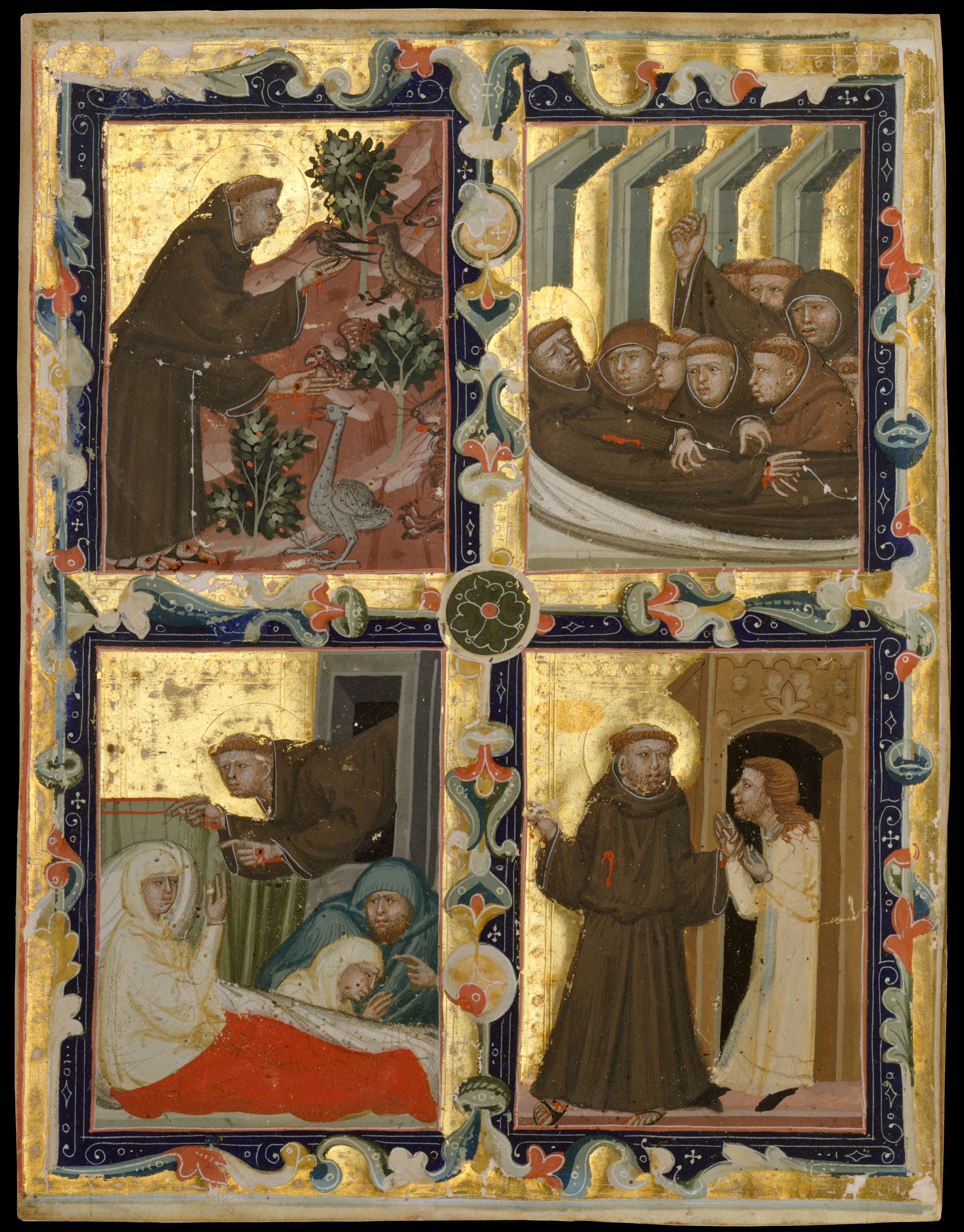
At Katherine Fashion Lab, we approach the artifact not merely as a historical object but as a lexicon of design principles waiting to be decoded. The Manuscript Leaf with Scenes from the Life of Saint Francis of Assisi, a singular work of Italian tempera and gold on parchment, offers a profound case study in narrative compression, material symbolism, and the tension between the earthly and the divine. This analysis deconstructs the leaf’s formal elements—its chromatic palette, gilded surfaces, and sequential storytelling—to propose a haute couture collection that reimagines sacred art as wearable architecture. The result is a dialogue between the ascetic and the opulent, where the humility of Saint Francis meets the extravagance of Italian Gothic craftsmanship.
Materiality as a Design Lexicon: Tempera, Gold, and Parchment
The leaf’s medium—tempera and gold on parchment—is itself a manifesto of material integrity. Tempera, a pigment bound with egg yolk, demands precision and layering; it does not allow for the fluid corrections of oil paint. For a couture house, this translates into a philosophy of constructional honesty. Each seam, each stitch must be deliberate, as if the garment were painted onto the body. The parchment, a cured animal skin, carries a tactile warmth and a subtle, organic irregularity. In our collection, we would emulate this through the use of raw silk, unbleached linen, and hand-finished leather—materials that age gracefully and retain the imprint of their making.
The gold leaf is the most potent signifier. In medieval illumination, gold was not decorative but theological—it represented the uncreated light of God, a portal to the divine. For the fashion lab, gold becomes a tool for spatial manipulation. We would apply it in irregular, cracked patterns, echoing the natural fissures in gilded parchment, to create surfaces that catch light asymmetrically. This is not the uniform shine of modern metallics but a fractured, ancient luminosity. Imagine a column gown where gold leaf is embedded between layers of sheer organza, appearing and disappearing with movement, or a tailored jacket where gold thread is woven into a herringbone pattern, evoking the manuscript’s illuminated borders.
Narrative Architecture: The Sequential Logic of Scenes
The leaf presents multiple scenes from Saint Francis’s life—his renunciation of wealth, the stigmata, his preaching to the birds—arranged in a vertical or horizontal sequence. This narrative compression is a masterclass in storytelling without words. For couture, we translate this into modular garment construction. A single dress might contain three distinct “scenes” or panels, each representing a phase of transformation. The top panel, perhaps in muted, earthy tones of umber and ochre, corresponds to Francis’s early life of privilege. The middle panel, in deep indigo and crimson, depicts his moment of conversion. The lower panel, brushed with silver and pale gold, signifies his union with nature and the divine.
The key is visual transition. In the manuscript, scenes are often separated by thin architectural frames—columns or arches. In our garments, these frames become structural seams, piped with corded silk or metallic thread. The wearer becomes a walking narrative, a living manuscript where each movement reveals a new chapter. This approach also informs our layering strategy. A sheer overlay might reveal a hidden scene beneath, much like the parchment’s surface conceals the animal substrate. The garment is not static; it invites the observer to decode its stories.
Chromatic Theology: The Palette of Devotion
The manuscript’s palette is deliberately restricted yet deeply symbolic. Lapis lazuli blue for the Virgin’s robe, cinnabar red for Christ’s wounds, verdigris green for the natural world, and the pervasive gold. For our collection, we extract these colors not as literal reproductions but as emotional frequencies. The blue is translated into a midnight indigo silk velvet, suggesting both sky and sorrow. The red appears as a deep madder stain on pleated chiffon, evoking blood and passion. The green is not a bright emerald but a muted, mossy tone—the color of Francis’s beloved forest.
The most radical translation is gold as a non-color. In the manuscript, gold functions as light, not as a hue. In our garments, we achieve this through metallic thread embroidery that catches light only at certain angles, and through the use of gold-leafed buttons that serve as small, reflective portals. The overall effect is a garment that changes character in different lighting conditions—subdued in shadow, radiant in direct light—mirroring the manuscript’s ability to reveal its brilliance only when illuminated.
Structural Borrowings: Architecture of the Sacred
The manuscript leaf, though small, contains architectural references: the Gothic arches of a church, the carved stone of a pulpit, the simple wooden cross. We translate these into structural silhouettes. A gown’s neckline might mimic the pointed arch of a cathedral window, with a skeletal boning that echoes ribbed vaulting. A capelet could be cut to resemble a monk’s cowl, but rendered in heavy brocade with gold-threaded edges. The tunic—Francis’s signature garment—becomes a minimalist base layer, while over it, a structured jacket or bodice imposes the geometry of the sacred.
The stigmata scene, where Francis receives the wounds of Christ, is a particularly potent motif. We interpret this not as literal injury but as perforated surfaces. A leather corset might have small, circular cutouts lined with gold, suggesting wounds that are also portals of light. A silk organza sleeve could be embroidered with tiny, jewel-like holes that reveal the skin beneath—a reference to the body as a vessel of divine suffering.
Texture as Devotion: The Hand of the Artisan
The manuscript leaf bears the marks of its maker: the slight unevenness of the brushstroke, the crackle of the gesso, the subtle texture of the parchment. In an age of digital precision, we celebrate the imperfect hand. Our collection would feature hand-painted silk panels where the brushwork is deliberately visible, irregular pleating that mimics the folds of a medieval robe, and hand-stitched embroidery that varies in tension. Each garment is unique, carrying the trace of its creation—a couture equivalent of the manuscript’s singular existence.
The gold leaf application is entrusted to a specialized atelier that works with traditional techniques. They apply thin sheets of 24-karat gold to certain panels, then seal them with a protective layer of resin. The result is a surface that reflects light with a warm, buttery glow, similar to the parchment’s illumination. Over time, the gold may develop a subtle patina, adding to the garment’s narrative depth.
From Leaf to Life: The Wearable Manuscript
The ultimate goal is not to replicate the manuscript but to channel its spiritual and aesthetic energy into a contemporary form. The collection is titled “Codex Aureus” (Golden Book), and it comprises twelve looks, each corresponding to a key scene from Francis’s life. The final look, a full-length gown of ivory silk with gold-threaded embroidery depicting the saint’s death and ascension, is a meditation on transcendence. The fabric is so sheer that the body is visible beneath, yet the gold embroidery forms a dense, protective cocoon. It is a garment that speaks of both vulnerability and glory.
In the couture atelier, we often speak of “the hand of the maker.” This manuscript leaf, created by an anonymous illuminator in a medieval Italian scriptorium, reminds us that fashion, at its highest level, is also a sacred act of devotion. The gold, the pigment, the parchment—they are not just materials but vessels of meaning. By translating them into fabric and form, Katherine Fashion Lab offers a new kind of illumination: one that dresses the body in the light of history, faith, and artistic mastery.