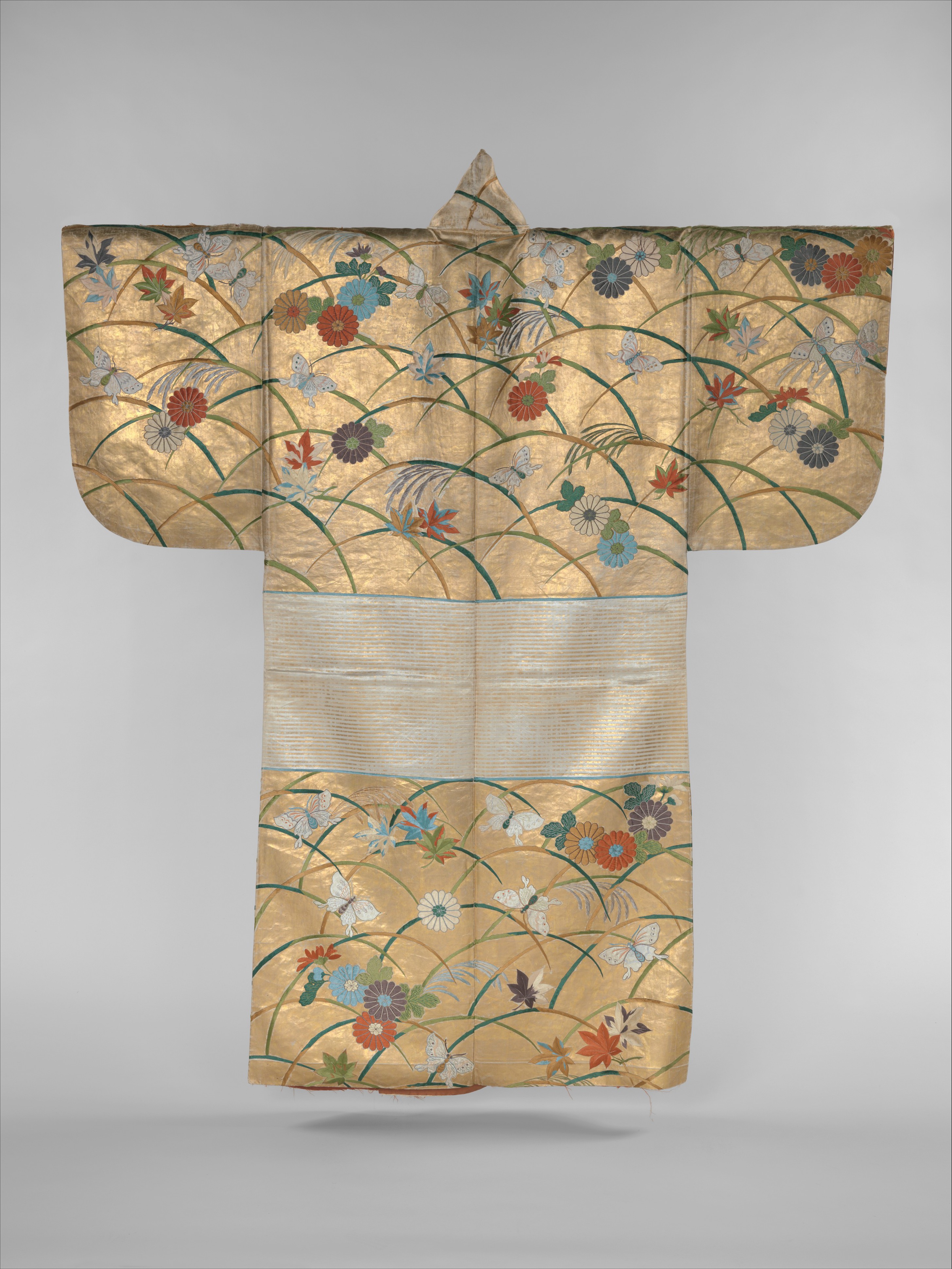
The Noh Robe (Nuihaku): An Exegesis of Temporal and Textile Artistry
The Noh robe, or Nuihaku, bearing a motif of butterflies, chrysanthemums, maple leaves, and miscanthus grass, stands as a profound testament to the confluence of Japanese aesthetic philosophy and masterful textile engineering. Executed in silk satin with intricate silk embroidery and delicate gold leaf, this garment transcends its theatrical function to become a standalone study in the articulation of time, nature, and material luxury. For the discerning eye of Katherine Fashion Lab, this piece offers a rich lexicon of design principles that resonate with contemporary couture—namely, the manipulation of surface, the narrative of seasonality, and the tension between ephemerality and permanence.
Materiality and the Language of Surface
The foundation of the robe is silk satin, a weave that inherently possesses a luminous, fluid surface. Satin’s characteristic float—where warp threads skip over multiple weft threads—creates a mirror-like sheen that captures light and shadow in a dynamic interplay. This is not a passive ground; it is an active participant in the visual dialogue. The choice of silk satin is deliberate: its smoothness provides an ideal canvas for the subsequent layers of embellishment, allowing the silk embroidery to rise with sculptural relief against the polished backdrop. The embroidery threads, themselves silk, introduce a matte texture that absorbs light, creating a stark contrast with the reflective satin. This juxtaposition of gloss and matte is a fundamental technique in high fashion—a manipulation of texture to guide the eye and create depth.
The application of gold leaf further complicates the surface narrative. Gold leaf is not merely a color; it is a substance that reflects light with a metallic, almost liquid quality. In the Nuihaku, the gold leaf is likely applied in thin sheets, adhering to the fabric through a labor-intensive process involving lacquer or adhesive. This technique, known as surihaku, results in a surface that is both fragile and opulent. The gold leaf catches ambient light, shimmering with movement, and its irregular application—often in geometric or stylized patterns—introduces a sense of randomness that mimics the natural scattering of light through leaves or the fleeting glint of a butterfly’s wing. In contemporary couture, this approach to surface embellishment is echoed in the use of metallic foils, sequins, and laminates, but the Nuihaku’s gold leaf retains an unmatched organic quality, as if the fabric itself has been gilded by a natural process.
Motif as Narrative: The Cycle of Seasons
The motifs on this robe are not arbitrary decorative elements; they constitute a sophisticated visual poem about the passage of time. The butterflies symbolize transformation and the fleeting beauty of life—a concept deeply rooted in Japanese aesthetics, where the cherry blossom is the quintessential emblem of ephemerality. Here, butterflies are rendered in silk embroidery, their wings likely stitched with fine, overlapping threads to simulate the delicate veining of real wings. The use of gold leaf in their bodies or wing edges adds a luminous quality, suggesting the creature’s ethereal nature.
Chrysanthemums are emblematic of autumn and longevity, often associated with the imperial family and the pursuit of perfection. In this context, they serve as a counterpoint to the butterfly’s transience. The chrysanthemum’s layered petals, meticulously embroidered, create a sense of structured abundance. The gold leaf may be used to highlight the centers of the flowers, drawing the eye inward and creating a focal point of radiant energy. Maple leaves are another autumnal symbol, representing the beauty of decay and the acceptance of change. Their jagged outlines and vibrant red-orange hues—achieved through dyed silk threads—contrast with the chrysanthemum’s formality. The maple leaves are often depicted in a state of falling, suggesting movement and the inexorable pull of gravity.
Miscanthus grass, with its tall, wispy stalks and feathery plumes, anchors the composition in the landscape of the Japanese countryside. It is a grass of subtle beauty, often used in poetry to evoke the melancholy of autumn fields. The embroidery of miscanthus requires a delicate hand; the stalks are thin and linear, while the plumes are soft and diffuse. Gold leaf may be sparingly applied to the tips, catching light like morning dew. Together, these motifs create a narrative of seasonal progression: the butterfly (spring/summer), the chrysanthemum and maple (autumn), and the miscanthus (late autumn). The robe becomes a garment that wears time itself, a concept that high fashion—from Issey Miyake’s pleats to Rei Kawakubo’s deconstruction—has repeatedly explored.
Composition and the Art of Asymmetry
The arrangement of motifs on the Nuihaku is not symmetrical in the Western sense. Instead, it employs asymmetrical balance, a principle central to Japanese design. The butterflies may cluster on one shoulder, while the chrysanthemums bloom across the lower hem. Maple leaves might cascade diagonally from the collar, and miscanthus grass rises vertically along the seams. This distribution creates a visual rhythm that guides the viewer’s eye across the garment, preventing static monotony. The asymmetry also mimics nature’s own randomness—no two leaves fall in the same pattern, no two butterflies land identically.
In couture, such asymmetry is a hallmark of advanced design, as seen in the work of Yohji Yamamoto or Alexander McQueen. The Nuihaku’s composition challenges the wearer to move, to turn, to reveal different aspects of the design with each gesture. The gold leaf, applied in scattered patches, further disrupts any sense of uniform pattern, adding a layer of unpredictability. This is a garment that demands interaction; it is not a static object but a living canvas.
Technical Mastery and Preservation
The creation of a Nuihaku requires extraordinary technical skill. The silk satin must be handled with care to avoid snagging; the silk embroidery is performed with needles fine enough to pierce the dense weave without distorting the fabric. The gold leaf application demands a steady hand and an understanding of adhesion—too much pressure, and the leaf cracks; too little, and it flakes off. The embroidery itself is likely done in a combination of satin stitch (for smooth, glossy surfaces) and couching (for outlining and defining shapes). The gold leaf may be applied in kanoko shibori patterns—a tie-dye technique that resists the leaf, creating tiny, irregular dots of gold.
From a preservation standpoint, this robe is a fragile artifact. The gold leaf is susceptible to abrasion and oxidation; the silk embroidery can fray with age. The satin weave may develop creases or discolor if exposed to light. For Katherine Fashion Lab, this fragility is not a flaw but a feature—a reminder that luxury is often synonymous with vulnerability. In modern couture, the use of delicate materials—organza, tulle, hand-painted silks—mirrors this ethos. The Nuihaku teaches that the value of a garment lies not in its durability but in its ability to capture a moment of beauty, however fleeting.
Conclusion: A Blueprint for Contemporary Couture
The Noh robe with butterflies, chrysanthemums, maple leaves, and miscanthus grass is more than a historical artifact; it is a masterclass in the synthesis of material, motif, and meaning. Its silk satin ground, silk embroidery, and gold leaf create a layered surface that interacts with light and movement. Its motifs weave a narrative of seasonal change, while its asymmetrical composition invites dynamic engagement. For the fashion professional, this garment offers a vocabulary of design strategies—texture contrast, symbolic layering, and intentional impermanence—that can be translated into contemporary collections. As a standalone study, it stands as a testament to the enduring power of textile artistry, reminding us that the most profound fashion is that which speaks to the human condition through the language of cloth.