Decoding Dynastic Dialogue: A Heraldic Cartoon as Strategic Couture
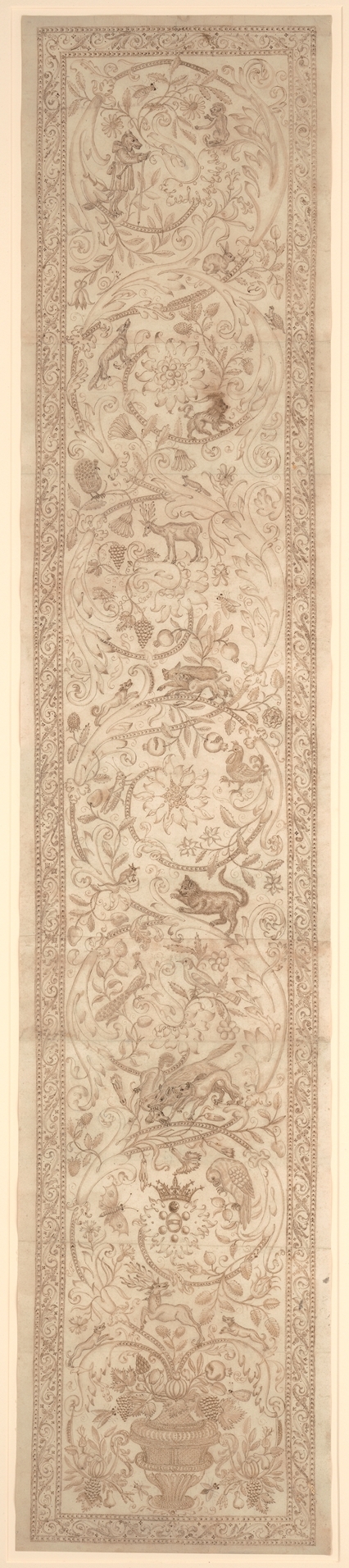
Within the Katherine Fashion Lab’s archive of global sartorial heritage, this pen and brown ink cartoon transcends its immediate function as an embroidery template. It is a profound exercise in applied semiotics, where heraldry becomes haute couture, and fabric transforms into a diplomatic parchment. The standalone study for an orphrey—a decorative band for ecclesiastical vestments—bearing the combined arms of the Medici and the House of Austria, represents a pinnacle of Renaissance power dressing. This is not mere ornamentation; it is a meticulously engineered visual manifesto, where every tincture, charge, and partition articulates a narrative of alliance, ambition, and legitimization.
The Canvas of Alliance: Orphrey as Political Instrument
To appreciate the strategic genius of this cartoon, one must first understand the context of the orphrey. In ecclesiastical vestments, particularly copes and chasubles, orphreys were bands of heavily embroidered fabric, often laden with theological iconography or donor portraits. By commissioning an orphrey for a religious institution, a patron could perform piety while permanently inscribing their identity into the sacred visual field. This cartoon, therefore, outlines a project where the wearer—a high-ranking cleric, likely with ties to both dynasties—would become a living, moving billboard for the union it proclaims. The choice of medium, pen and brown ink, indicates a precise, working design phase, where the balance and clarity of the complex heraldic message were paramount before the costly execution in silk, gold, and silver threads.
Heraldic Syntax: A Grammatical Analysis of the Blazon
The combined arms are a masterclass in visual diplomacy. The Medici arms—typically five to six roundels (palle) in red on a gold field—and the arms of the House of Austria (the red-white-red triband, or the later double-headed eagle of the Holy Roman Empire) are not merely placed side-by-side. Their combination follows strict heraldic grammar, likely achieved through impalement (splitting the shield vertically, with one coat on the dexter, or left from the bearer's perspective, and the other on the sinister) or quartering (dividing the shield into four or more sections).
This fusion speaks directly to specific marital alliances. The most salient union is that of Francesco I de' Medici and Joanna of Austria, daughter of Holy Roman Emperor Ferdinand I, in 1565. This marriage elevated the Medici, Florentine bankers and dukes, into the direct kinship network of the Habsburgs, Europe's preeminent sovereign dynasty. The embroidered orphrey would serve as a permanent, celebratory record of this colossal social climb. Alternatively, it could reference the 1584 marriage of Alessandro de' Medici to Margaret of Austria, the illegitimate daughter of Emperor Charles V. In either case, the cartoon captures a moment where commercial and political capital (Medici) merges with imperial bloodline sovereignty (Habsburg).
Material Intelligence: From Ink Cartoon to Textile Treasure
The lab’s analysis extends to the material translation implied by the drawing. The cartoon is the architectural blueprint for an object of staggering tactile and visual luxury. The brown ink lines demarcate areas that would be rendered in raised goldwork (likely *or nué* or couching), the reds in lustrous silk satin stitch, and the whites in precious silver thread or white silk. The "standalone study" nature suggests it was a focused exploration of the central heraldic motif, ensuring its legibility and impact when scaled and surrounded by the ancillary foliate or geometric patterns typical of orphrey borders.
The technical challenge was immense: to translate the flat, symbolic language of heraldry into a textured, light-interacting masterpiece of embroidery that would hold its dignity in the vast space of a cathedral. The precision of the pen work in the cartoon indicates an exacting standard for the embroiderers, for whom this design was a map to create a microcosm of dynastic authority in thread.
Contextualizing the Standalone Study: Beyond the Ecclesiastical
While destined for a liturgical garment, the implications of this study ripple outward into the secular sphere of Renaissance couture. This heraldic strategy was directly parallel to practices in courtly portraiture and state apparel. A noblewoman’s gown might incorporate the arms of her birth and marital families in its brocade or embroidery, literally weaving her identity and alliances into her garments. The orphrey cartoon is thus part of a broader ecosystem of wearable heraldry, where identity was not abstract but worn, performed, and viewed as an integral, daily proof of status and connection.
Furthermore, as a standalone study, this object possesses intrinsic value as a collectible work of design. It would have been kept in a *bottega* or workshop's portfolio, a testament to the atelier's ability to handle the most prestigious and politically sensitive commissions. It represents the intellectual property of the Renaissance couturier—the designer-heraldist who could navigate the treacherous waters of dynastic pride to produce a symbol acceptable to two mighty houses.
Conclusion: The Unspoken Narrative of Legitimacy
Ultimately, the Katherine Fashion Lab’s analysis reveals that this cartoon’s primary function extends beyond alliance into the realm of legitimization. For the Medici, perpetual newcomers to the European aristocracy despite their wealth and papal power, the constant visual association with the ancient, sacrosanct House of Austria was a potent tool. It grafted their lineage onto a tree of imperial descent, laundering commercial power into blue-blooded authority. Every stitch guided by this cartoon would hammer home that message in the most prestigious forum imaginable: the church itself.
In this single sheet of pen and ink, we find the complete blueprint for Renaissance power dressing—where aesthetics are strategy, craft is diplomacy, and a strip of embroidered fabric becomes a cornerstone of dynastic myth-making. It is a definitive case study in how couture, at its highest level, is never merely about adornment, but about the constitutional assembly of identity itself.