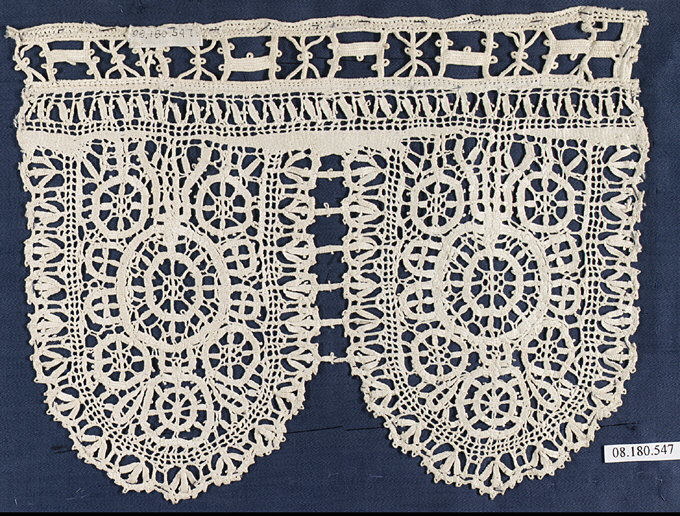
Deconstructing Heritage: The Fragment as a Complete Narrative in Bobbin Lace
In the rarefied sphere of haute couture, where every stitch is a declaration of intent, Katherine Fashion Lab presents a study that challenges the very notion of completion. The subject, Fragment, is not a deficiency but a deliberate aesthetic choice. Originating from the vast lexicon of Global Heritage, this piece is executed in the intricate medium of Bobbin Lace. As a standalone study, it invites a profound interrogation of memory, materiality, and the unspoken power of the incomplete. This analysis dissects how the Lab transforms a technique historically relegated to domestic ornamentation into a vessel for conceptual depth and architectural precision.
Conceptual Architecture: The Power of the Unfinished
The term "Fragment" in this context is a misdirection of the highest order. It does not signify a broken remnant but rather a curated excerpt from an imagined whole. Katherine Fashion Lab leverages the fragment as a narrative device, suggesting that the most compelling stories are those left partially untold. The garment—a sculptural bodice that appears to have been caught mid-creation—is a study in controlled imperfection. The bobbin lace does not terminate neatly at the hem or seam; instead, it dissolves into raw, unbound threads, as if the weaving process were arrested at a moment of peak tension. This is not accidental. It is a philosophical stance: the fragment is more honest than the finished object, for it acknowledges the impossibility of capturing a complete cultural heritage without reduction or distortion.
The global heritage referenced here is deliberately ambiguous. The patterns woven into the lace borrow from Venetian punto in aria (literally "stitches in the air"), Flemish geometric motifs, and Chinese knotting traditions. Yet, no single origin is privileged. Instead, the fragment becomes a palimpsest of global influences, each thread a line of dialogue between cultures. The Lab argues that heritage is not a monolithic block but a series of fragments, each carrying the weight of countless hands and histories. By presenting this as a standalone study, the piece refuses to be contextualized within a single tradition, asserting its autonomy as a hybrid artifact.
Material Mastery: Bobbin Lace as Structural Language
Bobbin lace, traditionally a delicate and time-intensive craft, is reimagined here as a structural medium. Katherine Fashion Lab’s atelier employs a technique that elevates the lace from mere embellishment to the primary load-bearing element of the design. The piece is constructed without a fabric base; the lace itself is the entire garment, supported by a fine internal framework of silk organza and metal thread that is itself woven into the lace pattern. This hybrid construction allows the Fragment to maintain both transparency and rigidity, creating a paradox of fragility and strength.
The material choice is deeply symbolic. Bobbin lace is a product of extreme patience, requiring hundreds of hours of manual manipulation of threads over a pillow. Each intersection of thread is a decision, a tiny knot of intention. In the Fragment, these knots are deliberately varied in tension. Some areas are tightly woven, creating opaque, armor-like panels, while others are loose, forming gossamer veils that shift with the wearer’s breath. This variation in density is not decorative but narrative. The tight sections represent moments of cultural consolidation—the codified rules of a tradition—while the loose sections evoke the porous boundaries where heritage is exchanged, forgotten, or reimagined.
Furthermore, the Lab introduces a subtle iridescence through the use of a blended thread: a core of Egyptian cotton wrapped in a fine filament of Japanese stainless steel. Under natural light, the lace appears matte and historical; under direct illumination, it glints with a metallic future. This dual quality positions the Fragment as a bridge between the archival and the avant-garde, refusing to be fixed in any single era.
Form and Silhouette: The Geometry of Dissolution
The silhouette of the Fragment is a study in asymmetry and negative space. It is not a full garment but a torso-covering structure that extends from one shoulder to the opposite hip, leaving the other side of the body exposed. This asymmetry mirrors the fragment’s conceptual premise: the body is not fully clothed but partially revealed, suggesting that heritage is never fully possessed but always partially visible. The exposed side is not bare; it is adorned with a single, unbroken thread that trails from the lace edge, pooling on the floor like a calligraphic stroke. This thread is a deliberate element, serving as a visual metaphor for the unfinished line of history.
The lace pattern itself follows a fractal logic. Close inspection reveals that a single motif—a six-petaled flower with a geometric center—is repeated at different scales, from the macro level of the bodice’s front panel to the micro level of the fringe. This fractal repetition echoes the way cultural motifs travel and mutate across geographies. The flower, for instance, could be read as a lotus, a rose, or a daisy, depending on the viewer’s cultural lens. The Fragment thus becomes a projective test for the observer, inviting them to complete the narrative based on their own heritage.
Contextual Significance: The Standalone Study as a Provocation
Presenting the Fragment as a standalone study is a radical departure from the traditional couture collection, where pieces are designed to converse with one another. Here, the Fragment exists in isolation, demanding singular attention. This format forces the viewer to engage with the piece on its own terms, without the crutch of a thematic collection or a runway narrative. It is an act of intellectual and aesthetic autonomy. The Lab positions this as a critique of the fashion industry’s tendency toward excess and narrative saturation. In a world of complete looks, the Fragment asks: what if one piece could hold all the meaning necessary?
Moreover, the standalone format aligns with the piece’s exploration of heritage. Heritage, the Lab suggests, is not a coherent story but a series of fragments that we assemble into personal meaning. By refusing to belong to a larger collection, the Fragment mirrors the experience of diaspora and cultural hybridity—the sense of carrying pieces of multiple traditions without a unified whole. It is a garment for the global citizen, who understands that identity is not a seamless garment but a lacework of disparate threads, held together by the tension of intention.
Conclusion: A Thread Through Time
Katherine Fashion Lab’s Fragment is not merely a garment; it is a philosophical proposition rendered in thread. Through the meticulous manipulation of bobbin lace, the piece transforms a craft of domestic heritage into a statement of global, contemporary relevance. It argues that the fragment is not a loss but a liberation—an invitation to engage with the unfinished, the partial, and the open-ended. In a fashion landscape obsessed with completion and perfection, the Fragment stands as a quiet, elegant rebellion. It reminds us that the most powerful narratives are those that leave space for the viewer to weave their own thread into the pattern. And in that space, heritage is not preserved in amber but kept alive, breathing, and forever in the process of becoming.