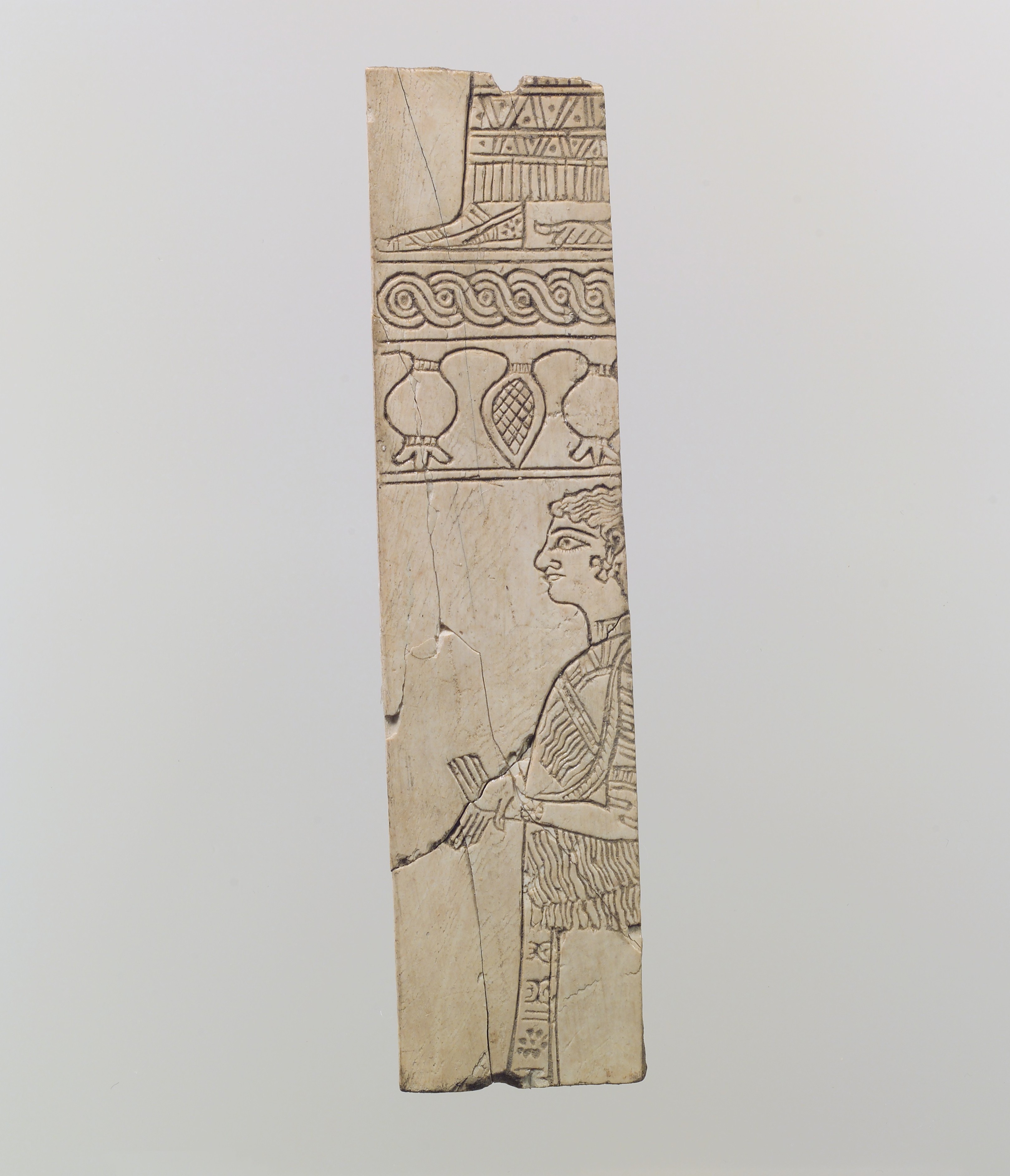
Executive Heritage Analysis: The Assyrian Incised Ivory Plaque
This analysis examines an incised ivory furniture plaque from the Assyrian Empire (c. 9th–7th century BCE), featuring two figures arranged in two registers. As a strategic standalone research document for Katherine Fashion Lab, this paper deconstructs the object’s symbolic power, historical adornment practices, and spiritual meaning, then translates these insights into a forward-looking luxury strategy for 2026. The plaque is not merely a decorative artifact; it is a coded statement of imperial authority, divine favor, and material mastery—themes that resonate profoundly with high-end luxury brand positioning today.
Symbolic Power: Hierarchy and Imperial Narrative
Registers as Visual Hierarchy
The two-register composition is a deliberate structural choice. In Assyrian visual culture, registers functioned as a spatial language of power. The upper register typically depicted the ruler or a divine figure, while the lower register featured subordinates, captives, or ritual attendants. This vertical ordering reinforced the cosmological order: the king as the intermediary between the divine realm (above) and the human world (below). For the modern luxury brand, this principle translates into stratified visual storytelling. A 2026 collection might use layered motifs—an upper tier of precious materials (diamonds, platinum) and a lower tier of handcrafted leather or silk—to imply hierarchy without overt statement. The plaque teaches that power is most potent when embedded in structure, not decoration.
Ivory as a Medium of Prestige
Ivory in the Assyrian context was not merely a material; it was a trophy. Sourced from elephants hunted or tributed from conquered territories, ivory signified the empire’s reach and its ability to extract value from distant lands. The incised technique—precise, labor-intensive, and requiring master carvers—further elevated the object’s status. For Katherine Fashion Lab, this suggests a material strategy rooted in provenance and scarcity. In 2026, luxury clients will demand not just beauty but narrative. An ivory-like aesthetic could be achieved through ethically sourced, sustainable alternatives (e.g., tagua nut or recycled polymer), paired with a story of acquisition: “Sourced from the forests of Sumatra, carved by artisans trained in a 300-year-old tradition.” The plaque’s power lies in its ability to make material a witness to history.
Historical Adornment: The Body and the Object
Furniture as Adornment of Space
In Assyrian palaces, furniture was not merely functional; it was a form of adornment for the built environment. Thrones, beds, and tables were inlaid with ivory plaques like this one, transforming utilitarian objects into vessels of identity. The two figures likely represent a king and a courtier or a divine being and a worshipper, suggesting that furniture served as a stage for ritual performance. For the luxury fashion house, this concept of adornment as environment is critical. A 2026 strategy could extend beyond garments to include “wearable” objects for the home—decorative panels, screens, or even jewelry for furniture. The plaque invites a redefinition of adornment: not just what one wears, but what one inhabits.
Incised Line as Tattoo of Culture
The incised technique—carving lines into the ivory surface—mirrors the practice of tattooing or scarification in ancient cultures. Each line is a permanent mark, a record of identity. In Assyrian art, these lines delineated costume details, hairstyles, and divine attributes. For the modern luxury client, this suggests a return to detail as signature. In 2026, Katherine Fashion Lab might explore collections where every seam, stitch, or laser-cut line carries symbolic weight—a visual language of exclusivity. The plaque teaches that adornment is most powerful when it is inscribed, not applied.
Spiritual Meaning: The Divine and the Mortal
The Two Registers as Cosmological Axis
The two figures in two registers are not simply human; they represent a dialogue between the divine and the mortal. In Assyrian belief, the king was the earthly representative of the god Ashur. The upper register likely depicts a winged protective spirit, a lamassu or apkallu, while the lower register shows a human supplicant. This vertical axis was a spiritual technology—a way to align the palace with the heavens. For luxury branding, this translates into ritualized product placement. A 2026 collection could be structured around a “ritual of dressing,” where each piece is activated by a specific gesture or moment. The plaque suggests that adornment is not static; it is a spiritual practice that connects the wearer to a lineage of power.
Protective Symbolism in Adornment
Ivory plaques were believed to possess apotropaic properties—warding off evil spirits and ensuring the ruler’s longevity. The incised figures, often with exaggerated eyes or wings, served as guardians. In a high-end luxury context, this protective function can be reimagined as emotional armor. In 2026, Katherine Fashion Lab could develop a line of “guardian” accessories—cuffs, pendants, or belts—that bear incised motifs derived from the plaque. The spiritual meaning becomes a selling point: not just beauty, but blessing. This aligns with the growing consumer interest in wellness, mindfulness, and objects imbued with intention.
2026 High-End Luxury Strategy: Translating the Plaque
Material Provenance and Ethical Storytelling
The Assyrian plaque’s power derived from the rarity of its material. For 2026, Katherine Fashion Lab must adopt a radical transparency model. Every material should be traceable to source, with a narrative of ethical acquisition. The plaque’s ivory can be reimagined through sustainable alternatives that mimic its luster and weight, such as bio-resin or fossilized palm wood. The incised technique can be revived through collaborations with master engravers, positioning the brand as a patron of endangered crafts. The strategy is not to copy the past but to channel its logic: rarity plus narrative equals desirability.
Hierarchical Design as Brand Architecture
The two-register structure offers a template for product line architecture. A 2026 collection could feature a “Upper Register” line—limited-edition, high-investment pieces (e.g., a handbag with hand-carved ivory-like panels)—and a “Lower Register” line—accessible luxury items (e.g., scarves with printed incised motifs). This creates a clear ladder of exclusivity, allowing clients to ascend the brand hierarchy. The plaque teaches that power is communicated through visual stratification, not uniformity.
Ritual as Retail Experience
Finally, the spiritual dimension of the plaque points to a new retail paradigm. In 2026, Katherine Fashion Lab’s flagship stores could be designed as “ritual spaces,” where each purchase is accompanied by a symbolic act—a blessing, a personalization, or a storytelling session. The two-register concept could be translated into a two-part shopping journey: an upper-level “sanctum” for VIP clients and a lower-level “atelier” for discovery. The goal is to transform consumption into communion, echoing the Assyrian belief that adornment connects the mortal to the divine.
Conclusion: The Plaque as Strategic Mirror
The incised ivory furniture plaque from the Assyrian Empire is far more than an archaeological curiosity. It is a masterclass in symbolic power, historical adornment, and spiritual meaning. For Katherine Fashion Lab, the plaque offers a blueprint for 2026 luxury: use material as narrative, structure as hierarchy, and ritual as experience. The two figures in two registers are not just a composition; they are a strategy. By understanding the Assyrian impulse to encode power in ivory, the modern brand can create objects that resonate with the same timeless authority—objects that are not merely worn, but inhabited.