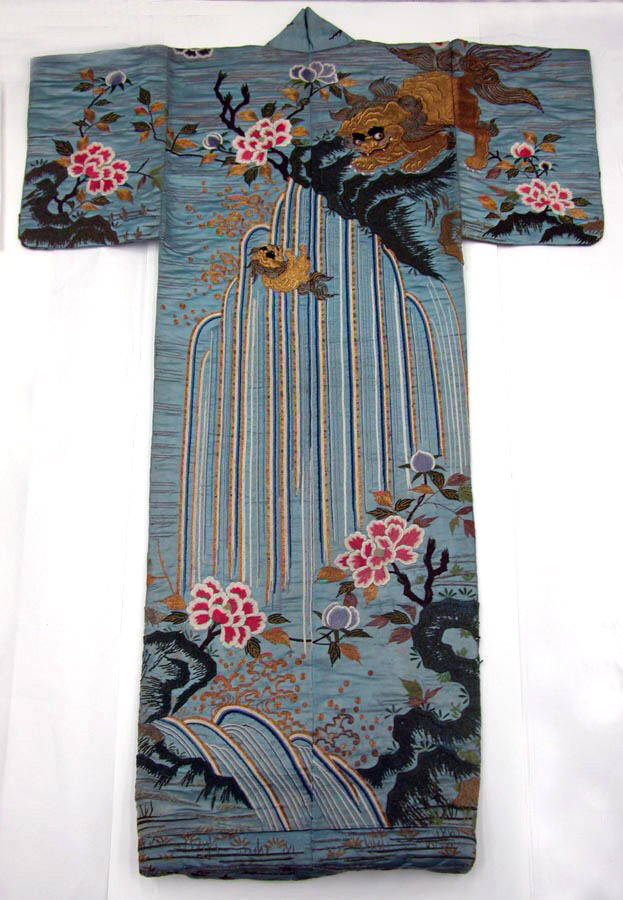
Deconstructing the Uchikake: A Couture Analysis of the Lioness and Cubs Kabuki Robe
Introduction: The Intersection of Theatricality and Textile Mastery
The Kabuki Costume: Outer Robe (Uchikake) with Design of Lioness and Cubs stands as a monumental artifact within the lexicon of Japanese sartorial art, demanding a rigorous couture analysis that transcends mere historical curiosity. As a standalone study, this garment—crafted from silk, cotton, metallic thread, glass, and embroidered satin—offers a profound case study in the synthesis of narrative, symbolism, and technical virtuosity. For the contemporary fashion scholar at Katherine Fashion Lab, this uchikake is not merely a relic of Edo-period theater; it is a blueprint for understanding how haute couture can encode complex cultural narratives through materiality and form. The garment’s design, centered on a lioness and her cubs, subverts traditional masculine tropes of power in Kabuki, presenting instead a nuanced exploration of maternal ferocity, protection, and imperial authority. This analysis will dissect the robe’s structural engineering, embroidery semantics, and chromatic orchestration, arguing that it represents a pinnacle of textile storytelling that prefigures modern couture’s obsession with narrative-driven design.
Structural Engineering: The Uchikake as Architectural Garment
The uchikake’s silhouette is a masterclass in theatrical scale. As an outer robe worn over multiple layers of kimono, its design prioritizes visual impact over practical mobility—a characteristic that resonates with contemporary runway extravagance. The garment’s broad, sweeping sleeves (furisode-style) extend nearly to the floor, creating a horizontal plane that amplifies the wearer’s presence on stage. This is not accidental; the Kabuki actor’s movements—exaggerated, deliberate, and stylized—are designed to manipulate the fabric’s weight and flow, transforming the robe into a living canvas. The use of silk as the primary foundation provides a lustrous, fluid base that catches light and shadow, while the cotton lining adds structural integrity without compromising the garment’s drape. The incorporation of metallic thread (gold and silver) and glass beads introduces a tactile dimensionality that embeds the robe with a subtle, kinetic shimmer—a technique that prefigures the use of sequins and beading in modern couture by centuries.
From a constructionist perspective, the robe’s weight is a critical design variable. The heavily embroidered satin panels on the front and back are strategically placed to anchor the garment, ensuring that the lioness motif remains prominent even during dynamic stage sequences. This balance between opulence and functionality is a hallmark of high-end costume design, where every stitch must serve both aesthetic and performative purposes. The robe’s open front and lack of closures (typical of uchikake) further emphasize its role as a ceremonial overlay, inviting the viewer to focus on the embroidered narrative rather than utilitarian details. For the Katherine Fashion Lab, this garment exemplifies how structural choices can elevate a piece from mere clothing to a sculptural statement—a lesson directly applicable to contemporary couture’s embrace of exaggerated proportions and architectural draping.
Embroidered Semiotics: The Lioness as a Symbol of Power and Nurture
The central motif—a lioness flanked by her cubs—is a deliberate departure from the lion (shishi) imagery more common in Kabuki, which typically symbolizes masculine strength, bravery, and the supernatural. Here, the lioness embodies a dual archetype: ferocity and maternal devotion. The embroidery depicts the lioness in a dynamic, protective stance, her mane rendered in gold metallic thread that catches the stage lights, creating an aura of divine authority. Her cubs, embroidered in softer silk floss and glass beads, are positioned at her flanks, their playful postures contrasting with the mother’s vigilant gaze. This juxtaposition creates a visual tension that mirrors the Kabuki performance’s emotional arc—often oscillating between moments of tenderness and explosive conflict.
The choice of satin as the embroidery ground is significant. Satin’s smooth, reflective surface allows the metallic threads to gleam with heightened intensity, while the glass beads add a three-dimensional quality that mimics the texture of fur and the glint of eyes. The embroiderers employed a technique known as nuihaku, combining embroidery (nui) with gold leaf application (haku), to achieve a luminosity that is almost painterly. Each thread and bead is meticulously placed to guide the viewer’s eye across the robe’s surface, creating a narrative flow from the lioness’s snarling mouth to the cubs’ curled tails. This level of detail underscores the robe’s function as a storytelling device—a concept that resonates with modern couture’s increasing reliance on embroidered narratives, from Schiaparelli’s surrealist motifs to Valentino’s botanical allegories.
Furthermore, the lioness motif carries political and spiritual connotations. In Japanese mythology, the lion (shishi) is a guardian against evil spirits, often depicted at temple entrances. By feminizing this symbol, the robe subtly challenges gender norms within the Kabuki tradition, where male actors (onnagata) portray female roles. The lioness thus becomes a meta-commentary on the performance of femininity itself—a theme that echoes in contemporary fashion’s exploration of gender fluidity. For the Katherine Fashion Lab, this garment is a testament to how embroidery can function as a semiotic system, encoding layers of meaning that extend beyond the visual.
Chromatic Orchestration: The Palette of Authority and Emotion
The color palette of this uchikake is a sophisticated interplay of deep indigo, crimson, gold, and ivory, each hue serving a distinct narrative function. The indigo ground—achieved through natural dyeing with the indigo plant—evokes the night sky, a traditional backdrop for Kabuki dramas set in the liminal space between reality and fantasy. This dark background makes the crimson accents (on the lioness’s tongue, the cubs’ eyes, and scattered floral elements) pop with visceral intensity, symbolizing life force, danger, and passion. The gold metallic threads are not merely decorative; they represent the divine or imperial, linking the lioness to the celestial realm and the authority of the shogunate. The ivory satin used for the cubs’ bodies introduces a note of innocence and vulnerability, contrasting sharply with the mother’s aggressive posture.
This chromatic strategy is reminiscent of color blocking in modern couture, where deliberate contrasts are used to direct the viewer’s attention and evoke specific emotional responses. The robe’s designers understood that color is not merely aesthetic but psychological—a principle that informs everything from Balenciaga’s monochromatic severity to Dior’s chromatic storytelling. In the context of Kabuki, where lighting was often dim and the audience distant, these bold color choices ensured that the narrative was legible from every angle. For the Katherine Fashion Lab, this palette offers a masterclass in color theory as a narrative tool, demonstrating how hue, saturation, and contrast can be orchestrated to convey power, vulnerability, and drama.
Cultural and Couture Implications: A Legacy for Modern Design
As a standalone study, this uchikake transcends its theatrical origins to offer enduring insights for contemporary couture. Its emphasis on narrative embroidery prefigures the rise of “story-driven” fashion in the 21st century, where designers like John Galliano and Alexander McQueen have used garments as canvases for complex allegories. The robe’s structural opulence—its weight, scale, and material richness—challenges the modern industry’s obsession with minimalism and mass production, reminding us that couture’s true value lies in its ability to embody cultural memory. Moreover, the lioness motif’s subversion of gender tropes aligns with contemporary dialogues around femininity and power, offering a historical precedent for fashion as a site of social critique.
The craftsmanship involved—from the hand-dyed silk to the painstaking nuihaku embroidery—represents a level of artisanal investment that is increasingly rare in the age of fast fashion. For the Katherine Fashion Lab, this garment is a call to preserve and evolve such techniques, integrating them into sustainable, high-value design practices. The robe also underscores the importance of contextual research in design education: understanding the Kabuki aesthetic—its exaggerated movements, symbolic colors, and narrative depth—can inform how modern designers approach theatricality and storytelling in their own work.
In conclusion, the Kabuki Costume: Outer Robe (Uchikake) with Design of Lioness and Cubs is far more than a historical artifact; it is a living lesson in the convergence of art, culture, and craft. Its analysis reveals that couture, at its highest expression, is not merely about adornment but about encoding the human experience into fabric. For the students and practitioners at Katherine Fashion Lab, this robe serves as both inspiration and instruction—a reminder that the most enduring garments are those that speak, through every thread and bead, to the complexities of the world they inhabit.