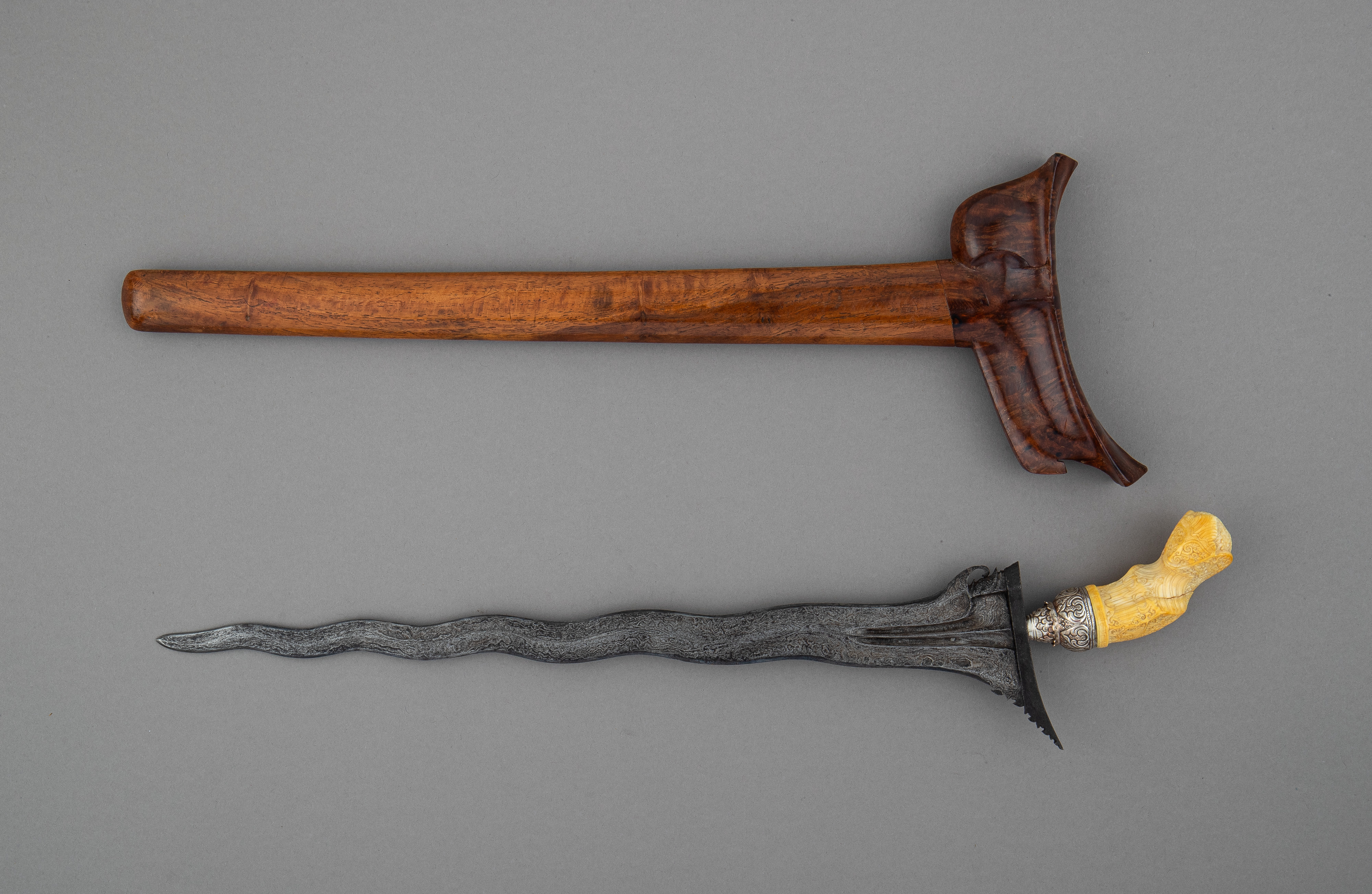
Heritage Analysis: The Sumatran Kris with Sheath
In the pursuit of positioning Katherine Fashion Lab at the vanguard of 2026 high-end luxury, we turn to the Sumatran Kris with Sheath—a ceremonial dagger of profound cultural resonance. This heritage artifact, forged from steel, wood, ivory, silver, and copper, transcends its functional origins to embody a complex lexicon of symbolic power, historical adornment, and spiritual meaning. As Lead Heritage Curator, I present this strategic standalone research to distill the kris’s essence into actionable insights for luxury brand strategy, where authenticity, narrative depth, and material mastery converge.
Symbolic Power: The Kris as a Conduit of Authority and Identity
The Sumatran kris is not merely a weapon; it is a potent symbol of social hierarchy, martial prowess, and ancestral legitimacy. Within the archipelago’s courtly traditions, the kris served as a regalia of sultans and chieftains, its ownership restricted to those of noble birth or exceptional achievement. The blade’s distinctive wavy form, known as luk, is believed to represent the mythical naga serpent, a guardian of cosmic balance. Each curve signifies a layer of spiritual protection and political authority, with the number of waves often denoting the bearer’s rank.
For Katherine Fashion Lab, this symbolism translates into a design language of status and exclusivity. In 2026 luxury, where consumers seek markers of personal power and lineage, the kris’s visual grammar—its sinuous lines, asymmetrical balance, and deliberate ornamentation—offers a template for collections that communicate controlled strength and refined dominance. Consider how the kris’s handle, often carved from ivory or wood, is ergonomically contoured to fit the hand of a leader. This principle of ergonomic luxury—where form follows authority—can inform bespoke accessories, from clutches to cufflinks, that mirror the kris’s assertive yet elegant silhouette.
Historical Adornment: Materiality as a Record of Prestige
The kris with sheath is a masterclass in material storytelling. Its construction integrates steel for the blade, wood and ivory for the hilt, and silver or copper for the sheath’s fittings. Historically, these materials were not chosen arbitrarily; they reflected trade routes, artisan guilds, and the patron’s wealth. The pamor—the layered steel pattern on the blade—was achieved through intricate forge-welding, a technique that required years of apprenticeship. Similarly, the sheath’s silver overlay, often embossed with floral or geometric motifs, signaled the owner’s connection to Islamic and pre-Islamic decorative traditions.
For high-end luxury strategy, this material hierarchy offers a roadmap for artisanal differentiation. In 2026, discerning clients will prioritize provenance and craftsmanship over mass-produced opulence. Katherine Fashion Lab can emulate the kris’s approach by sourcing rare materials—such as ethically harvested ivory alternatives, reclaimed silver, or region-specific woods—and collaborating with master artisans to create limited-edition pieces. The kris’s sheath, with its dual function as protection and display, also inspires modular luxury design: a handbag or jewelry box that opens to reveal a carefully curated interior, much like the sheath unveils the blade.
Spiritual Meaning: The Kris as a Talisman of Protection and Power
Beyond its physical form, the Sumatran kris is imbued with animistic and Islamic spiritual significance. It is considered a living object, often blessed by a shaman or spiritual leader before being passed down through generations. The blade is believed to possess a tuah—a mystical energy that can bring fortune, ward off evil, or even influence the wearer’s fate. This belief system elevates the kris from a mere artifact to a personal totem, a tangible connection between the earthly and the divine.
In the context of 2026 luxury, spirituality is emerging as a key consumer driver. The post-pandemic era has seen a surge in demand for objects that offer emotional grounding and metaphysical resonance. Katherine Fashion Lab can harness this by positioning its collections as “modern talismans”—pieces that are not just worn but ritualistically engaged. For instance, a kris-inspired pendant could be designed with a hidden compartment for a personal inscription or a gemstone charged with intention. This approach aligns with the luxury trend of “slow adornment,” where the act of wearing becomes a daily ritual of self-empowerment.
2026 High-End Luxury Strategy: Translating Heritage into Brand Equity
To integrate the Sumatran kris’s heritage into a cohesive 2026 strategy, Katherine Fashion Lab must move beyond mere aesthetic appropriation. The following strategic pillars, grounded in MBA principles of brand architecture and consumer psychology, are recommended:
1. Narrative-Driven Product Architecture
Develop a dedicated “Kris Collection” that tells a story of transformation—from raw material to spiritual artifact. Each piece should be accompanied by a digital provenance card detailing the artisan’s lineage, the material’s origin, and the symbolic meaning of its design. This creates a value chain of authenticity, justifying premium pricing while fostering emotional attachment.
2. Experiential Retail and Ritual
Launch pop-up “Sanctuaries” in key luxury markets (e.g., Singapore, London, Dubai) where clients can participate in a curated blessing ceremony led by cultural custodians. This mirrors the kris’s spiritual activation and positions the brand as a guardian of intangible heritage. The experience should be intimate, by appointment only, reinforcing exclusivity.
3. Collaborative Artisanship
Partner with Sumatran empu (bladesmiths) and silversmiths to co-create a limited run of 100 pieces. This artisan equity model not only preserves traditional techniques but also generates press-worthy narratives of cultural preservation. The collaboration can be framed as a “revival of forgotten craft,” appealing to the luxury consumer’s desire for meaningful consumption.
4. Symbolic Color and Pattern Language
Abstract the kris’s visual motifs—the wavy blade, the pamor patterns, the floral silverwork—into a signature brand pattern for textiles, leather goods, and packaging. This pattern should be subtle, recognizable only to connoisseurs, creating a code of belonging among elite clientele.
Conclusion: The Kris as a Strategic Archetype
The Sumatran kris with sheath is more than a museum piece; it is a strategic archetype for 2026 luxury. Its fusion of symbolic power, historical adornment, and spiritual meaning offers Katherine Fashion Lab a blueprint for creating objects that are not just beautiful but culturally charged. By honoring the kris’s origins through ethical collaboration and narrative depth, the brand can achieve a rare equilibrium: honoring tradition while driving innovation. In an era where luxury is increasingly defined by storytelling and soul, the kris reminds us that the most enduring artifacts are those that carry the weight of worlds.