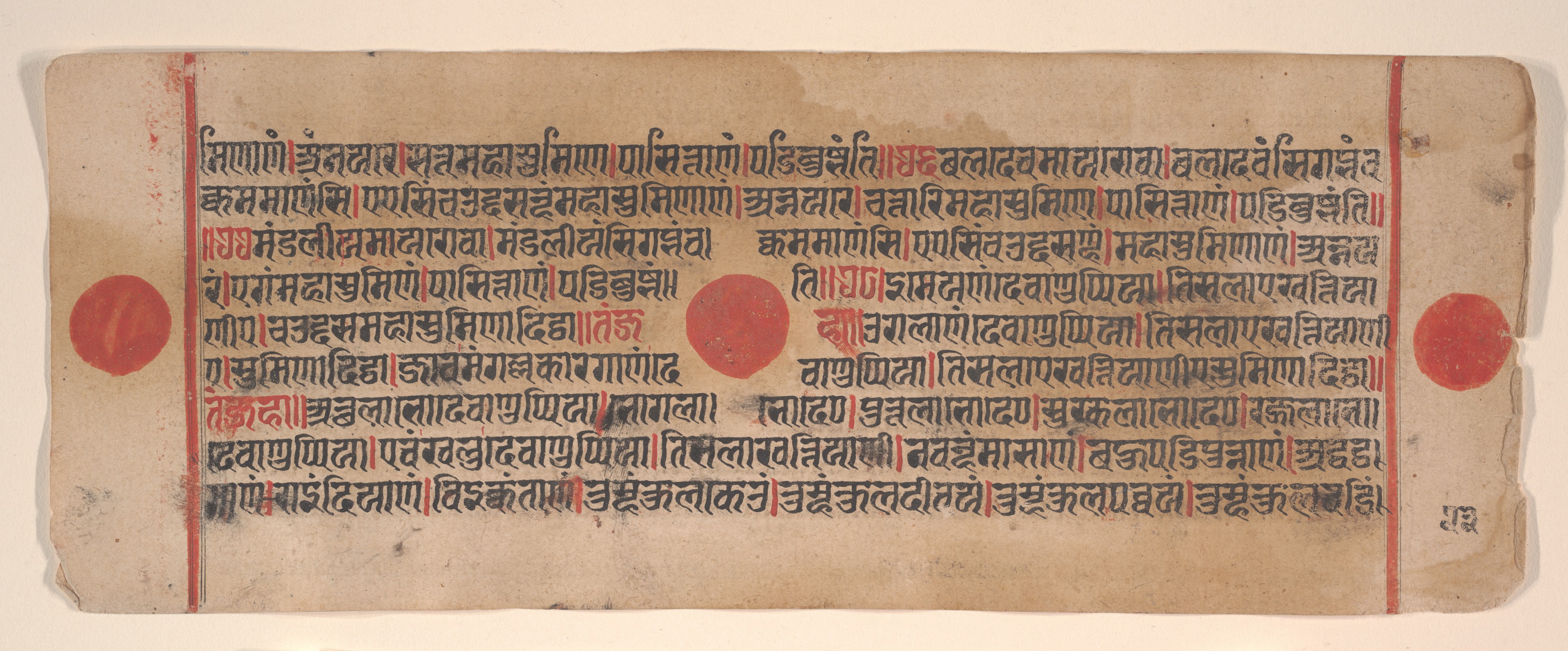
Heritage Analysis: Leaf from a Kalpa Sutra (Jain Book of Rituals)
Executive Overview: Strategic Significance for Katherine Fashion Lab
This heritage analysis examines a leaf from a Kalpa Sutra, a Jain sacred manuscript originating in Gujarat, India, circa 15th–16th century. Executed in ink, opaque watercolor, and gold on paper, this artifact represents a pinnacle of spiritual artistry and symbolic communication. For Katherine Fashion Lab, this object offers profound insights into the intersection of sacred adornment, material symbolism, and luxury brand narrative. As the brand prepares for its 2026 high-end luxury strategy, this research provides a foundational framework for integrating historical symbolism, ethical provenance, and transcendent aesthetics into a contemporary luxury offering.
Symbolic Power: The Language of Sacred Geometry and Iconography
The Kalpa Sutra leaf is not merely an illustration; it is a meticulously encoded system of spiritual and social meaning. The central figure, typically a Tirthankara or a revered monk, is depicted with elongated limbs, a practice that signifies detachment from earthly form and a transcendence of physical limitation. The use of gold leaf or gold paint is not decorative but sacral, representing the eternal, immutable nature of the soul (atman) and the purity of the liberated state. The lotus motif, often present in the background or as a pedestal, symbolizes spiritual unfolding and purity amidst the material world. For luxury strategy, these symbols translate into a visual language of rarity, perfection, and spiritual aspiration. Katherine Fashion Lab can leverage this symbolic lexicon to communicate that its garments are not mere products but vessels of intention, embodying the wearer’s journey toward inner refinement. The gold, a perennial symbol of wealth and divinity, becomes a meta-narrative for the brand’s commitment to material excellence and transcendent value.
Historical Adornment: The Art of Manuscript Illumination as Prototype for Luxury Craft
The Kalpa Sutra leaf exemplifies the Gujarati school of manuscript painting, a tradition that flourished under Jain patronage. The medium—opaque watercolor on paper—required extraordinary precision and patience. Pigments were derived from natural sources: lapis lazuli for blue, cinnabar for red, and orpiment for yellow. The application of gold was a ritualistic act, often reserved for the most sacred elements. This artisanal rigor is a direct precursor to the haute couture techniques Katherine Fashion Lab champions. The leaf’s composition, with its balanced asymmetry and intricate border patterns, mirrors the structural logic of a luxury garment’s silhouette and detailing. Historically, these manuscripts were commissioned by wealthy merchants and royalty as acts of merit and status display. The conspicuous spirituality of the object served to elevate the patron’s social standing while affirming their piety. For the 2026 strategy, this suggests a powerful model: luxury as visible virtue. Katherine Fashion Lab can position its collections as modern-day manuscripts, where each stitch, embroidery, and fabric choice is a deliberate act of cultural reverence and personal distinction.
Spiritual Meaning: The Kalpa Sutra as a Blueprint for Transcendent Luxury
At its core, the Kalpa Sutra is a book of rituals, detailing the lives of the Tirthankaras and the practices of Jain monks. The leaf’s purpose is to guide the devotee toward ahimsa (non-violence), aparigraha (non-attachment), and anekantavada (multiplicity of viewpoints). These principles offer a radical framework for luxury in 2026. The concept of non-attachment challenges the traditional luxury model of accumulation. Instead, Katherine Fashion Lab can embrace a philosophy of curated minimalism—pieces that are so meaningful and versatile they become lifelong companions. The leaf’s use of gold and vibrant color, despite the asceticism of Jainism, reveals a nuanced truth: spiritual transcendence does not require the rejection of beauty, but its intentional deployment. This is a critical insight for high-end luxury strategy. The brand can position its offerings as sacred objects that elevate daily life, not through excess but through profound aesthetic and ethical coherence. The Kalpa Sutra’s narrative structure—a sequence of sacred biographies—suggests a storytelling approach to collections, where each garment tells a chapter of a larger, timeless narrative of transformation and grace.
2026 High-End Luxury Strategy: Translating Heritage into Competitive Advantage
To operationalize these insights, Katherine Fashion Lab must adopt a three-pillar strategy: Material Sanctity, Narrative Depth, and Ethical Provenance.
Material Sanctity refers to the deliberate selection of materials that echo the manuscript’s reverence for natural pigments and precious metals. For 2026, the brand should partner with ethical gold suppliers and natural dye artisans to create a limited “Kalpa Collection” featuring gold-thread embroidery on handwoven silks. The color palette—deep indigo, vermilion, saffron, and gold—should be presented as “sacred chromatic notes” in the brand’s lexicon. Each garment’s construction should reflect the manuscript’s precision, with seams and finishes that invite close examination, much like the leaf’s intricate brushwork.
Narrative Depth involves embedding the Kalpa Sutra’s spiritual meanings into the brand’s communication. The 2026 campaign can be structured around “Seven Virtues of Adornment,” each corresponding to a Tirthankara’s quality: non-violence (soft, cruelty-free fabrics), non-attachment (versatile, timeless designs), and multiplicity (inclusive sizing and modular pieces). The leaf’s gold accents become a metaphor for the brand’s commitment to illuminating the wearer’s inner light. Storytelling should be multi-layered, from lookbook narratives to in-store immersive experiences that replicate the meditative act of viewing a manuscript.
Ethical Provenance is non-negotiable. The Kalpa Sutra’s origins in Gujarat demand a respectful, non-appropriative engagement. Katherine Fashion Lab should establish a Cultural Advisory Board with Jain scholars and Gujarati artisans to ensure authenticity and mutual benefit. A percentage of proceeds from the Kalpa Collection can fund the preservation of Jain manuscript traditions. This transforms the brand from a passive inheritor of heritage to an active steward. In the 2026 luxury landscape, where consumers increasingly demand transparency and cultural sensitivity, this approach builds trust and differentiation. The leaf’s gold, once a symbol of royal patronage, now symbolizes the brand’s ethical luminosity.
Conclusion: The Kalpa Sutra as a Strategic Compass
This leaf from a Kalpa Sutra is more than an artifact; it is a strategic compass for Katherine Fashion Lab’s 2026 luxury strategy. Its symbolic power teaches the language of aspiration; its historical adornment models the discipline of craft; its spiritual meaning offers a philosophy of intentional consumption. By translating the manuscript’s sacred geometry into design, its ritual precision into craftsmanship, and its ethical foundations into brand governance, Katherine Fashion Lab can achieve a rare synthesis: luxury that is both opulent and transcendent, exclusive yet inclusive, modern yet timeless. The gold on this page is not just a pigment—it is a promise. For the brand, the promise is to create not just garments, but heirlooms of the spirit.