The Poetics of Partition: A Couture Analysis of Katherine Fashion Lab’s “Border (One of Two Joined)”
Context and Conceptual Foundation
In the rarefied domain of haute couture, where fabric becomes philosophy and stitch transforms into statement, Katherine Fashion Lab presents a singular artifact: “Border (One of Two Joined)”. This piece, conceived as a standalone study rather than part of a seasonal collection, interrogates the very nature of boundaries—both physical and metaphysical. The title itself is a provocation: a border that is simultaneously singular and relational, one half of a dyad that implies an absent counterpart. This duality echoes the tension between separation and connection, a theme that resonates deeply in a globalized world where heritage and identity are constantly negotiated.
The standalone study format liberates the work from the constraints of a runway narrative. It is not a garment to be worn but a textile artifact to be contemplated—a meditation on craft, memory, and the liminal spaces that define human experience. The choice to isolate this piece from a collection underscores its conceptual weight: it exists as a discrete object, yet its meaning is inherently dialogical, requiring the viewer to imagine the missing “other” that completes it.
Material Mastery: Needle Lace as Metaphor
At the heart of this analysis lies the material: needle lace. This is not a fabric of convenience but one of profound intentionality. Needle lace, a technique that emerged in Renaissance Europe and reached its apogee in the courts of Venice and France, is among the most labor-intensive of textile arts. Each loop, knot, and bridge is executed by hand, often over months, using a single needle and thread. The process is both meticulous and meditative, demanding a patience that borders on the devotional.
Katherine Fashion Lab’s deployment of needle lace is not merely decorative; it is structural and symbolic. The openwork of the lace creates a porous boundary—a border that is both present and absent, solid and ethereal. This material paradox mirrors the conceptual framework of the piece: a border that defines a space yet remains permeable. The threads, fine as spider silk, weave a narrative of connection across voids, each stitch a fragile yet deliberate link between two realms.
Moreover, needle lace’s historical association with global heritage adds layers of cultural resonance. While the technique originated in Europe, it was transformed by trade routes, colonial exchanges, and regional adaptations. In India, the “chikan” embroidery of Lucknow echoes lace’s intricacy; in China, “su xiu” silk embroidery parallels its precision; in Latin America, “encaje” traditions blend indigenous and European motifs. By choosing needle lace, the Lab aligns itself with a transnational lineage of craftsmanship, honoring the global diffusion of textile knowledge without appropriating any single culture. The material itself becomes a border—a meeting point of histories, techniques, and aesthetics.
Design Analysis: The Geometry of Connection
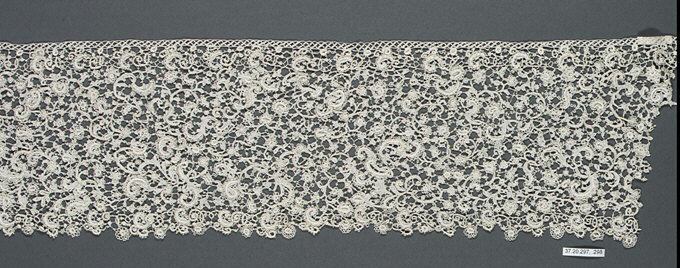
The physical form of “Border (One of Two Joined)” is deceptively simple. It presents as a long, narrow strip of needle lace, approximately 120 centimeters in length and 15 centimeters in width. The edges are irregular, scalloped, as if the lace has been torn from a larger whole. This imperfection is deliberate: it suggests that the border is not a finished boundary but an interruption, a fragment awaiting completion.
The pattern within the lace is a study in geometric restraint. Repeating motifs of interlocking diamonds and staggered circles create a rhythm that oscillates between order and organic flow. The diamonds, sharp and angular, evoke the rigidity of political borders, while the circles suggest cycles, continuity, and the organic boundaries of nature—tree rings, cell membranes, the horizon. The interplay between these shapes generates a visual tension: the border is both a cage and a gateway.
Color is minimal but significant. The lace is rendered in a single, undyed thread of natural linen, its pale ecru hue evoking parchment, aged bone, and the neutrality of unmarked territory. This chromatic asceticism forces the viewer to focus on texture and structure rather than chromatic distraction. The absence of color is a statement: borders are not inherently colorful; they are human constructs, often invisible until contested.
The scale of the piece is intimate, demanding close inspection. At a distance, it reads as a simple ribbon; up close, the complexity of the lace reveals itself. This shift in perception mirrors the experience of borders themselves—abstract on a map, visceral on the ground. The viewer must lean in, engage, and trace the threads with their eyes, becoming a participant in the act of joining.
Conceptual Depth: The Border as Existential Threshold
“Border (One of Two Joined)” transcends its materiality to become a philosophical object. In a world increasingly defined by walls—physical, digital, ideological—the Lab asks: What does it mean to be joined? The title’s parenthetical “one of two” implies that the border is incomplete without its counterpart. This relational ontology challenges the notion of borders as absolute divisions. Instead, they are portrayed as interdependent constructs, existing only in relation to what they separate.
The piece also engages with temporality. Needle lace, by its nature, is slow. Each stitch is a moment, and the completed work is a chronology of labor. The border thus becomes a record of time—a palimpsest of hours, days, and months spent in concentrated creation. This temporal density contrasts with the instantaneity of modern border crossings, where identity is verified in seconds by a scanner. The Lab’s work insists on the duration of connection, suggesting that true joining requires patience, care, and the willingness to dwell in the liminal.
Furthermore, the piece addresses cultural hybridity. As a global heritage artifact, the border does not belong to a single tradition. It is a synthesis of European lace techniques, Asian embroidery influences, and the nomadic aesthetics of trade routes. This hybridity is not a dilution but an enrichment—a testament to the creativity that emerges when cultures meet at their edges. The border, in this reading, is not a barrier but a site of exchange, a threshold where identities are negotiated and transformed.
Technical Execution and Artisanal Integrity
From a technical standpoint, the execution of this piece is exemplary. The needle lace is constructed using a continuous thread technique, where the entire piece is formed from a single strand without breaks or knots. This method requires exceptional skill, as any error in tension or spacing cannot be corrected without unraveling the whole. The result is a fabric of extraordinary uniformity and strength, despite its delicate appearance.
The grid structure of the lace is reinforced by subtle variations in stitch density. The diamonds are outlined in a heavier gauge thread, creating a raised, almost sculptural effect. The circles, by contrast, are rendered in finer thread, with open centers that allow light to pass through. This interplay of opacity and transparency creates a dynamic visual rhythm, shifting as the viewer moves or the lighting changes. The border is never static; it breathes, reflects, and transforms.
The finishing of the edges is particularly noteworthy. Rather than a clean hem, the scalloped border is left raw, with threads trailing off in tiny loops. This deliberate incompleteness reinforces the theme of the “joined” piece—it is a border that acknowledges its own provisional nature, a line that knows it is not a wall.
Conclusion: The Border as a Mirror
Katherine Fashion Lab’s “Border (One of Two Joined)” is a masterwork of conceptual couture, a piece that uses the language of textile art to explore the most pressing questions of our time. Through its choice of needle lace, its geometric rigor, and its philosophical depth, it transforms a simple strip of fabric into a mirror of human condition. It asks us to consider the borders we erect—between nations, between cultures, between selves—and the fragile, labor-intensive threads that can, with patience, join them.
In an era of quick fixes and digital divides, this standalone study reminds us that true connection is crafted, not given. It is a border that does not divide but invites—a threshold that, in its openness, becomes a bridge. The missing half of the dyad is not absent; it is the viewer, the world, the other that we are forever seeking to join.