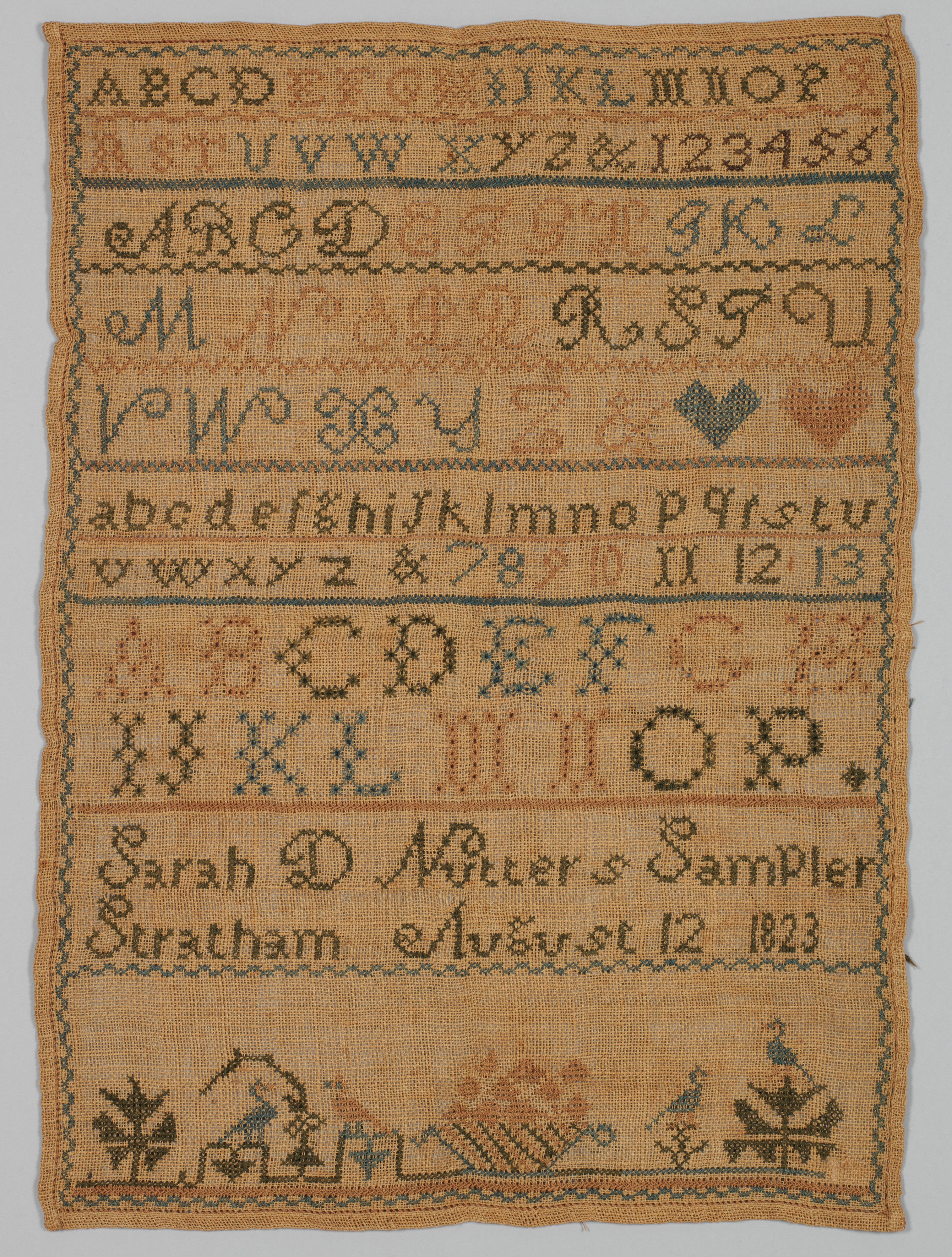
Deconstructing the Sampler: From Domestic Ephemera to Couture Canvas
Within the hallowed, minimalist atelier of Katherine Fashion Lab, the humble sampler—a once-ubiquitous artifact of feminine domestic education—is subjected to a rigorous, transformative analysis. This is not an exercise in nostalgic revivalism but a profound deconstruction of a global heritage object. The sampler, in its original context, was a paradox: a constrained exercise in obedience that became a vessel for silent, stitched autobiography. By isolating it as a standalone study and transposing its essence onto a foundation of cotton on linen canvas, the Lab engages in a critical discourse on memory, labor, value, and the very fabric of cultural transmission. This analysis posits the sampler not as a relic, but as a pre-industrial database, a tactile algorithm of skill and story waiting to be decoded by contemporary couture intelligence.
The Substrate: Linen Canvas as Archive and Arena
The choice of linen canvas as the primary ground is a deliberate strategic move, laden with semiotic weight. Historically, linen signified purity, durability, and a certain domestic prestige. As a canvas, it references the fine art world, immediately elevating the stitched mark from craft to authored statement. This material decision reframes the sampler's purpose. It is no longer a functional test of household mending proficiency but becomes an archival field, a neutral yet texturally rich plane upon which narrative is built. The inherent slubs and irregularities of the linen interact with the applied cotton elements, creating a dialogue between the foundational support and the ornamental intervention. This mirrors the original sampler's existence: a young woman's personal expression (the cotton threads) forever intertwined with, and constrained by, the societal framework (the linen ground) provided to her.
The application of cotton—the sampler's traditional medium—onto this canvas is re-engineered. At Katherine Fashion Lab, cotton is not merely threaded through a needle. It is manipulated as a three-dimensional, structural element: padded, cabled, twisted, and sometimes left raw and frayed. This treatment investigates the materiality of communication. A raised, corded cotton alphabet letter becomes a Braille-like testament; a flat, satin-stitched motif speaks of public presentation; a tangled, knotted section whispers of frustration or experimental deviation. The canvas thus becomes an arena where the tactile vocabulary of historical female labor is amplified and re-contextualized, demanding a physical, not just visual, engagement from the observer.
Stitch as Syntax: Decoding a Global Visual Language
The sampler's origin in global heritage is crucial to this study. From English Jacobean crewelwork to Chinese silk embroidery, from Palestinian *tatriz* to Mexican *tenango* patterns, the sampler represents a decentralized, yet interconnected, network of visual knowledge. Katherine Fashion Lab approaches these stitch techniques not as ethnic motifs to be appropriated, but as discrete units of syntactic code. A French knot is analyzed for its volumetric potential; a cross-stitch is deconstructed into its constituent X-shaped vectors, exploring its pixel-like capacity for building complex imagery.
This analytical process reveals the sampler as a proto-digital medium. The counted-thread technique is a grid system, a precursor to the pixel array. The repetitive, algorithmic nature of filling a shape with satin stitch mirrors computational rendering. By isolating these elements in a standalone study, the Lab highlights how these historical techniques were, in fact, sophisticated data storage and transmission systems. Patterns, alphabets, and moral verses were coded into fabric, passed from mother to daughter, migrant to community, across oceans and generations. The couture interpretation thus becomes an act of data visualization, pulling this embedded code to the surface and recompiling it to express contemporary narratives of identity, diaspora, and digital-physical hybridity.
From Ephemeral Exercise to Enduring Artifact: The Value Proposition
The most radical element of this standalone study lies in its re-assessment of value. The historical sampler existed in a liminal space—precious to its maker and family, but often dismissed by broader historical and economic canons as "women's work." By treating the sampler's conceptual framework with the gravity of haute couture, Katherine Fashion Lab executes a dramatic value transposition. The hundreds of hours of meticulous labor, once an expected domestic duty, are re-framed as the ultimate luxury: irreplaceable time and focused human intention.
The "standalone study" format is key. Liberated from the need to become a garment—a functional object—the analysis exists purely as an intellectual and artistic proposition. It forces the viewer to confront the content without the distraction of form. This mirrors how museums display historical samplers: behind glass, as cultural texts. The Lab's work, however, is not static; it is a living analysis that proposes a future for this heritage. The cotton-on-linen canvas becomes a speculative blueprint, suggesting how these principles of narrative construction, grid-based design, and tactile communication can inform future couture methodologies—perhaps in the cut of a jacket whose seams follow the logic of a stem stitch, or in a gown whose embellishment tells a personal history in a coded, stitched language.
Conclusion: The Sampler Re-Threaded
Katherine Fashion Lab's analysis of the sampler concludes not with a definitive garment, but with a powerful set of operational principles. The study demonstrates that heritage is not a reservoir of motifs to be mined, but a complex system of thought, technique, and communication waiting to be reverse-engineered. By focusing on the material dialectic of cotton on linen canvas, the Lab highlights the enduring tension between individual expression and societal structure. By decoding the sampler's global visual language, it reveals universal human impulses to record, beautify, and belong. And by presenting this as a standalone study, it makes an uncompromising argument for the sampler's relevance as a critical, conceptual tool for the future of couture. The thread is not cut; it is merely being re-threaded into the needle of contemporary consciousness, poised to stitch a new, profoundly intelligent narrative into the canvas of fashion.