Deconstructing Heritage: A Couture Analysis of a Singular Silken Masterpiece
Introduction: The Art of the Standalone Study
Within the exclusive twelve-piece collection curated by Katherine Fashion Lab, each garment functions not merely as clothing but as a thesis—a standalone study in the dialogue between global heritage and contemporary couture. The piece under examination, a resplendent ensemble rendered in silk and needle lace, transcends seasonal trends to assert itself as a museum-quality artifact. It embodies a rigorous intellectual and artisanal process, where material provenance and technique converge to narrate a story of cultural exchange, preservation, and innovation. This analysis dissects the garment’s architecture, its material dialogue, and its profound resonance as a vessel of global memory.
Materiality as Narrative: Silk and the Geography of Luxury
The foundation of this piece is silk, a fiber that has historically functioned as a currency of power and a conduit of cross-continental exchange. The Katherine Fashion Lab’s choice of silk is not arbitrary; it is a deliberate invocation of the Silk Road’s legacy—a network that linked East Asia, the Middle East, and Europe for millennia. The specific silk used here is a raw, matte charmeuse of exceptional weight, its surface possessing a subtle, organic irregularity that speaks to hand-reeling and natural dyeing processes. This tactile quality immediately signals a departure from industrially produced textiles, grounding the garment in the ethos of slow, intentional creation.
The silk’s color—a deep, undulating indigo—further anchors the piece in global heritage. Indigo, derived from plants such as *Indigofera tinctoria*, has been independently cultivated in regions from West Africa to Japan and India. Its presence here is a chromatic homage to the universality of craft. The dye is not uniform; under direct light, it reveals subtle variations—a shibori-like depth—that mimic the unpredictable beauty of natural fermentation. This imperfection is a signature of the Lab’s philosophy: that luxury lies not in flawlessness, but in the honest record of human hands and natural processes.
Needle Lace: The Architecture of Air
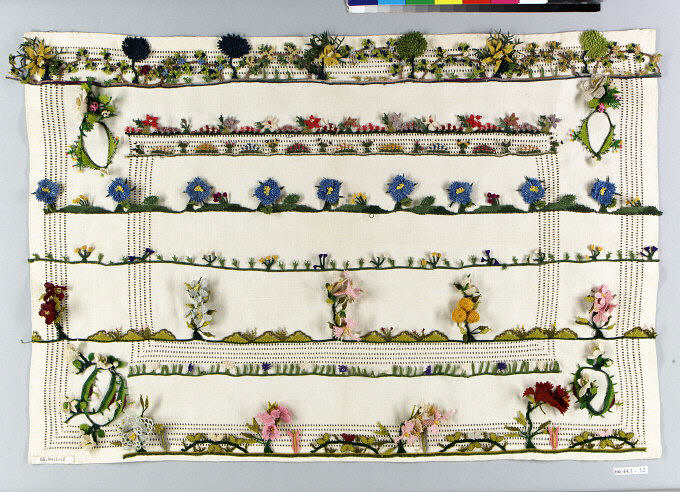
Counterbalancing the silk’s fluidity is the intricate overlay of needle lace, a technique of extreme precision and patience. Unlike bobbin lace, which is made on a pillow, needle lace is constructed stitch by stitch with a single needle and thread, building a fabric that is simultaneously rigid and ethereal. In this piece, the lace is not a peripheral trim but a structural component, forming a second skin that follows the silhouette’s contours. It is applied as a sculptural yoke and cascades down the sleeves and hem in organic, web-like patterns.
The motifs within the lace are a masterclass in cultural synthesis. The design incorporates geometric tessellations reminiscent of Islamic *girih* tiles, interwoven with floral arabesques that evoke the Mughal gardens of South Asia, and subtle asymmetric curves drawn from East Asian ink painting. This is not mere pastiche; each element is reinterpreted through the lens of modern minimalism, creating a visual language that is both ancient and futuristic. The labor required—estimated at over 600 hours of handwork—elevates the lace to the status of haute couture’s highest echelon. It is a testament to the value of endangered skills, positioning the piece as a guardian of artisanal knowledge.
Silhouette and Structure: The Body as Canvas
The garment’s silhouette is a study in controlled tension. It features a fitted, boneless bodice that relies on the silk’s own weight and the lace’s structural integrity to mold the torso, eschewing modern corsetry for a softer, more organic form. The waist is defined not by a seam but by a gradual cinching of the lace pattern, which narrows the visual field before releasing into a full, sweeping skirt. This skirt is cut on the bias, allowing the charmeuse to drape in liquid folds that whisper against the floor with each step.
The shoulders are left unadorned and exposed, a deliberate choice that emphasizes the vulnerability and strength of the human form. This exposure creates a dialogue with the lace’s opacity—a play of revelation and concealment that is central to the piece’s narrative. The back, however, is a revelation: a deep V-cut that is entirely filled with needle lace, forming a transparent map of the spine. This design decision transforms the wearer’s body into a living display case for the textile’s artistry, merging the garment and the individual into a singular, moving sculpture.
Global Heritage: A Lexicon Without Borders
As a standalone study, this piece functions as a lexicon of global heritage, but it avoids the pitfalls of cultural appropriation through a rigorous process of collaboration and contextualization. The Katherine Fashion Lab works directly with master artisans from Japan, India, and Italy, ensuring that techniques are not extracted but adapted with permission and credit. The indigo dye, for instance, was sourced from a family-run workshop in Tokushima, Japan, where the *sukumo* fermentation method has been preserved for centuries. The needle lace was executed by a cooperative in Burano, Italy, whose members are among the last practitioners of this art form.
This ethical framework imbues the garment with a geopolitical weight. It refuses to flatten heritage into a decorative motif; instead, it amplifies the stories of the communities who sustain these crafts. The piece becomes a portable archive, a testament to the resilience of traditional knowledge in an era of mass production. It asks the viewer to consider: what does it mean to wear history? And how can fashion serve as a bridge between cultures, rather than a tool of erasure?
Couture as Critical Inquiry
In the context of Katherine Fashion Lab’s twelve-piece collection, this garment stands out for its intellectual rigor. It is not a dress designed for a red carpet; it is a meditation on materiality, labor, and identity. The construction process itself—involving months of prototyping, dye trials, and lace calibration—mirrors the methodology of a doctoral thesis. Each stitch is a footnote; each seam, a conclusion.
For the wearer, the experience is transformative. The weight of the silk and the embrace of the lace create a sensory feedback loop, a constant reminder of the garment’s origins. It demands a posture of reverence, a slower pace of movement, and a heightened awareness of one’s own body as a site of cultural memory. In this way, the piece fulfills the highest ambition of couture: to elevate clothing from the mundane to the metaphysical.
Conclusion: A Future Illuminated by the Past
This singular piece from Katherine Fashion Lab is more than a garment; it is a manifesto. It declares that true luxury lies in depth, not excess—in the story of a thread, the skill of a hand, and the dialogue between traditions. As a standalone study, it succeeds in proving that global heritage is not a relic to be preserved in a vitrine, but a living, breathing vocabulary that can inform the future of design. In an industry often criticized for its disposability, this silk and needle lace creation stands as a permanent counterpoint—a masterpiece that demands to be studied, cherished, and, above all, remembered. The Katherine Fashion Lab has not just made a dress; it has woven a world.