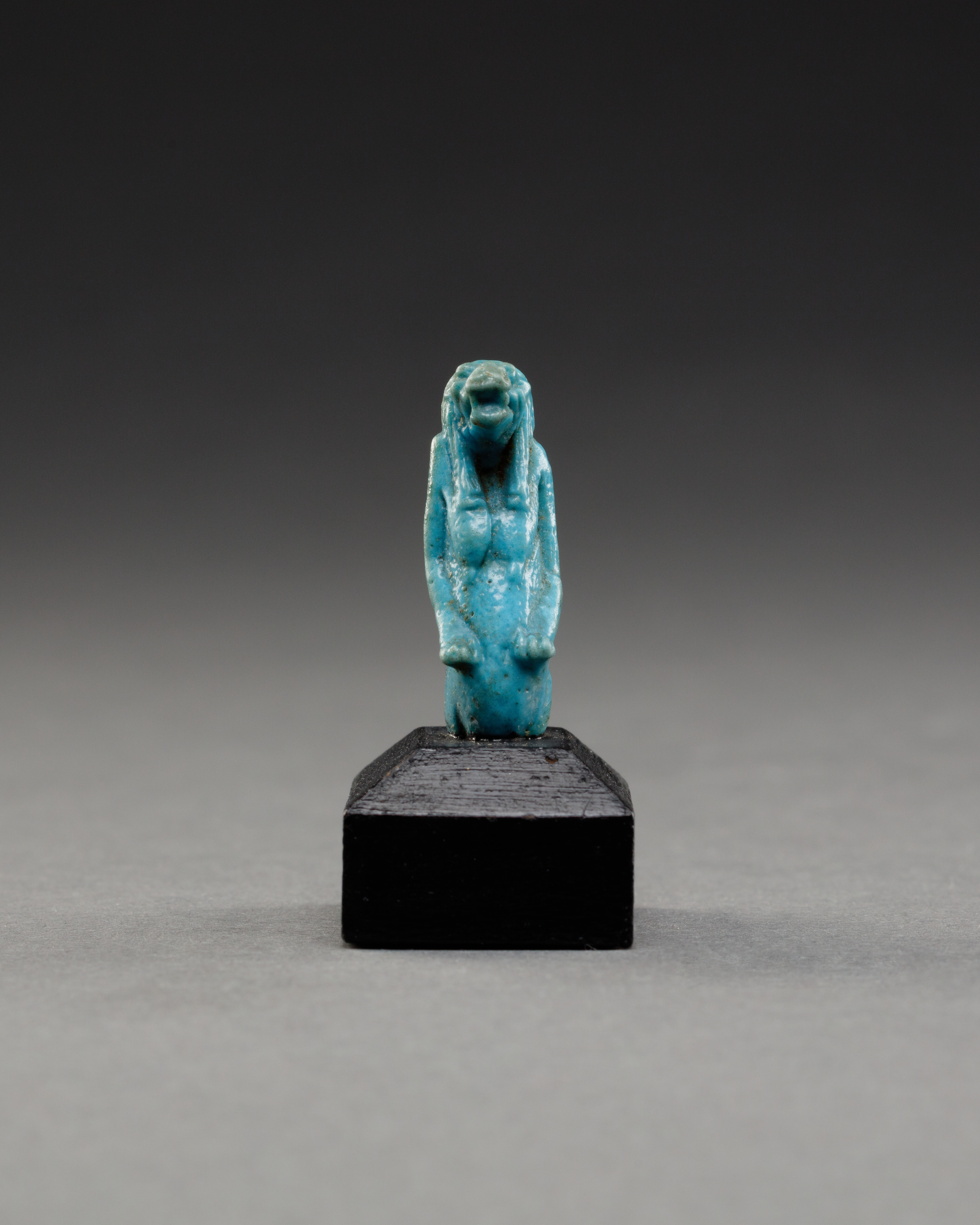
Heritage Analysis: The Partial Statuette of a Hippo Goddess
This report presents a strategic heritage analysis of a Partial Statuette of a Hippo Goddess, rendered in faience and originating from an ancient civilization. As the Lead Heritage Curator for Katherine Fashion Lab, I examine this artifact through the lenses of symbolic power, historical adornment, and spiritual meaning. The findings are then synthesized into a high-end luxury strategy for 2026, positioning Katherine Fashion Lab at the intersection of cultural depth and contemporary exclusivity.
Artifact Overview and Material Significance
The statuette, though fragmentary, is a masterwork of ancient faience—a sintered-quartz ceramic celebrated for its luminous, vitreous surface. Faience was not merely a medium but a sacred technology, often associated with rebirth and eternal life due to its synthetic, sky-blue or green glazes that mimicked precious stones like turquoise and lapis lazuli. In ancient civilizations, such as those of the Nile Valley, faience was reserved for elite funerary objects and temple offerings, imbuing the statuette with an inherent aura of rarity and ritual purpose. The partial nature of this piece does not diminish its value; rather, it invites contemplation of loss, endurance, and the fragmentary nature of historical memory—a potent narrative for luxury branding.
Symbolic Power of the Hippo Goddess
The hippopotamus, in ancient cosmology, embodied a duality of creation and destruction. As a goddess, she was often associated with fertility, protection, and the primordial waters from which life emerged. The hippo goddess, such as the Egyptian deity Taweret, was a guardian of women during childbirth and a protector of the home, yet her aggressive nature also symbolized the chaotic forces that must be appeased. This symbolic power is deeply relevant to high-end luxury strategy, where brands must balance nurturing heritage with bold, disruptive innovation. The hippo goddess’s dual identity offers a compelling archetype for Katherine Fashion Lab: a guardian of tradition who wields the power to transform and challenge conventions.
Historical Adornment and Aesthetic Legacy
Adornment in ancient civilizations was never merely decorative; it was a language of status, spirituality, and identity. The hippo goddess statuette, likely once part of a larger ensemble or amulet, would have been worn or displayed to channel protective energies. The faience glaze, with its cool, aqueous hues, reflects a sophisticated understanding of color psychology and material alchemy. For Katherine Fashion Lab, this offers a blueprint for using color and texture to evoke emotional resonance. The strategic takeaway is the integration of cerulean blue and malachite green as signature palette elements for the 2026 collection, referencing the faience’s luminous depth while signaling calm, authority, and spiritual richness.
Spiritual Meaning and Ritual Context
The spiritual dimension of the hippo goddess extends beyond mere superstition. She was a liminal figure, bridging the terrestrial and the divine, the living and the ancestral. In ritual contexts, her image was used to invoke protection during vulnerable transitions—birth, death, and rebirth. This aligns with contemporary luxury consumers’ growing desire for meaningful, ritualistic experiences. Katherine Fashion Lab can leverage this by designing not just garments but ceremonial accessories that serve as modern talismans. For example, a limited-edition scarf or jewelry piece inspired by the hippo goddess could be marketed as a “guardian of transformation,” appealing to clients who seek spiritual depth in their luxury purchases.
Strategic Implications for 2026 High-End Luxury
Translating this heritage analysis into a actionable luxury strategy requires a multi-faceted approach. The following recommendations are grounded in the artifact’s symbolic, aesthetic, and spiritual attributes, tailored to the 2026 market landscape.
Collection Theme: “Primordial Guardians”
Launch a capsule collection themed “Primordial Guardians,” drawing directly from the hippo goddess’s protective and creative duality. The collection should feature structured silhouettes with fluid, water-like drapes, echoing the goddess’s aquatic domain. Key pieces include a tailored blazer with faience-inspired embroidery in glass beads and a ceremonial cape with hand-painted motifs of the hippo goddess’s symbolic markings. The color story centers on glacial blue, deep teal, and gold leaf accents, referencing the faience’s regal associations. This strategy positions the brand as a custodian of ancient wisdom, appealing to the ultra-wealthy who value narrative and rarity over mass-market trends.
Material Innovation: Modern Faience
Collaborate with material scientists to develop a proprietary textile or finish that mimics the translucent, glazed quality of ancient faience. This could be achieved through lacquer-like coatings on silk or resin-embedded crystals that catch light like faience. Such innovation creates a signature material for Katherine Fashion Lab, reinforcing exclusivity and technical mastery. The partial statuette’s fragmented state also inspires a design philosophy of “beautiful imperfection,” where asymmetrical cuts and raw edges are celebrated as markers of authenticity and history.
Ritual-Based Marketing and Client Experience
High-end luxury in 2026 will increasingly rely on experiential marketing that resonates with consumers’ search for meaning. Develop a private event series titled “Rituals of Protection,” where select clients are invited to intimate gatherings in spaces reminiscent of ancient temples—dimly lit, with water features and faience-inspired decor. Each guest receives a custom amulet box containing a miniature sculpture of the hippo goddess, paired with a bespoke fragrance blending aquatic notes and myrrh. This transforms a purchase into a spiritual journey, fostering deep brand loyalty and word-of-mouth prestige.
Strategic Positioning: The Curator-Designer
Finally, Katherine Fashion Lab should adopt a “curator-designer” identity, explicitly linking each collection to a specific heritage artifact. The Partial Statuette of a Hippo Goddess becomes the anchor for the 2026 narrative, with detailed provenance and symbolism shared via limited-edition lookbooks and digital archives. This positions the brand as an arbiter of cultural knowledge, appealing to a clientele that values intellectual capital as much as aesthetic quality. The strategy also allows for cross-sector collaborations with museums and conservation foundations, further elevating the brand’s ethical and cultural standing.
Conclusion
The Partial Statuette of a Hippo Goddess is not merely a relic but a strategic asset for Katherine Fashion Lab’s 2026 luxury vision. Its faience medium, symbolic duality, and spiritual resonance offer a rich tapestry for innovation in design, material, and experience. By honoring the artifact’s heritage while translating its essence into contemporary luxury, the brand can achieve differentiation, depth, and enduring relevance in an increasingly competitive market. This analysis affirms that true luxury is not about newness but about the timeless dialogue between past and future—a dialogue that Katherine Fashion Lab is uniquely positioned to lead.