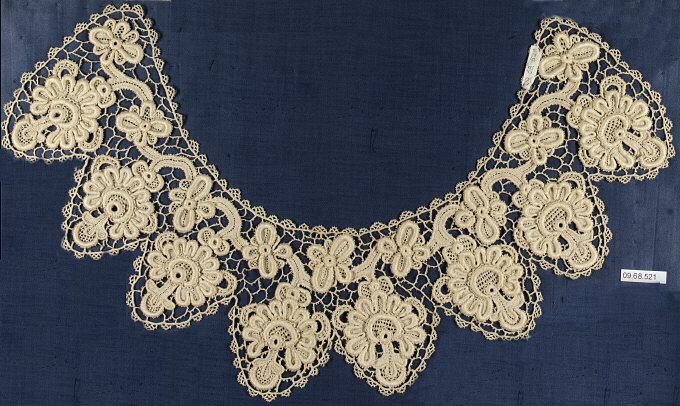
The Architectural Poetry of the Collar: A Needle Lace Study in Global Heritage
In the rarefied echelons of haute couture, the collar is seldom an afterthought. It is the frame for the face, the threshold between garment and identity, and—in the hands of Katherine Fashion Lab—a standalone artifact of profound cultural resonance. This analysis dissects the collar as an object of study, stripped of the body’s narrative yet imbued with the weight of global heritage. The medium is needle lace, a technique of painstaking precision that transforms thread into a lattice of light and shadow. Here, the collar is not merely an accessory; it is a cartography of human ingenuity, a testament to the enduring dialogue between craft and culture.
Needle Lace: The Syntax of Silence
Needle lace, or punto in aria (“stitch in the air”), emerged in 16th-century Venice as a rebellion against the woven ground of fabric. It is a technique where the lacemaker builds structure from nothing—a single thread, a needle, and an unyielding commitment to geometry. In the context of Katherine Fashion Lab’s standalone study, needle lace becomes a metaphor for cultural memory: each loop, knot, and picot is a stitch in the fabric of time. The material’s inherent fragility belies its tensile strength; it requires no reinforcement, no backing, no apology. For the collar, this means a silhouette that is at once ethereal and architectural, capable of standing erect or draping in cascades of organic filigree.
The global heritage of needle lace is not monolith. From the Reticella of Renaissance Italy—geometric, almost geometric in its precision—to the Battenberg lace of Eastern European courts, each tradition inscribes a distinct cultural logic. Katherine Fashion Lab’s study draws from this lexicon but refuses mimicry. Instead, the lab deconstructs and recombines these legacies: a Chantilly scallop edge meets a Burano point de neige (snowflake stitch), and a Maltese cross motif is reinterpreted as a structural node. The result is a collar that speaks in a polyglot of stitches, each dialect honoring its origin while contributing to a new, hybrid syntax.
Materiality and the Standalone Object
To analyze the collar as a standalone study is to liberate it from the tyranny of the garment. Without a dress, without a blouse, the collar must justify its own existence. Needle lace, with its intrinsic transparency, achieves this by creating a negative space that frames the wearer’s throat and collarbone as part of the composition. The lab’s approach emphasizes the collar’s autonomy: it is a sculpture that lives on the body but does not rely on it. When placed on a mannequin or a display stand, the collar retains its poise—a frozen gesture of lace that invites the viewer to trace its contours.
The material’s tactile properties are equally critical. Needle lace is not soft in the way of cotton or silk; it has a crispness, a slight resistance that suggests rigidity. Yet, when held to light, it dissolves into a network of shadows and highlights, revealing the labor of thousands of hours. In Katherine Fashion Lab’s study, the collar is treated as a textile architecture, where the stitch density varies to create zones of opacity and transparency. A high-density center panel might mimic the rigidity of a standing band collar, while the edges dissolve into scalloped waves, evoking the fluidity of a sailor collar or a bertha. This interplay of structure and delicacy is the hallmark of the standalone collar: it must be both fortress and filigree.
Global Heritage: A Cartography of Stitches
The concept of “global heritage” in this study is not a vague nod to multiculturalism but a rigorous mapping of specific traditions. Katherine Fashion Lab’s research archives reference four key regions:
- Venetian Point (Italy): The progenitor of needle lace, characterized by geometric grids and raised motifs. In the collar, this translates to a structural core—a grid of buttonhole stitches that anchors the design.
- Alençon (France): Known for its fine net ground and floral motifs, often outlined with a cordonnet. The lab adapts this into a border technique, where a thicker thread defines the collar’s edge, creating a crisp silhouette.
- Ruskin Lace (England): A revivalist style emphasizing naturalistic forms and open spaces. This influences the collar’s negative-space motifs, where voids become as important as stitches.
- Hedebo (Denmark): A white-on-white embroidery-lace hybrid with cutwork and drawn-thread elements. The lab integrates its eyelet patterns into the collar’s center, allowing skin to peek through like a secret.
Each tradition is not replicated but translated. The Venetian grid becomes a foundation for asymmetrical draping; the Alençon cordonnet is reimagined as a structural rib that allows the collar to stand upright. The result is a piece that belongs to no single culture but honors all of them—a global artifact in the truest sense.
Construction and Wearability: The Paradox of Preciosity
A collar made entirely of needle lace presents a paradox: it is precious yet durable, delicate yet structural. Katherine Fashion Lab addresses this through a hybrid construction. The lace is worked in sections on a fabric base—a fine silk organza that is later dissolved—allowing the lace to hold its shape without visible support. The collar’s closure system is equally ingenious: a hidden magnetic clasp embedded within the lace, invisible to the eye, ensures that the piece sits flush against the neck without distorting the pattern.
Wearability is further enhanced by ergonomic mapping. The collar’s curve is not arbitrary; it follows the natural arc of the cervical spine, rising at the nape and dipping at the clavicle. The weight is distributed across the shoulders via a lace yoke that extends two inches below the collar’s visible edge, anchoring it without bulk. This allows the collar to be worn for hours without discomfort—a crucial consideration for a standalone piece that might be paired with a simple sheath dress or a bare-shouldered gown.
The Collar as Cultural Commentary
In the broader context of fashion, the collar has historically signaled status, profession, or rebellion. The Elizabethan ruff, the Victorian high collar, the 1920s cloche collar—each marks an epoch. Katherine Fashion Lab’s needle lace collar, however, resists temporal anchoring. It is timeless because it is craft-forward: the viewer’s eye is drawn not to a period silhouette but to the thread itself, to the evidence of human hands. In an era of fast fashion and digital printing, this collar is a quiet manifesto. It declares that heritage is not a relic but a resource, that the most radical act in couture might be to slow down, to stitch, to remember.
This standalone study, therefore, is not merely an exercise in technique. It is a proposal for how fashion can engage with the past without being imprisoned by it. The needle lace collar from Katherine Fashion Lab is a bridge—between Venice and Copenhagen, between the 16th century and the present, between the artisan and the wearer. It is a collar that speaks, and its language is the universal grammar of the stitch.