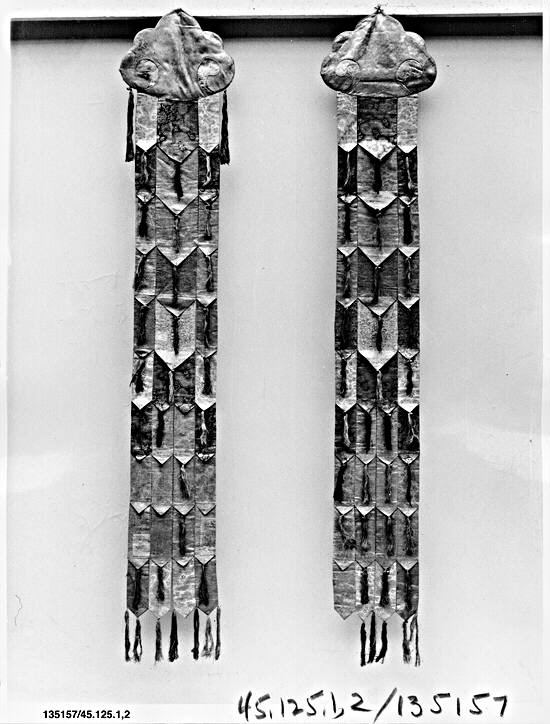
Heritage Analysis: Temple Hanging (One of a Pair)
Artifact Overview and Provenance
This temple hanging, one of a pair, originates from China and is crafted from silk and metallic thread, with tassels adorned by metal bells. Dating likely from the Qing Dynasty (1644–1912) or earlier, such hangings were suspended in Buddhist or Taoist temples, often flanking altars or sacred icons. The pair’s symmetry reinforces cosmic balance—a core principle in Chinese cosmology. As a standalone research object, this piece offers profound insights into symbolic power, historical adornment, and spiritual meaning, which can inform a 2026 high-end luxury strategy for Katherine Fashion Lab.
Symbolic Power: Cosmic and Imperial Resonance
The hanging’s symbolic power derives from its material and iconography. Silk, a luxury fiber historically monopolized by China, signifies wealth, purity, and divine connection. Metallic thread—often gold or silver—represents enlightenment and the sun’s eternal radiance, linking the earthly to the celestial. The metal bells on tassels serve a dual purpose: their sound is believed to purify the space, ward off malevolent spirits, and summon divine attention during rituals. In Buddhist context, bells symbolize wisdom and compassion, their resonance echoing the Dharma (universal truth).
For a high-end luxury brand, these elements translate into invisible authority—a product’s ability to command respect through material integrity and acoustic or tactile engagement. The hanging’s visual weight—its intricate embroidery, likely featuring dragons, clouds, or lotus motifs—embodies imperial patronage, as temples often received such offerings from emperors seeking merit. This symbolic power is not static; it is performative, activated by placement and ritual use. In 2026, luxury brands can harness this by designing objects that transform space—e.g., limited-edition wall hangings or wearable art that, like the temple hanging, are meant to be seen and heard.
Historical Adornment: Craftsmanship as Cultural Currency
Historical adornment in this piece reflects a sophisticated craft economy. Silk weaving and metallic embroidery required master artisans, often working in imperial workshops. The tassels with metal bells are not mere decoration; they are functional adornments that combine textile and metallurgy—a rare fusion that elevates the object beyond clothing or interior decor. In Chinese tradition, tassels (liú sū) symbolize the flow of qi (life energy), while bells (líng) mark sacred thresholds.
From a luxury strategy perspective, this historical adornment underscores rarity through complexity. The hanging’s production would have taken months, using materials sourced from across Asia (silk from Jiangnan, metals from Yunnan). For 2026, Katherine Fashion Lab can adopt a neo-ritualistic approach: limited drops of hand-embroidered silk panels with detachable bell-tassels, sold as modular luxury goods. Each piece would be accompanied by a digital provenance certificate, tracing the artisan’s lineage and material origins—mirroring the historical value of temple offerings as cultural currency. The bells, in particular, offer a sensory differentiator: luxury brands can engineer signature sounds (e.g., tuned to specific frequencies) to create an auditory brand identity, much like a perfume’s scent.
Spiritual Meaning: Ritual Function and Transcendence
Spiritually, the hanging is a liminal object—it bridges the mundane and the sacred. Its placement in a temple marks the boundary between human and divine realms. The pair (the second hanging is its mirror) represents yin and yang, duality and unity. The bells’ sound is not random; it is a mantra in material form, each chime a prayer offered to the cosmos. In Buddhist practice, the hanging’s movement—stirred by wind or ritual action—symbolizes impermanence (anicca), a core teaching.
For 2026 luxury consumers, spiritual meaning is increasingly sought in objects that offer mindfulness and intentionality. The temple hanging’s design can inspire a “sacred home” collection: silk wall pieces with embedded chimes, designed for meditation spaces. The spiritual value lies not in religious dogma but in ritualized interaction—the user activates the object’s meaning by touching or moving it. Brands can market this as “wearable sanctuary” or “portable temple” for the ultra-wealthy seeking inner peace amid global volatility. The pair aspect also invites collectible storytelling: clients purchase both halves as a set, representing harmony in a fragmented world.
2026 High-End Luxury Strategy: From Artifact to Archetype
To translate this heritage into a 2026 strategy, Katherine Fashion Lab must position the temple hanging as an archetype of sacred luxury. Here are three actionable pillars:
1. Material Alchemy: Reinterpret silk and metallic thread through modern technology—e.g., biodegradable silk infused with conductive threads that produce soft light or sound. The metal bells could be replaced with precision-cast brass or titanium, tuned to a 432 Hz frequency (associated with universal harmony). This merges tradition with innovation, appealing to eco-conscious and tech-savvy elites.
2. Ritualized Commerce: Create a “Temple Edition” collection limited to 100 pairs, sold via invitation-only experiences. Each purchase includes a commissioning ceremony where a spiritual leader (e.g., a Buddhist monk) blesses the piece. The bells are activated by the buyer during a private ritual, recorded as a digital asset (NFT) for the metaverse. This transforms a transaction into a life event, justifying a price point of $50,000+.
3. Cultural Stewardship: Partner with Chinese museums or monasteries to authenticate the original hanging’s provenance. Use the research to create a “Heritage Trust” fund, where a percentage of sales supports preservation of temple textiles. This builds brand legitimacy and counters accusations of cultural appropriation. The hanging’s symbolic power—its ability to sanctify space—becomes a brand promise: “Katherine Fashion Lab: The Art of Sacred Adornment.”
Conclusion
This temple hanging is more than a relic; it is a strategic artifact for the future of luxury. Its symbolic power, historical adornment, and spiritual meaning reveal a blueprint for experience-driven opulence in 2026. By honoring its origins while reimagining its form, Katherine Fashion Lab can lead a new category: heritage luxury as living ritual. The hanging’s bells will not just chime—they will resonate across markets, reminding consumers that true luxury is not owned but inherited, activated, and passed forward.