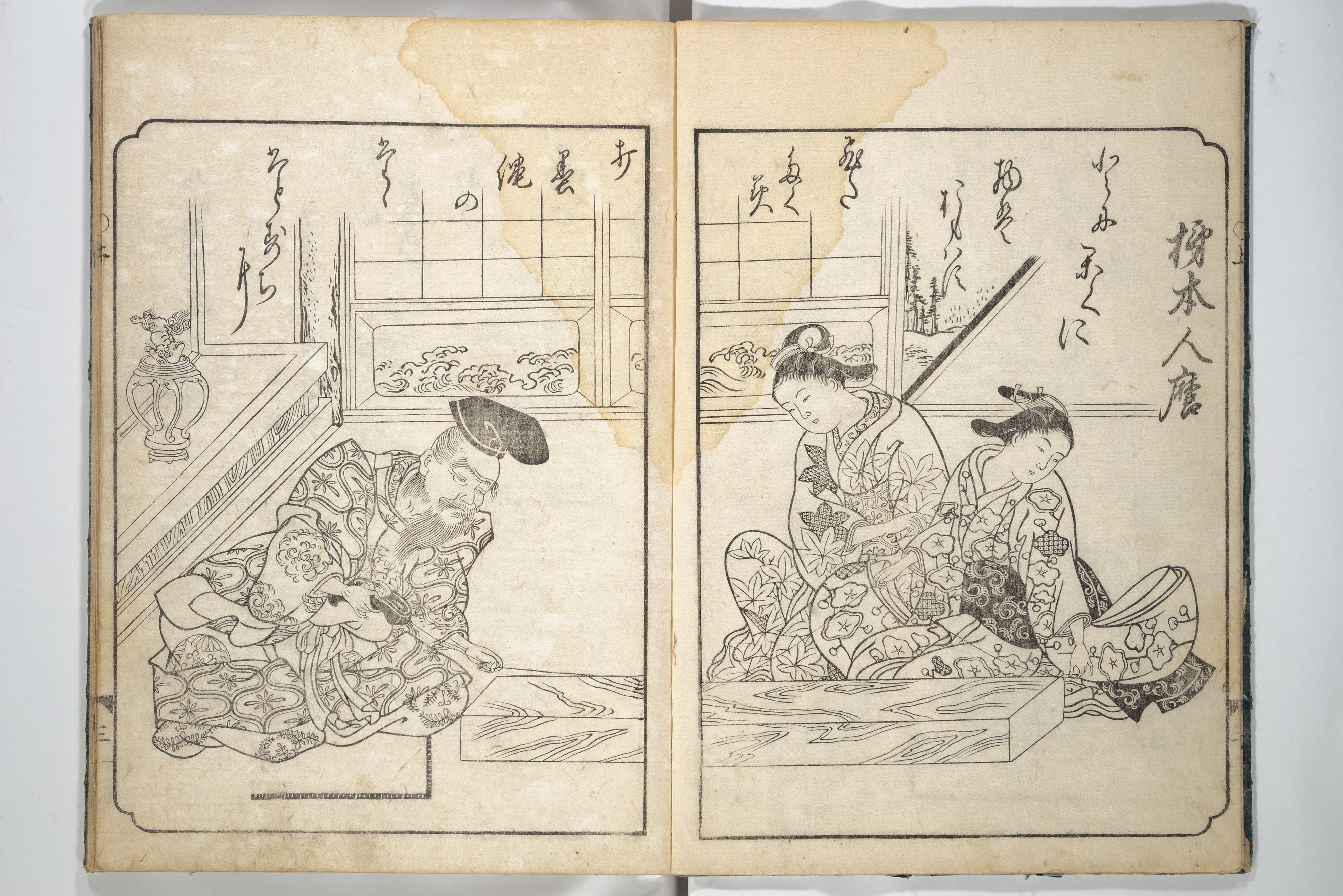
The Immortal Poets as Couture: Deconstructing the Sartorial Codes of *Fūryū Kasen Ehon Waka no Ura*
At Katherine Fashion Lab, we approach the study of fashion not merely as a study of cloth, but as a profound language of cultural memory, identity, and aesthetic philosophy. Our latest analysis turns to an extraordinary artifact: the two-volume woodblock printed book, *Fūryū Kasen Ehon Waka no Ura* (風流歌仙絵本和歌浦), or *A Fashionable Representation of the Immortals of Poetry: Picture Book of Waka-no-ura*. Created in the early 19th century during Japan’s Edo period, this set of ink-on-paper works is far more than a literary homage. It is a masterclass in the semiotics of dress, a visual treatise on how garments encode status, poetic sensibility, and the very essence of artistic immortality.
For the modern luxury strategist, this book offers a prescient blueprint: how to represent a canon of cultural icons through visual rhetoric that is both historically grounded and stylistically transcendent. The “immortals” depicted—the legendary *kasen* or thirty-six master poets of the Heian and Kamakura periods—are not shown in mere historical accuracy. Instead, they are dressed in a deliberate fusion of courtly elegance and idealized, almost theatrical, fashion. This is couture as a narrative device, a language of power and refinement that we must decode.
The Layered Silhouette: A Grammar of Status and Temporality
The most immediate sartorial observation is the reliance on the *jūnihitoe* (十二単), the twelve-layered robe, and its masculine counterpart, the *sokutai* (束帯). However, the artist’s hand is not that of a documentarian. The layers are rendered with a precision that exaggerates their volume and color gradation. In the prints, fabric stacks at the collar and hem are depicted with a painterly attention to the *kasane no irome* (重ねの色目)—the art of combining colored layers to evoke seasons, emotions, or poetic tropes.
For instance, a poet of autumn might be shown in a deep crimson over a pale green, the colors bleeding into one another like fading maple leaves. This is not arbitrary decoration. It is a strategic branding of the individual through a palette of allusion. The fashion designer today can learn from this: every seam, every hue, every fold is an opportunity to tell a story. The *jūnihitoe* in *Waka no Ura* is not just clothing; it is a three-dimensional poem, where the visual weight of the fabric mirrors the emotional weight of the verse.
Furthermore, the silhouette itself—broad at the shoulders, trailing at the feet, with sleeves that extend like wings—creates a sense of monumentality. These poets are not mere mortals; they are icons, their bodies transformed by fabric into statues of cultural memory. The exaggerated length of the *hakama* (trousers) that pool on the ground is a deliberate signifier of leisure and aristocracy. In a modern context, this translates to the power of excess as a symbol of exclusivity. The couturier’s challenge is to use volume not for spectacle alone, but to imbue the wearer with an aura of timeless authority.
Pattern and Motif: The Embroidery of Poetic Identity
Moving beyond silhouette, the surface design of the garments in these woodblock prints is a repository of symbolic meaning. The artists employed a sophisticated system of patterns—*shokko* (brocade), *asanoha* (hemp leaf), and *kiku* (chrysanthemum)—each tied to specific poetic or seasonal associations. However, what is revolutionary is the customization of these patterns to the individual poet.
Consider the depiction of Kakinomoto no Hitomaro, often considered the father of Japanese poetry. His robe might be adorned with a repeating wave pattern (*seigaiha*), referencing his famous poems about the sea. Ono no Komachi, the legendary female poet of beauty and transience, is often shown in robes with scattered cherry blossom motifs (*sakura*), a direct visual metaphor for her verses on fleeting love. This is fashion as a personalized lexicon. The garment becomes a mobile canvas of biography.
For the contemporary fashion house, this offers a powerful model for bespoke storytelling. The use of jacquard weaving or digital embroidery to embed a client’s personal narrative—a favorite flower, a line of poetry, a family crest—into the very fabric of a garment is a direct lineage from this Edo-period practice. The *Waka no Ura* demonstrates that true luxury is not generic; it is deeply, almost obsessively, specific.
Color as Code: The Chromatic Hierarchy of the Immortals
The color palette in *Waka no Ura* is not decorative; it is hierarchical and symbolic. The use of deep purple (*murasaki*) is reserved for the highest-ranking poets, a color historically associated with the imperial court and the highest levels of Buddhism. Vermillion (*shu*) appears on garments of poets known for passion or political influence. Indigo (*ai*) and ochre (*ōdo*) are used for more rustic or contemplative figures, grounding them in the natural world they celebrated.
This chromatic system is a visual syntax of status. It tells the viewer, at a glance, the poet’s rank in the literary canon. The modern equivalent is the color psychology of luxury branding. A Hermès orange, a Tiffany blue, a Valentino red—these are not accidental. They are deliberate codes that communicate value and exclusivity. The *Waka no Ura* teaches us that color, when deployed with historical and cultural intelligence, becomes a non-verbal contract between the object and the observer.
Moreover, the contrast of light and dark in the woodblock prints—achieved through the *bokashi* (gradation) technique—creates a dramatic tension. The fabrics seem to glow from within, suggesting an inner luminosity of the poets themselves. This technique is analogous to the use of light-reflecting threads or strategic pleating in haute couture, where the play of light on fabric creates a sense of movement and life. The immortals are not static; their clothes breathe with the same rhythm as their poetry.
Accessories as Cultural Capital: The Fan, the Sword, the Scroll
No analysis of this book is complete without examining the accessories. Each poet is depicted holding or wearing items that are extensions of their identity. The folding fan (*sensu*) is ubiquitous, but its color and design vary. A fan painted with a moon suggests a poet of nocturnal melancholy; one with a pine tree suggests endurance. The sword, worn by male poets, is not a weapon but a symbol of bushido (the way of the warrior) integrated with literary cultivation. The scroll of poetry, sometimes tucked into the obi (sash), is the ultimate accessory—a literal embodiment of their life’s work.
This teaches a critical lesson for modern luxury: accessories are not afterthoughts; they are primary signifiers. A handbag, a watch, a piece of jewelry—these are the modern equivalents of the fan or the sword. They must be chosen with the same narrative precision as the garment itself. In *Waka no Ura*, the accessories complete the gestalt of the immortal. They are the final punctuation marks in a visual sentence.
Conclusion: The Couture of Cultural Immortality
*Fūryū Kasen Ehon Waka no Ura* is a seminal work for any student of fashion as a cultural system. It demonstrates that the highest form of representation is not mere replication, but translation—the translation of poetic essence into fabric, color, and form. The artists of this book understood that to make the immortals fashionable was to make them eternally relevant. They did not dress them in the clothes of the past; they dressed them in the clothes of an idealized present, a present where every fold of silk is a line of verse.
For Katherine Fashion Lab, this analysis reaffirms our core philosophy: couture is the ultimate archive of human expression. The *Waka no Ura* is not a historical curiosity; it is a living textbook on how to use fashion to elevate, sanctify, and immortalize. In an era of fast fashion and disposable trends, this book stands as a testament to the power of deliberate, intelligent, and deeply poetic design. The immortals of poetry, through their fashionable representation, continue to speak to us—not in words, but in the timeless language of style.