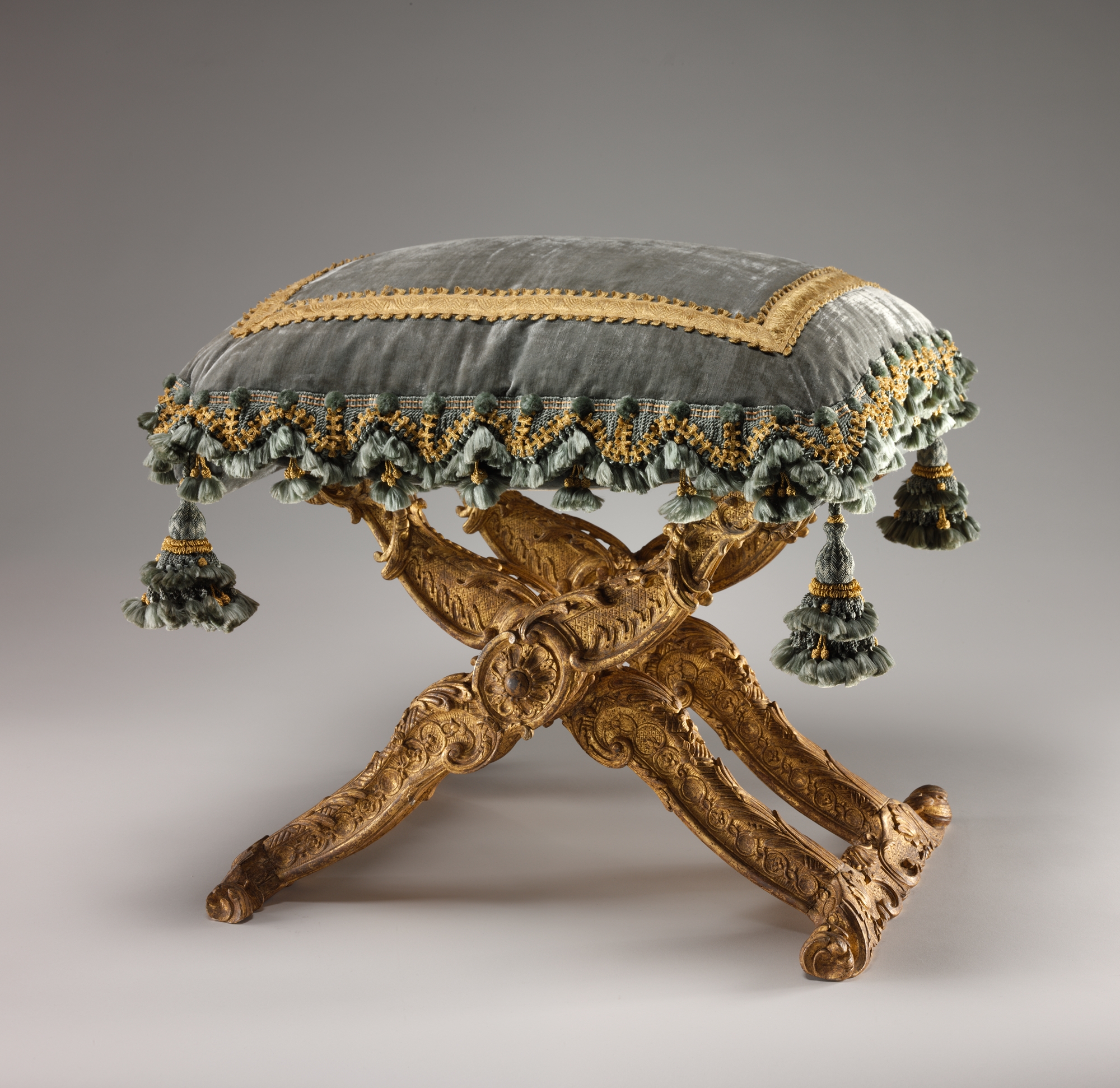
The Pliant Paradox: Deconstructing the Folding Stool as a Couture Artifact
In the rarefied world of haute couture, the line between functional object and artistic statement is perpetually blurred. At Katherine Fashion Lab, we do not merely study garments; we dissect the anatomy of presence—how objects command space, confer status, and narrate identity. The subject of this analysis, a folding stool (pliant) from a pair, presents a compelling case study in the intersection of global heritage, material opulence, and the silent language of power. Originating from an undefined yet distinctly global lineage, this stool transcends its utilitarian purpose to become a portable throne, a micro-architecture of authority designed for the transient yet consequential moments of a life curated for display.
I. The Global Heritage: A Nomadic Lexicon of Power
The folding stool, or pliant, is one of the most ancient and cross-cultural forms of prestige furniture. Its very structure—a collapsible X-frame—speaks to a nomadic heritage, a design born of necessity for rulers, generals, and diplomats who required a symbol of authority that could travel with them. From the Roman sella curulis, the ivory and bronze seat of magistrates, to the Chinese jiao yi (folding chair) reserved for scholars and officials, and the African asipim stools of the Akan peoples, the pliant is a global archetype of portable sovereignty.
This particular stool, while unmoored from a specific geographic origin, embodies this syncretic heritage. Its carved and gilded walnut frame echoes the Baroque grandeur of 17th-century European courts, where gilding was not mere decoration but a direct assertion of wealth and divine right. Yet, the X-form itself is a nod to the East and the ancient world, a design language that predates and transcends European hegemony. The Global Heritage classification is thus not a mark of ambiguity but a deliberate acknowledgment of the stool’s hybrid DNA—a piece that belongs to no single culture but to the universal vocabulary of power. In the context of a standalone study, this stool becomes a cultural palimpsest, with each carved scroll and gilded leaf whispering of the Silk Road, the Roman Empire, and the Renaissance court.
II. The Material Lexicon: Walnut, Gilding, and the Velvet Intervention
The material choices of this pliant are a masterclass in sensory branding. The frame is carved and gilded walnut—a wood prized for its strength, rich grain, and ability to hold intricate detail. Walnut, in the hierarchy of European cabinetmaking, was second only to ebony in prestige. The gilding, likely achieved through water-gilding with gold leaf, transforms the structural elements into luminous sculpture. The light catches the carved acanthus leaves, volutes, and possibly heraldic motifs, creating a dynamic interplay of shadow and brilliance. This is not a passive object; it is designed to perform under candlelight or the controlled beams of a gallery, its surface alive with reflected authority.
The most provocative element, however, is the upholstery: silk velvet with gold trim, noted as not original. This intervention is critical to the couture analysis. Original seating would likely have been of leather, tapestry, or a more durable silk damask. The decision to replace it with silk velvet—a fabric of extreme luxury, fragility, and tactility—fundamentally alters the object’s identity. Velvet is the fabric of the boudoir, the theater, the coronation; it invites touch, but it also demands reverence. The gold trim further frames the seat as a precious reliquary for the body. This replacement is not a restoration but a re-imagination. It shifts the stool from a functional antique to a couture object, prioritizing aesthetic sensation over historical accuracy. The velvet introduces a softness that contrasts with the hard, gilded wood, creating a dialectic of restraint and opulence. The sitter is cradled by luxury, yet perched on a structure of gilded power.
III. The Standalone Study: The Object as a Solo Performer
Context is everything in couture. A throne is meaningless without a court; a gown is incomplete without a body. Yet, this pliant is presented as a standalone study, a deliberate decontextualization that forces a new kind of analysis. Removed from its pair, it becomes a singular protagonist. It no longer implies a symmetrical arrangement of status (two stools for two dignitaries) but rather a monologue of power. It is the seat for the solitary ruler, the artist, the collector who sits alone to contemplate, to command, to be seen without a counterpart.
This isolation amplifies the stool’s sculptural qualities. The X-frame, when viewed in the round, creates a dynamic silhouette—an architectural arch that supports the seat. The carved and gilded details demand a 360-degree examination. The back, often unseen in a pair, is here fully exposed, revealing the craftsmanship of the joinery and the gilding’s application. The velvet seat, now the focal point, becomes a stage for the absent body. In couture analysis, we speak of the negative space—the impression left by the wearer. Here, the stool’s empty seat is a void of potential. It invites the viewer to project a narrative: Who sat here? What decisions were made? What performance of self was enacted?
As a standalone object, the stool also challenges the notion of completeness. A pair implies balance, repetition, and social interaction. A single stool implies singularity, hierarchy, and introspection. This shift in context is a curatorial choice that elevates the object from a mere antique to a conceptual artwork. It is no longer furniture; it is a proposition about power, solitude, and the materiality of presence.
IV. Couture Implications: The Stool as a Wearable Metaphor
For Katherine Fashion Lab, every object is a garment for the environment. The pliant stool, with its gilded frame and velvet seat, can be read as a metaphor for the body in couture. The rigid, carved frame is the structure—the corset, the boning, the architectural tailoring that shapes the silhouette. The gilding is the embellishment—the embroidery, the beading, the gold thread that catches light and signifies status. The velvet seat is the interface—the lining, the inner layer that touches the skin, the intimate luxury that the public never sees but the wearer feels.
The non-original velvet introduces a critical couture concept: the intervention of the curator as designer. Just as a couturier reworks a vintage fabric into a new silhouette, the choice to reupholster this stool in silk velvet is an act of creative reinterpretation. It acknowledges that objects, like garments, are not static; they are re-authored by each generation. The gold trim, a detail often associated with military uniforms and ceremonial regalia, further militarizes the object, suggesting a battle-ready elegance. The stool becomes a seat of strategy, a perch from which to command the room.
In the final analysis, this folding stool transcends its origins. It is a portable monument, a gilded exoskeleton for the ego, a velvet cocoon for the body. In its standalone study, it speaks not of a pair, but of a singular, uncompromising vision. For the connoisseur of couture, it is a reminder that the most powerful statements are often made in silence, seated, on a throne that folds away into the shadows, waiting for the next performance of authority.