Deconstructing the Strip: A Couture Analysis of Katherine Fashion Lab’s Needle Lace Ensemble
In the rarefied realm of haute couture, where fabric meets philosophy, Katherine Fashion Lab’s latest standalone study—titled “Strip”—emerges as a masterclass in narrative restraint and technical virtuosity. The collection, which draws its creative force from the concept of Global Heritage, is not merely a garment but a cartography of cultural memory. By weaving the ancient techniques of needle lace and punto di Ragusa with the unassuming purity of linen, the Lab has produced a piece that interrogates the very nature of adornment, absence, and the linearity of human connection. This analysis dissects the ensemble’s materiality, its historical underpinnings, and its quiet revolution against the volume of contemporary fashion.
The Conceptual Frame: Strip as Narrative Device
The title “Strip” is deliberately polysemous. On one level, it refers to the physical strips of linen and lace that form the garment’s structural core. On another, it evokes an act of reduction—stripping away excess, ornament, and even color to reveal a skeletal truth. Katherine Fashion Lab has long championed a minimalist ethos, but here, minimalism is not an aesthetic choice; it is a philosophical position. The ensemble consists of a floor-length, columnar gown and an accompanying capelet, both constructed from vertical bands of material that alternate between solid linen and openwork lace. These strips are not sewn together in a conventional seam; rather, they are joined by delicate, hand-stitched bridges of punto di Ragusa, creating a visual and tactile rhythm of continuity and rupture. The “strip” thus becomes a metaphor for the fragmented yet interconnected nature of global heritage—each band a distinct cultural thread, yet bound by the same human hand.
Materiality and Technique: The Lace of Memory
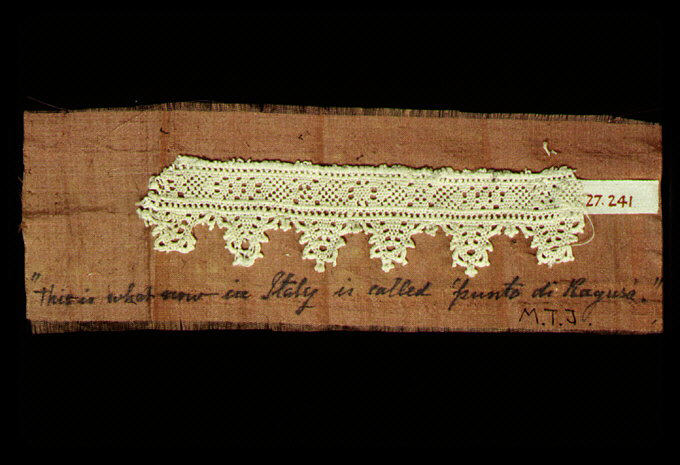
The choice of needle lace as a primary material is a deliberate invocation of labor-intensive, pre-industrial craftsmanship. Needle lace, unlike bobbin lace, is created with a single needle and thread, building loops and stitches into intricate patterns without a pre-existing mesh. This technique, which flourished in 16th-century Venice, requires an almost monastic patience. Katherine Fashion Lab’s iteration uses a punto di Ragusa variant—a raised, three-dimensional stitch that originates from the Dalmatian coast—to create a geometric, almost architectural grid within the lace. The effect is one of controlled chaos: the linen strips, in their natural, unbleached ecru, provide a flat, matte ground, while the lace inserts shimmer with a subtle, dimensional relief. The contrast is stark yet harmonious, as if the garment is simultaneously solid and dissolving.
The linen itself is sourced from a small, family-run mill in Normandy, known for its long-staple flax fibers. Linen was chosen not only for its sustainability but for its symbolic resonance: it is a fabric of both utility and ritual, used for everything from ancient Egyptian mummy wrappings to Renaissance chemises. In the “Strip” ensemble, the linen is left untreated, its natural slubs and irregularities visible. This raw quality grounds the ethereal lace, preventing the piece from becoming merely decorative. The tactile interplay—the cool, smooth surface of linen against the raised, scratchy precision of the lace—invites the wearer and viewer into a dialogue about haptic memory. Each strip feels like a verse in a forgotten epic, a line of a song sung by generations of lacemakers.
Global Heritage: A Tapestry of Origins
Katherine Fashion Lab explicitly positions “Strip” within the framework of Global Heritage, a curatorial stance that rejects cultural appropriation in favor of cultural dialogue. The needle lace technique, while often associated with European aristocracy, has parallel histories in Asia, the Middle East, and the Americas. The Lab’s research team traveled to the island of Pag in Croatia to study the specific punto di Ragusa stitches, which were traditionally used in wedding veils and ecclesiastical vestments. Simultaneously, they consulted with lacemakers from the Tamil Nadu region of India, where a similar needle-lace tradition—known as Nakshi Kantha—uses running stitches to create narrative panels on cloth. The “Strip” ensemble does not mimic these traditions but rather synthesizes their shared principles: the use of negative space, the celebration of the hand-drawn line, and the belief that fabric can hold stories.
The garment’s color palette—or lack thereof—further underscores this global dialogue. The ecru of the linen and the ivory of the lace are not bleached or dyed, preserving the natural tones of the fibers. This chromatic restraint allows the structural geometry to take center stage. The strips are arranged in a Fibonacci-like progression: narrow bands of lace near the shoulders widen into broader linen panels at the hem, creating a visual rhythm that mimics the movement of a wave or the growth of a spiral. This pattern is not arbitrary; it references the golden ratio found in ancient Greek architecture, Indian mandalas, and Islamic geometric art. The “Strip” thus becomes a wearable atlas, mapping the mathematical and spiritual connections that traverse continents.
Construction and Wearability: The Architecture of Absence
From a construction standpoint, the “Strip” ensemble is a feat of engineering. The gown is built without a single zipper or button; it is entirely lace-and-linen, held together by the tension of the punto di Ragusa bridges. The capelet, which drapes asymmetrically over one shoulder, is similarly constructed, with strips that fan out like the ribs of a leaf. This approach challenges the conventional notion of a garment as a closed, protective shell. Instead, the “Strip” is porous, allowing air and light to pass through the gaps between the strips. The wearer’s skin becomes part of the design, visible through the lace apertures. This transparency is not immodest but intellectual; it invites the viewer to consider the body as the final, living component of the garment—a strip of flesh among strips of fiber.
The weight of the ensemble is surprisingly light, thanks to the openwork construction. Yet the garment possesses a gravity of presence, a quiet authority that comes from its labor-intensive making. It is not a dress for movement in the conventional sense; it is a dress for contemplation. The strips sway independently when the wearer walks, creating a kinetic, ever-changing silhouette. This movement echoes the original purpose of lace in historical dress: to signify status through the display of leisure and wealth. However, the Lab subverts this narrative by using humble linen and an unbleached palette, suggesting that true luxury lies in the time and skill invested, not in the opulence of the material.
Conclusion: A Standalone Study in Silence
Katherine Fashion Lab’s “Strip” is a standalone study in the truest sense—a singular, self-contained exploration that resists categorization as a collection piece or a trend. It is a meditation on heritage not as a static archive but as a living, stitched conversation. The ensemble asks us to reconsider what couture can be: not a spectacle of excess, but a testament to reduction. By stripping away color, pattern, and even conventional structure, the Lab reveals the essence of craft—the needle, the thread, the hand, and the global lineage that binds them. In an era of fast fashion and digital distraction, “Strip” stands as a quiet, radical act of preservation and innovation. It is not merely worn; it is read, felt, and remembered. And in that act of remembering, it becomes eternal.