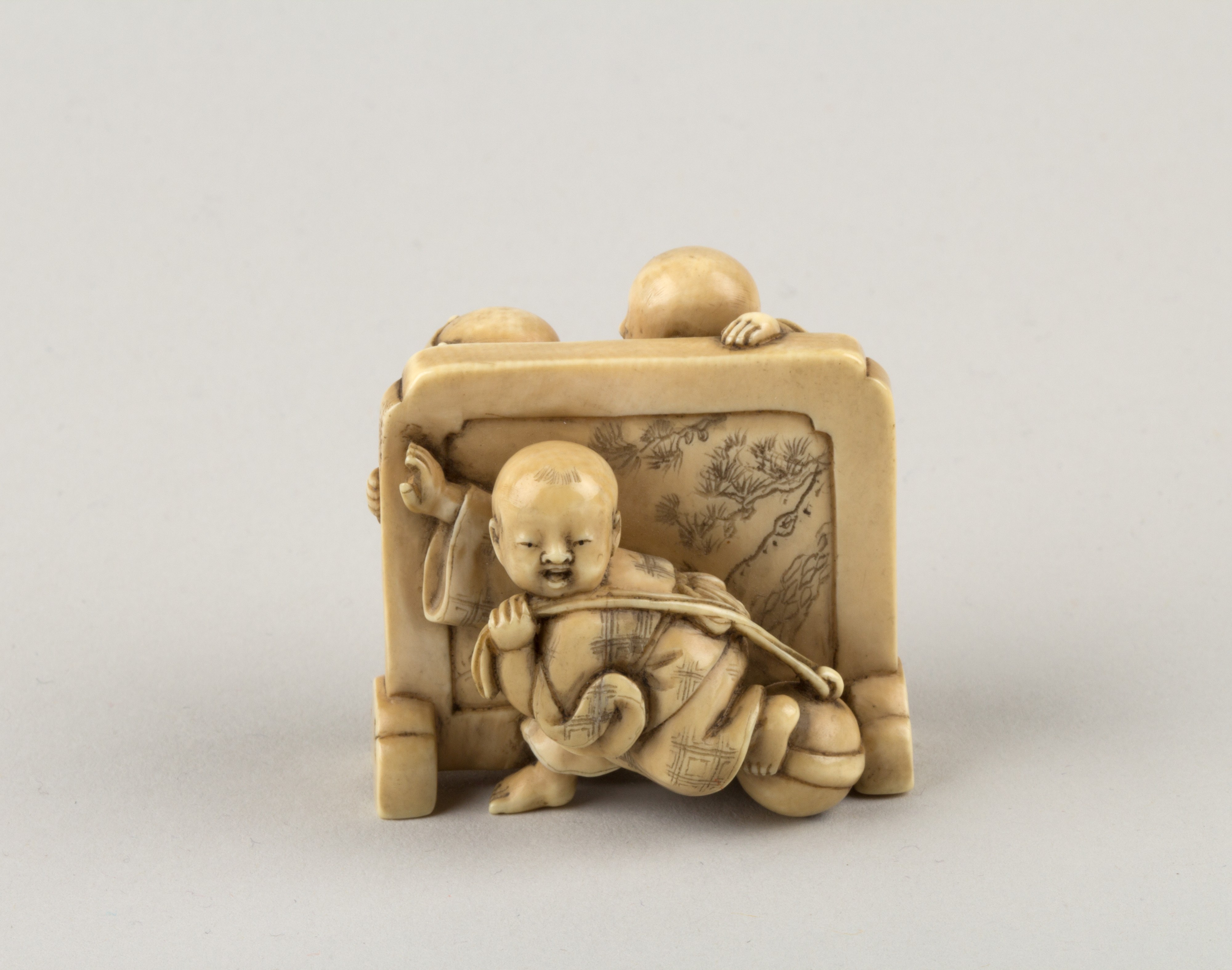
Heritage Analysis: Netsuke of Three Boys Playing around a Screen
Introduction: The Object as Cultural Artifact
The Netsuke of Three Boys Playing around a Screen, carved from ivory in Edo-period Japan (circa 17th–19th century), represents far more than a miniature toggle for securing an inro (seal case) to a kimono sash. This object embodies a sophisticated interplay of symbolic power, historical adornment, and spiritual meaning. As a strategic standalone research piece for Katherine Fashion Lab, this analysis deconstructs the netsuke’s heritage to inform a 2026 high-end luxury strategy, leveraging its narrative depth for brand differentiation and cultural resonance.
Symbolic Power: Hierarchy, Play, and the Screen as Threshold
The composition—three boys engaged in play around a byobu (folding screen)—is laden with symbolic significance. In Japanese visual culture, the screen functions as a liminal device, separating public and private, sacred and profane. The boys, unencumbered by adult social codes, represent innocence and spontaneity, yet their positioning around the screen suggests a deliberate negotiation of boundaries. This juxtaposition conveys a subtle commentary on social hierarchy and the permeability of status. For Katherine Fashion Lab, this symbolism offers a powerful metaphor for luxury’s dual nature: exclusivity (the screen) and accessibility (the children’s play). A 2026 strategy could invoke this tension through limited-edition collections that reveal hidden narratives—garments or accessories that unfold or transform, much like the screen’s shifting panels.
The number three holds numerological weight in Japanese tradition, often representing harmony, fertility, and the triad of heaven, earth, and humanity. The boys’ collaborative play reinforces social cohesion and collective joy, values that resonate with contemporary luxury consumers seeking community and authenticity. By embedding these principles into brand storytelling—such as through exclusive client events or collaborative design processes—Katherine Fashion Lab can position itself as a curator of meaningful experiences rather than mere products.
Historical Adornment: Netsuke as Functional Sculpture
Historically, netsuke were indispensable accessories in Edo-period Japan, worn by men of the samurai class and wealthy merchants. Their small size (typically 2–5 centimeters) demanded extraordinary craftsmanship, with ivory carving requiring precision, patience, and deep cultural knowledge. The Three Boys motif reflects the ukiyo-e aesthetic of capturing fleeting moments of everyday life—a democratization of art that paralleled the rise of the merchant class. This historical context underscores the netsuke’s role as a status marker: owning a finely carved netsuke signaled not only wealth but also cultural literacy and taste.
For Katherine Fashion Lab, this object illuminates the importance of functional adornment in luxury design. The netsuke was not merely decorative; it served a practical purpose, securing the inro and enabling mobility. This dual function aligns with the 2026 luxury trend toward versatility and utility, where high-end consumers demand pieces that transition seamlessly from day to evening, from professional to leisure contexts. A strategic takeaway is the development of modular accessories—such as detachable brooches, convertible necklaces, or multi-functional belts—that echo the netsuke’s blend of artistry and utility. The ivory medium, now ethically replaced by sustainable alternatives like tagua nut or resin, can be reinterpreted using modern materials while preserving the tactile heritage.
Spiritual Meaning: Protection, Transience, and the Sacred
Beyond its secular function, the netsuke carried spiritual significance. Carved from ivory—a material associated with purity and longevity—it was believed to offer protective properties, warding off evil spirits and ensuring the wearer’s safe passage through daily life. The boys’ playful scene, while seemingly secular, invokes the Shinto concept of kami (spirits) inhabiting natural and crafted objects. The screen itself may reference theatrical traditions like Noh or Kabuki, where screens delineate sacred performance spaces. This spiritual layer transforms the netsuke from a mere toggle into a talismanic object, imbued with the power to connect the wearer to ancestral traditions and cosmic order.
In the context of 2026 luxury strategy, this spiritual dimension offers a profound opportunity for brand authenticity and emotional resonance. Modern luxury consumers increasingly seek objects with soul—pieces that tell stories, offer protection, or foster mindfulness. Katherine Fashion Lab could develop a “Sacred Adornment” capsule, inspired by talismanic motifs from global traditions, with each piece accompanied by a narrative of its symbolic origins. For example, a pendant echoing the three boys could be marketed as a symbol of harmony and protection, paired with a ritual of care or meditation. This approach aligns with the wellness luxury trend, positioning the brand as a purveyor of holistic elegance.
2026 High-End Luxury Strategy: Reinterpreting Heritage for Modernity
To translate the netsuke’s heritage into a 2026 luxury strategy, Katherine Fashion Lab must balance historical reverence with contemporary relevance. The following pillars emerge from this analysis:
1. Craftsmanship as Narrative
The netsuke’s intricate carving exemplifies the slow luxury movement, where artisanal skill is prized over mass production. A 2026 strategy should emphasize limited-edition collaborations with master artisans from Japan, Italy, or other heritage regions, creating pieces that require months of handwork. Each item would include a certificate of origin and a digital story (e.g., QR code linking to a video of the carving process), reinforcing the brand’s commitment to preserving endangered crafts.
2. Symbolic Storytelling in Product Design
The three-boy motif can be adapted into repeating patterns, silhouettes, or hardware for handbags, scarves, or jewelry. The screen’s folding form inspires modular garment structures—a jacket with detachable panels, a skirt that transforms via pleats. These designs would be marketed as “narrative pieces”, with lookbooks or digital campaigns explaining the symbolism behind each element. For instance, a “Screen of Play” scarf could feature a hidden print revealed only when folded, echoing the netsuke’s layered meanings.
3. Experiential Retail and Community
Luxury in 2026 is increasingly experiential. Katherine Fashion Lab could host private salons where clients learn about netsuke history, handle replicas, and co-create bespoke accessories. A “Play and Protection” event series could blend art, spirituality, and fashion, with a portion of proceeds supporting cultural preservation. This builds a loyal community around shared values of heritage and mindfulness.
4. Ethical Materiality and Sustainability
The ivory medium, now illegal and unethical, necessitates a commitment to sustainable alternatives. Katherine Fashion Lab should pioneer the use of recycled or bio-based materials that mimic ivory’s luster and durability, such as plant-based resins or upcycled bone from food industry byproducts. This aligns with the conscious luxury trend, appealing to eco-aware high-net-worth individuals without compromising aesthetic integrity.
Conclusion: From Artifact to Archetype
The Netsuke of Three Boys Playing around a Screen is a microcosm of Japanese cultural philosophy—a fusion of function, art, and spirituality. For Katherine Fashion Lab, this object serves as a strategic archetype, guiding a 2026 luxury strategy rooted in symbolic depth, historical authenticity, and ethical innovation. By transforming heritage into a living narrative, the brand can differentiate itself in a crowded market, offering not just products but portable legacies that resonate with discerning consumers seeking meaning in their adornment. The netsuke’s small form belies its immense potential: to inspire a luxury vision that honors the past while shaping the future.