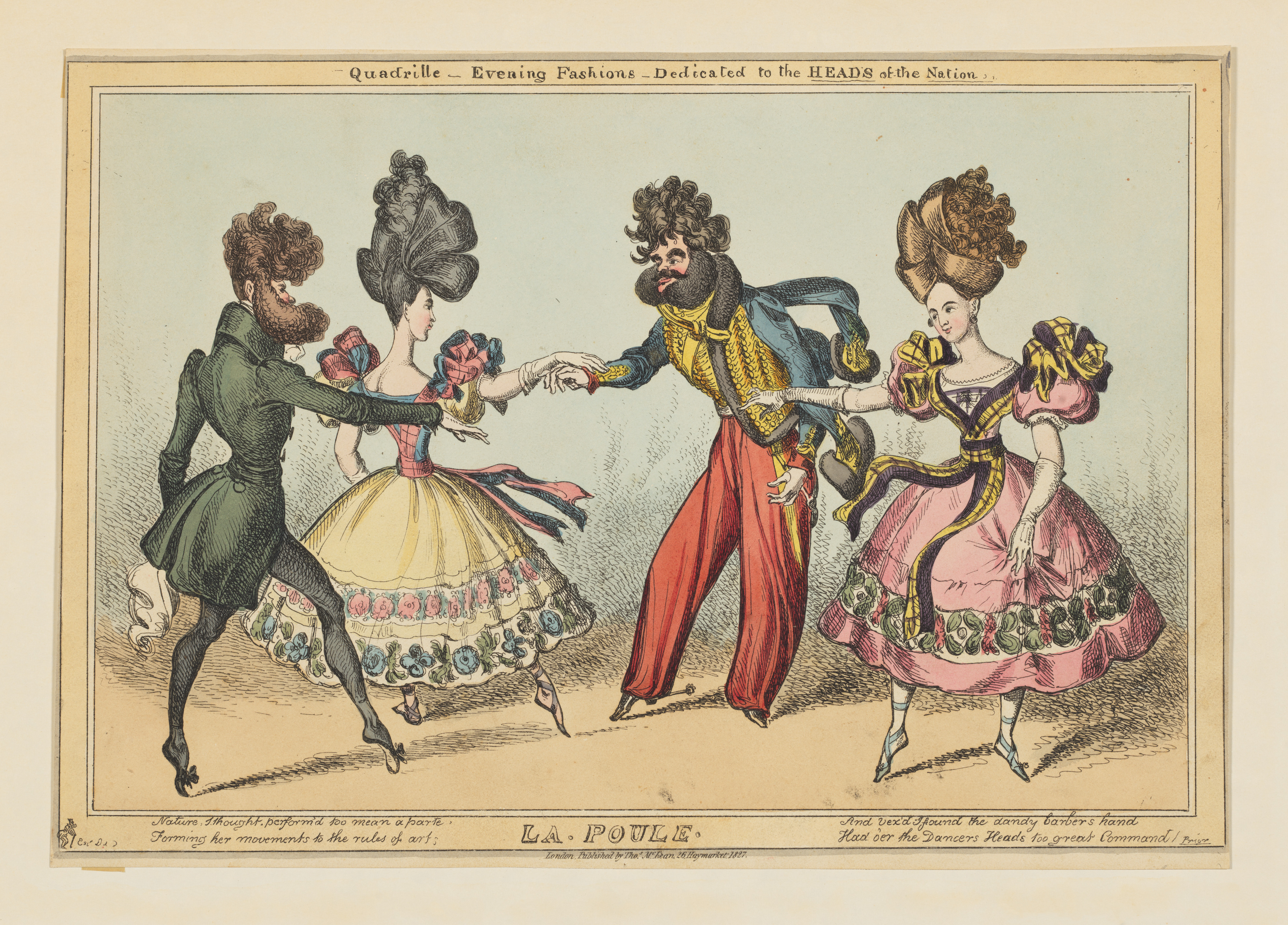
The Quadrille as Political Cartography: Deconstructing “La Poule” at Katherine Fashion Lab
In the rarefied air of haute couture, where fabric meets fantasy and silhouette speaks to sovereignty, Katherine Fashion Lab presents a singular artifact: “Quadrille–Evening Fashions– Dedicated to the Heads of the Nation: La Poule.” This hand-colored etching, a standalone study from the late 18th or early 19th century, transcends mere fashion plate to become a sophisticated piece of sociopolitical cartography. As Lead Curator, I position this work not as a relic, but as a living dialogue between power, performance, and the ephemeral nature of style. The subject—a quadrille, a formal square dance performed by the elite—becomes a metaphor for the choreographed hierarchies of nationhood, with “La Poule” (The Hen) serving as a subversive emblem of both fertility and folly.
Materiality and the Hand-Colored Etching: A Study in Precision and Intent
The medium itself is a testament to the era’s intersection of art and commerce. Hand-colored etching was not merely decorative; it was a deliberate act of communication. Each stroke of pigment—whether vermilion for a jacket, verdigris for a train, or ochre for a feathered headdress—was applied by skilled artisans who understood the language of color as status. The etching’s line work, sharp and unyielding, delineates the rigid architecture of the quadrille’s formation. Yet the hand-coloring introduces an organic, almost rebellious warmth. This duality mirrors the tension between the “heads of the nation”—the ruling class—and the chaotic energy of the dance itself.
In our analysis at Katherine Fashion Lab, we note how the etching’s standalone nature amplifies its impact. Without the context of a series or a journal, the image demands singular contemplation. The viewer is forced to confront the global heritage embedded in its composition: the quadrille, though French in nomenclature, was a global phenomenon, adapted in Caribbean colonies, British ballrooms, and Russian courts. The etching thus becomes a node in a transnational network of fashion diplomacy, where a “La Poule” motif could signify both Parisian sophistication and colonial mimicry.
Decoding “La Poule”: From Barnyard to Ballroom
The title “La Poule” is deceptively simple. In the quadrille, each figure—Le Pantalon, L’Été, La Poule, La Pastourelle, and La Finale—carried specific choreographic and symbolic weight. “La Poule” was often the most energetic, a series of rapid steps and turns that required both grace and stamina. To dedicate this figure to the “heads of the nation” is a layered gesture. On one level, it flatters the political elite, aligning their governance with the vitality and precision of the dance. On another, it subtly critiques the follies of court life—the hen, after all, pecks and clucks, a creature of instinct rather than intellect.
The fashion depicted in the etching amplifies this ambiguity. The female figures wear gowns with exaggerated panniers, their skirts billowing like the plumage of a prized fowl. The male figures, in tailcoats and powdered wigs, adopt postures of controlled elegance. Yet the hand-coloring introduces a note of the absurd: a flash of scarlet on a sleeve, a too-bright yellow on a waistcoat. These choices suggest that “La Poule” is not merely a dance step but a performance of national identity, where fashion becomes a tool for both unity and satire. The etching invites us to question: Are these heads of state leading the dance, or are they being led by the whims of fashion?
Global Heritage: The Quadrille as Cultural Cartography
To claim that this etching is of global heritage is to recognize the quadrille as a migratory form. Originating in French court dances of the 17th century, the quadrille was exported via colonialism and trade routes. In the Caribbean, it merged with African rhythms and movements, becoming the “quadrille” of Haiti and Jamaica—a form of resistance and cultural preservation. In the etching, we see traces of this hybridity: the dancers’ postures are European, but the energy of “La Poule” hints at a more syncopated, earthy pulse. The hand-coloring, with its bold, non-naturalistic hues, echoes the vibrant textiles of global trade—Indian chintz, Chinese silks, Ottoman brocades.
As a standalone study, the etching functions as a microcosm of power dynamics. The “heads of the nation” are not named, yet their presence is felt in the formalized gestures and luxurious fabrics. The dedication transforms the fashion plate into a political document, one that records the aspirations and anxieties of a ruling class navigating revolution, empire, and modernization. At Katherine Fashion Lab, we interpret this as a strategic branding exercise: by associating the quadrille with national leadership, the etching elevates fashion from mere adornment to a tool of statecraft.
Strategic Implications for Couture Analysis
From a strategic MBA perspective, this etching offers a case study in luxury positioning. The dedication to the “heads of the nation” is an early example of celebrity endorsement, albeit of the sovereign variety. The hand-coloring, with its labor-intensive process, signals exclusivity—each print is unique, a bespoke artifact for a discerning audience. The global heritage of the quadrille allows the etching to transcend local fashion, appealing to a transnational elite who recognize the dance as a shared language of power.
Moreover, the choice of “La Poule” as the subject is a masterclass in brand storytelling. The hen, often dismissed as mundane, is here recontextualized as a symbol of resilience and abundance. In many cultures, the hen represents motherhood, nourishment, and the cycle of life—themes that resonate with the stability and continuity that national leaders wish to project. Yet the hen’s association with foolishness (the “silly chicken”) introduces a note of irony, a knowing wink to the audience that even the most powerful are subject to the absurdities of fashion.
Conclusion: The Enduring Relevance of “La Poule”
In the context of Katherine Fashion Lab’s mission to interrogate the intersections of heritage, power, and design, “Quadrille–Evening Fashions– Dedicated to the Heads of the Nation: La Poule” stands as a provocative artifact. It challenges us to see fashion not as frivolous, but as a strategic language of governance and identity. The hand-colored etching, with its delicate lines and vibrant pigments, captures a moment when dance, dress, and diplomacy converged in the candlelit ballrooms of the elite.
As we deconstruct “La Poule”, we are reminded that the heads of the nation are always performing—on the dance floor, in the salon, and on the world stage. Their costumes, like the etching itself, are both armor and invitation. At Katherine Fashion Lab, we honor this legacy by continuing to analyze, curate, and reimagine the ways in which fashion shapes our understanding of power, heritage, and the human condition. “La Poule” may have been a dance step, but its echoes resound in every couture collection that dares to dedicate itself to the heads of a nation—past, present, and future.