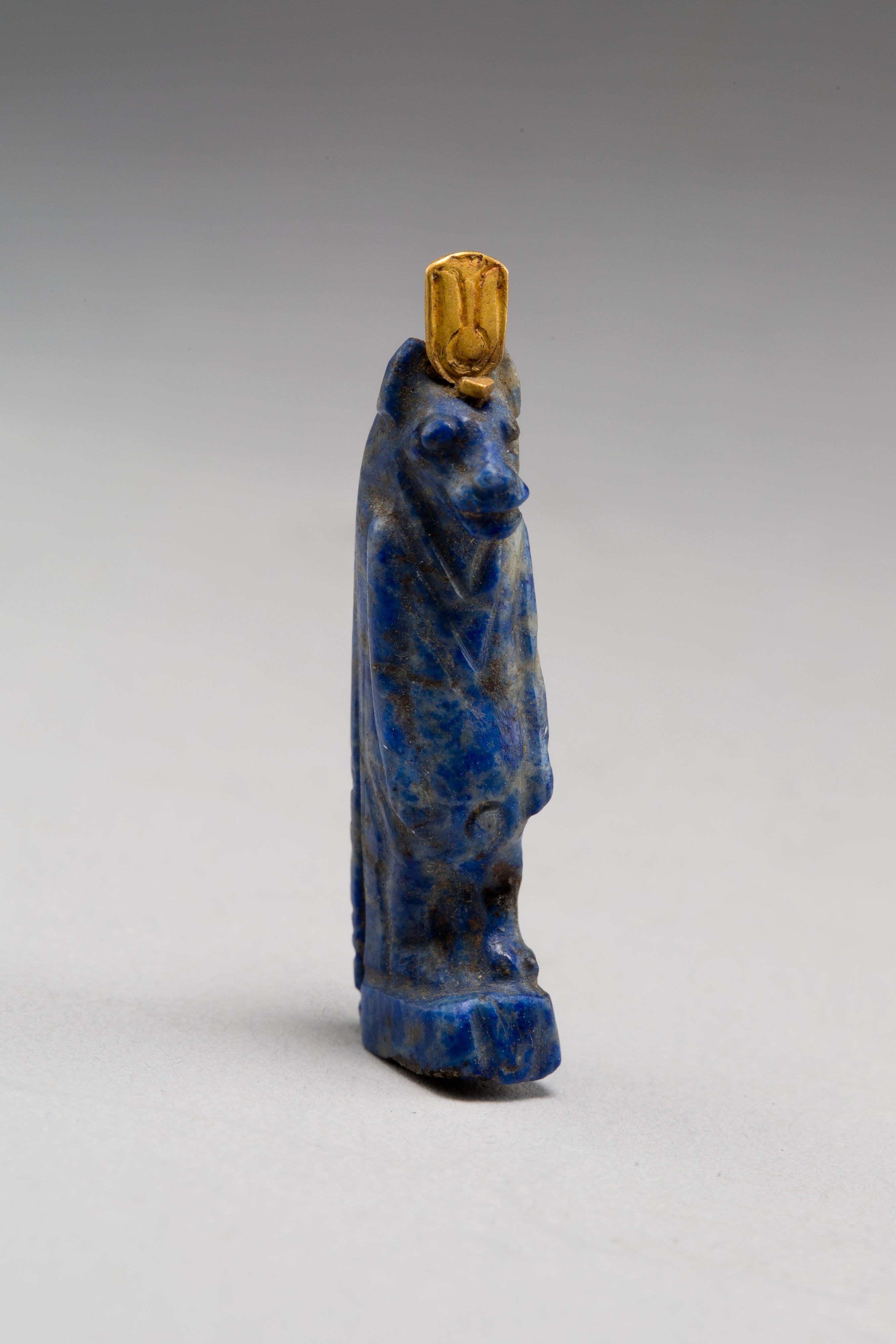
Heritage Analysis: The Taweret Amulet in Lapis Lazuli and Gold
Executive Summary
This strategic heritage analysis examines the Taweret amulet—a rare composite artifact crafted from lapis lazuli and gold—as a potent symbol for Katherine Fashion Lab’s 2026 high-end luxury strategy. Originating from ancient Egyptian civilization, this amulet embodies a fusion of protective divinity, maternal power, and celestial resonance. By decoding its symbolic power, historical adornment practices, and spiritual meaning, this paper proposes a framework for translating ancient iconography into contemporary luxury narratives. The analysis concludes with actionable insights for positioning the Taweret motif as a signature emblem of resilience, exclusivity, and cultural stewardship within the 2026 luxury market.
Symbolic Power: The Protective Matriarch of the Nile
Divine Guardianship and Cosmic Authority
The Taweret amulet represents the ancient Egyptian goddess Taweret, a composite deity combining the features of a hippopotamus, lion, and crocodile. As a protective figure, Taweret was venerated primarily by women and children, safeguarding households during childbirth and infancy. The lapis lazuli medium—a stone associated with the heavens and the night sky—amplifies the amulet’s cosmic authority, linking the goddess to the celestial realm. Gold, meanwhile, denoted the eternal, imperishable flesh of the gods, reinforcing Taweret’s role as a timeless guardian against chaos.
In the context of luxury branding, this symbolic power translates into a narrative of unassailable strength and nurturing protection. For Katherine Fashion Lab, the Taweret amulet can be positioned as an emblem of resilient femininity—a counterpoint to fragile notions of luxury. The amulet’s dual nature as both fierce (lion, crocodile) and maternal (hippopotamus) offers a nuanced archetype for modern women who seek power without sacrificing empathy. This duality aligns with 2026 consumer trends favoring brands that celebrate authentic, multifaceted identities.
Lapis Lazuli as a Conduit of Divine Light
Lapis lazuli, sourced from the remote mines of Badakhshan (modern-day Afghanistan), was more precious than gold in ancient Egypt. Its deep blue hue, flecked with golden pyrite, was believed to mirror the star-studded sky—a conduit for divine energy. The Taweret amulet, when carved from this stone, was thought to channel the goddess’s protective power directly into the wearer’s aura. This material choice elevates the amulet from mere ornament to a sacred technology of spiritual defense.
For Katherine Fashion Lab’s 2026 strategy, lapis lazuli offers a rare and ethically resonant material. Its historical association with royalty and the divine can be leveraged to create limited-edition collections that emphasize exclusivity and provenance. By partnering with ethical lapis suppliers, the Lab can further enhance its brand narrative around cultural preservation and responsible luxury—key differentiators in a market increasingly driven by conscious consumption.
Historical Adornment: From Tomb to Body
Amulets as Portable Power
In ancient Egyptian practice, amulets like the Taweret were not mere jewelry but functional objects imbued with apotropaic (evil-averting) properties. They were placed on the body during life—often worn as pendants or sewn into garments—and later incorporated into mummy wrappings to ensure safe passage through the underworld. The materiality of adornment was critical: gold provided permanence, while lapis lazuli offered spiritual resonance. This dual function—material and metaphysical—elevated the amulet to a status symbol for elites who could afford such potent protection.
For Katherine Fashion Lab, this historical context informs a strategic positioning of the Taweret amulet as a wearable talisman for the modern elite. The 2026 luxury consumer seeks more than aesthetic beauty; they desire objects that encode meaning and confer identity. By marketing the amulet as a contemporary “protection piece,” the Lab can tap into the growing demand for mindful luxury—where adornment serves as both personal armor and cultural statement.
Gold as the Immortal Medium
Gold’s incorruptibility made it the material of choice for divine and royal objects in ancient Egypt. The Taweret amulet’s gold elements—often used for the goddess’s headdress or base—signified eternal life and unwavering power. This association with immortality is particularly resonant for luxury brands, where gold remains the ultimate signifier of enduring value. For Katherine Fashion Lab, integrating 18k or 24k gold into the Taweret design reinforces the amulet’s investment-grade appeal—a critical factor for the 2026 high-net-worth customer who views luxury as a store of wealth.
Moreover, gold’s malleability allows for intricate detailing that honors the original craftsmanship. By employing master goldsmiths to replicate the amulet’s ancient motifs—such as the papyrus scepter or the ankh—the Lab can create a bridge between antiquity and modernity, appealing to collectors who value artisanal heritage.
Spiritual Meaning: The Amulet as Inner Sanctuary
Protection from Chaos and the Evil Eye
The Taweret amulet’s primary spiritual function was to ward off malevolent forces, including the demon Apep (chaos serpent) and the evil eye. In a world where ancient Egyptians believed supernatural threats were omnipresent, the amulet served as a portable sanctuary, anchoring the wearer to divine order (Ma’at). This spiritual meaning is not lost on contemporary luxury consumers, who increasingly seek objects that provide psychological comfort and emotional resilience in an era of global uncertainty.
For Katherine Fashion Lab, the Taweret amulet can be marketed as a luxury talisman for modern anxieties. By aligning with 2026 wellness trends—such as mindfulness, meditation, and energy protection—the Lab can position the amulet as a status symbol of inner peace. This narrative dovetails with the broader shift toward holistic luxury, where material wealth is complemented by spiritual wealth.
Fertility, Motherhood, and Rebirth
Taweret’s role as a fertility goddess imbues the amulet with generative power. In ancient Egypt, women wore the amulet to ensure safe childbirth, while men wore it to invoke the goddess’s protective energy for family continuity. The lapis lazuli’s deep blue, often associated with the waters of Nun (the primordial ocean), further symbolizes creation and rebirth. This spiritual dimension offers Katherine Fashion Lab a rich narrative for collections targeting life milestones—such as weddings, births, or career transitions—where the amulet becomes a meaningful heirloom.
The 2026 luxury market is increasingly defined by experiential and sentimental value. By positioning the Taweret amulet as a gift of protection for loved ones, the Lab can tap into the gifting economy, which accounts for a significant portion of high-end jewelry sales. Limited-edition “Protection Collections” featuring the amulet, paired with storytelling cards detailing its spiritual history, can enhance emotional engagement and brand loyalty.
2026 High-End Luxury Strategy: Translating Heritage into Demand
Exclusivity Through Scarcity and Provenance
For Katherine Fashion Lab’s 2026 strategy, the Taweret amulet must be positioned as a rare artifact rather than a mass-produced accessory. This can be achieved through limited-edition drops of no more than 100 pieces, each accompanied by a certificate of authenticity detailing the lapis lazuli’s origin and the goldsmith’s lineage. The scarcity model aligns with the luxury principle of conspicuous rarity, while the provenance narrative satisfies the 2026 consumer’s demand for transparency and traceability.
Additionally, the Lab can collaborate with Egyptian heritage foundations to co-create the amulet, ensuring that a portion of proceeds funds archaeological preservation. This cultural stewardship not only enhances brand credibility but also appeals to the philanthropic luxury consumer who values social impact.
Digital Storytelling and Immersive Experience
The Taweret amulet’s rich symbolism lends itself to immersive digital campaigns. Katherine Fashion Lab can develop a virtual reality (VR) experience that transports users to an ancient Egyptian temple, where they can “activate” the amulet’s protective powers through interactive storytelling. This phygital approach (physical + digital) resonates with the 2026 luxury audience, which seeks experiential engagement beyond the product itself.
Furthermore, the Lab can leverage blockchain technology to create a digital twin of each amulet, allowing owners to access a secure ledger of its history, spiritual meaning, and care instructions. This digital provenance adds a layer of exclusivity and innovation, positioning the amulet as a future-proof luxury asset.
Pricing and Distribution Strategy
Given the amulet’s materials and heritage, a price point of $15,000–$25,000 is justified for the lapis lazuli and gold version, with a platinum and diamond variant at $50,000 or more. Distribution should be limited to flagship boutiques in key luxury capitals (New York, Paris, Dubai, Tokyo) and private client events to maintain exclusivity. The Lab can also offer bespoke commissions for ultra-high-net-worth clients, allowing them to customize the amulet’s gemstone or inscription—a service that reinforces personalization as a core luxury value.