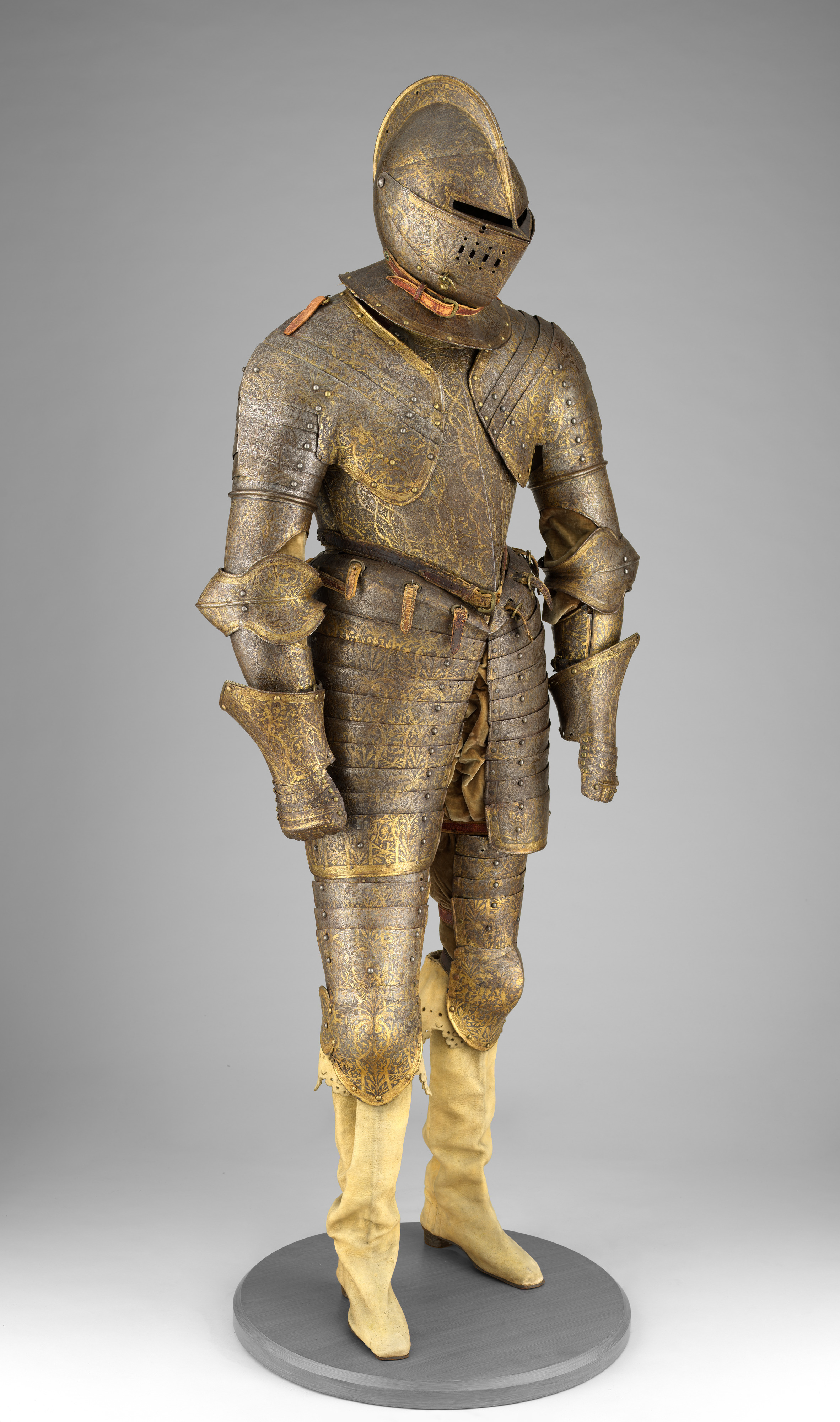
The Armor of the Gendarme: A Couture Analysis of French Heavy Cavalry Armor
In the annals of military history and material culture, few artifacts command the same intersection of brutal utility and refined artistry as the armor of the French heavy cavalry, or gendarmes. At Katherine Fashion Lab, we approach this artifact not merely as a tool of war, but as a profound expression of Renaissance-era couture—a wearable sculpture that negotiates the tensions between protection, status, and the human form. This standalone study dissects a late 16th-century French heavy cavalry armor, composed of steel, gold, leather, and textile, to reveal how its construction anticipates modern principles of haute couture: structural engineering, material hierarchy, and symbolic communication.
Material Hierarchy: Steel as the Structural Foundation
The primary material—steel—serves as the armor’s foundational skeleton, analogous to a couture gown’s boning or a tailored suit’s canvas. French armorers of the period, particularly those in workshops in Paris, Lyon, and the Loire Valley, perfected a metallurgy that balanced hardness with malleability. The steel plates of this armor are not uniformly thick; rather, they exhibit a graduated thickness that mirrors the ergonomic demands of the human body. The breastplate, for instance, is forged to a thickness of approximately 2.5 millimeters at its center, where a lance or sword strike would be most devastating, while tapering to 1.5 millimeters at the edges to allow for articulation and reduced weight. This gradated structural logic is a direct precursor to modern couture’s use of varying fabric weights—such as a silk gazar for structure and a chiffon for drape—to achieve both protection and grace.
Beyond the steel, the integration of gold introduces a layer of conspicuous luxury. Gilding, applied through mercury amalgam or fire-gilding techniques, was not merely decorative; it signified the wearer’s elevated social rank. In the context of French heavy cavalry, the gendarme was often a nobleman, and his armor was a mobile declaration of his lineage. The gold accents—etched into intricate arabesques, classical motifs, or heraldic emblems—function as a visual counterpoint to the steel’s austerity. This interplay between matte and reflective surfaces, between the functional and the ornamental, is a hallmark of couture design: the contrast between a tailored wool jacket and its silk lapels, or a structured leather handbag with gold-plated hardware. The gold on this armor is not an afterthought; it is an integral component of the silhouette, drawing the eye to the chest, shoulders, and helmet—the zones of authority and action.
Leather and Textile: The Second Skin
Beneath the steel, the armor’s foundation relies on leather and textile—materials that serve as the interface between the rigid metal and the wearer’s body. The leather, typically vegetable-tanned cowhide or occasionally deerskin for its suppleness, is cut into straps and linings that secure the plates to the torso and limbs. This leather functions as a structural web, distributing the weight of the armor across the shoulders and hips, much like a couture gown’s internal corset or a modern backpack’s load-bearing frame. The stitching—often executed with waxed linen thread in a saddle stitch—is both utilitarian and aesthetic, creating a rhythmic line that echoes the repetitive motifs on the steel.
The textile elements, such as velvet or brocade linings and decorative panels, introduce a tactile softness that contrasts with the cold steel. In this specific armor, a deep burgundy velvet lines the interior of the gorget (neck guard) and the armpit areas, providing comfort and wicking moisture. This choice of textile is not arbitrary; burgundy was a color associated with the French monarchy and the House of Valois, reinforcing the wearer’s political allegiance. The textile also serves a thermal and acoustic function, dampening the clatter of metal against metal and insulating the body from the heat of the sun or the chill of the battlefield. In couture terms, this is the equivalent of a silk charmeuse lining inside a tweed jacket—a hidden luxury that enhances the wearer’s experience without compromising the exterior’s statement.
Silhouette and Articulation: The Couture of Movement
The silhouette of this armor is defined by its anatomical precision. Unlike earlier medieval plate armor, which often encased the body in a rigid barrel shape, French Renaissance armor for heavy cavalry emphasizes a more naturalistic, athletic form. The breastplate is subtly curved to follow the pectoral muscles, while the backplate mirrors the spine’s S-curve. The pauldrons (shoulder guards) are articulated with overlapping lames—small, sliding plates—that allow the arms to raise, lower, and rotate for swordplay. This articulation is achieved through riveted leather straps and internal steel pins, creating a system of joints that mimic the human skeleton’s range of motion.
From a couture perspective, this articulation is analogous to a tailored sleeve with a gusset or a pleated back panel that accommodates movement. The armor’s designers understood that a static, beautiful form was useless if it hindered the wearer’s ability to fight. Similarly, a couture gown must allow the wearer to walk, sit, and gesture with ease while maintaining its sculptural integrity. The overlapping lames of the armor, for instance, create a visual rhythm of horizontal lines across the shoulders—a design element that modern designers might reinterpret as a series of laser-cut leather strips or metal mesh panels. The armor’s silhouette is not merely a shell; it is a dynamic envelope that responds to the body’s kinetic energy.
Symbolic Communication: The Armor as a Social Text
Every element of this armor communicates a layered message. The gold etching often includes scenes from classical mythology or biblical narratives, such as the Labors of Hercules or the Triumph of David, aligning the wearer with heroic archetypes. The helmet, a close-fitting armet with a visor, features a gold-plated crest in the form of a lion or fleur-de-lis, signifying courage and royal favor. These symbols are not merely decorative; they function as a visual rhetoric that asserts the wearer’s identity in a pre-literate or semi-literate society. In couture, this is the equivalent of a designer’s logo, a signature silhouette, or a fabric’s provenance—like a Chanel tweed or a Dior bar jacket—that instantly communicates taste, wealth, and affiliation.
The armor also employs color theory through its materials. The steel’s natural grey-blue hue is offset by the gold’s warm yellow and the burgundy velvet’s deep red. This triadic palette—cool metal, warm precious metal, and rich textile—creates a visual tension that is both commanding and harmonious. In modern couture, a similar effect is achieved through the juxtaposition of a silver lamé with a ruby silk and a charcoal wool. The armor’s palette is designed to be legible from a distance, whether on the battlefield or in a courtly procession, ensuring that the wearer is both protected and seen.
Conclusion: The Armor as a Prototype of Wearable Art
This French heavy cavalry armor is not a relic of a bygone era but a prototype of wearable art that anticipates the principles of haute couture. Its steel skeleton, gold embellishments, leather infrastructure, and textile linings form a cohesive system that balances protection, mobility, and status. At Katherine Fashion Lab, we recognize that the armor’s designers were, in essence, couturiers of steel—engineers of form who understood that the body is the ultimate canvas. The armor’s articulation, material hierarchy, and symbolic language offer a rich vocabulary for contemporary designers seeking to merge function with fantasy. Whether in a museum or on a runway, this armor stands as a testament to the enduring dialogue between the human form and the materials that shape it.