The Chimney Piece: A Tapestry of Genesis in American Needlework
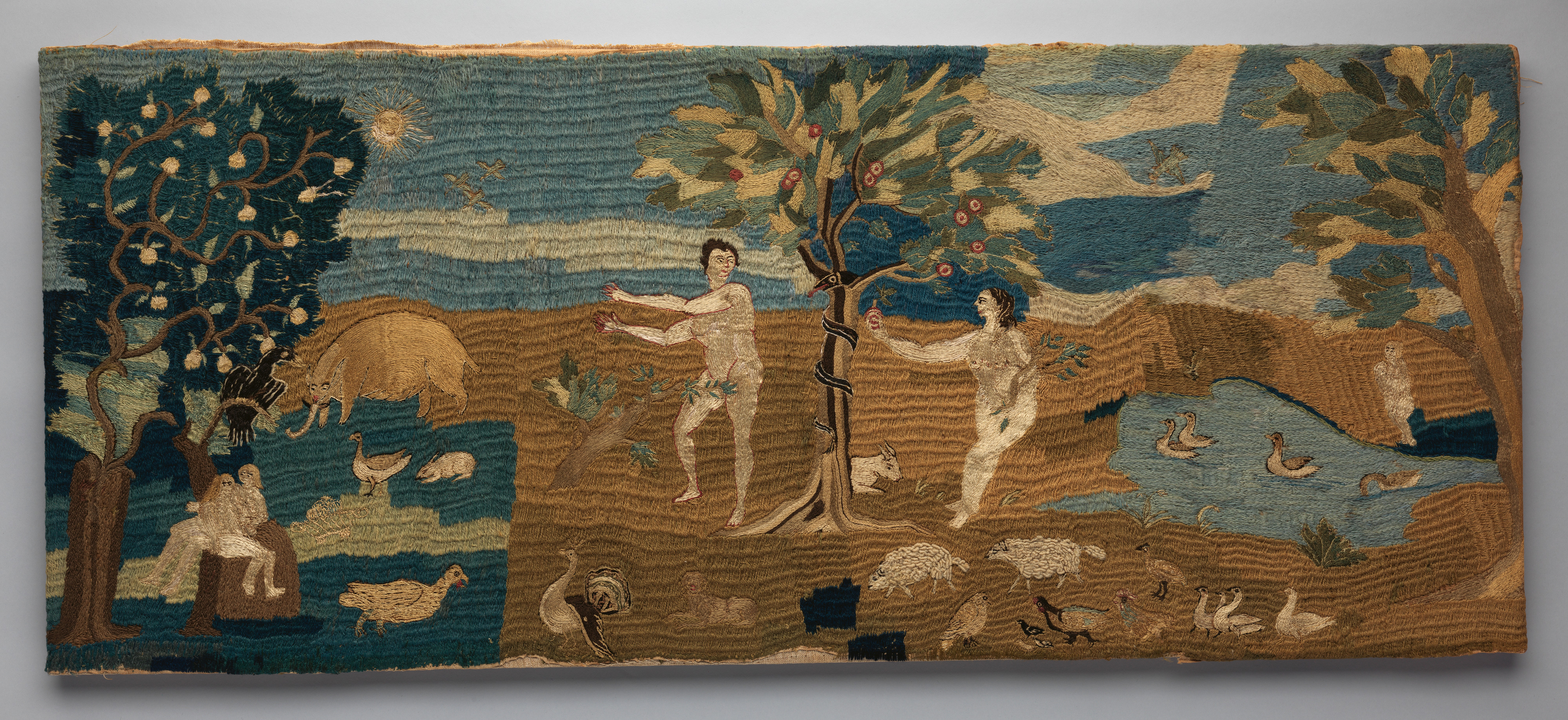
In the annals of American decorative arts, few objects capture the intersection of domestic craft, theological narrative, and material sophistication as compellingly as the “Chimney Piece with Images of Adam and Eve.” This extraordinary artifact, rendered in wool and silk embroidery on linen, is not merely a decorative panel but a profound cultural statement. As Lead Curator of Katherine Fashion Lab, I invite you to examine this piece through the lens of couture analysis—where technique, symbolism, and context converge to reveal a masterwork of American needlework.
Materiality and Technique: The Embodied Craft
The choice of materials in this chimney piece is deliberate and revealing. Wool and silk embroidery on linen represents a hierarchy of textile resources in the early American household. Linen, derived from flax, was a staple of domestic production—sturdy, breathable, and symbolizing self-sufficiency. Wool, often hand-spun and dyed with natural pigments, provided texture and warmth. Silk, however, was a luxury import, its luster and smoothness evoking refinement and global trade. By combining these fibers, the embroiderer asserted both practicality and aspiration, grounding the sacred narrative in the tangible realities of American life.
The embroidery technique itself is a testament to skill. Long-and-short stitch creates subtle gradations of color in Adam’s flesh and Eve’s flowing hair, while satin stitch lends a polished sheen to the serpent’s scales and the apple’s skin. The use of split stitch for outlines ensures that the figures remain distinct against the linen ground. This precision is not accidental; it mirrors the precision of a couture atelier, where every thread serves both aesthetic and structural purpose. The wool’s nubby texture contrasts with silk’s gloss, creating a tactile dialogue that invites close inspection—a hallmark of high-quality needlework.
Iconography: Adam and Eve as American Archetypes
The depiction of Adam and Eve in this chimney piece transcends biblical illustration. Here, the figures are rendered with a naïve yet expressive quality that characterizes early American folk art. Adam stands with a spade, his posture suggesting labor rather than idleness, while Eve reaches for the forbidden fruit with a gesture that is both tentative and determined. This interpretation reframes the Fall not as a catastrophe but as a necessary prelude to human industry—a distinctly American ethos.
The serpent, coiled around the Tree of Knowledge, is rendered with a sinuous elegance that belies its malevolent role. Its scales are embroidered in alternating shades of green and gold, evoking both the Garden’s vitality and the temptation’s allure. The apple itself, a single crimson orb, is the focal point of the composition. In the context of American needlework, this apple may also reference fertility, abundance, and the agrarian ideal—themes central to the nation’s identity.
Notably, the background is not a lush Eden but a sparsely populated landscape with stylized trees and a single dwelling in the distance. This simplification reflects the embroiderer’s domestic experience: the Garden is not a distant paradise but a metaphor for the American frontier, where creation and fall are re-enacted daily through toil and choice. The piece thus becomes a moral allegory for the young republic, urging viewers to embrace responsibility and redemption.
Context: The Chimney Piece as Standalone Study
This artifact is described as a “standalone study,” meaning it was not part of a larger suite of textiles but was designed to be viewed independently, likely mounted above a fireplace. The chimney piece was a focal point of the domestic interior in 18th- and 19th-century America. Positioned at the heart of the home, it served as both a heat source and a visual anchor. By placing Adam and Eve above the hearth, the embroiderer imbued the space with spiritual and cultural significance. The fire below would have cast flickering light on the embroidery, animating the figures and reinforcing the narrative of creation and fall.
The piece’s American origin is crucial. Unlike European needlework, which often adhered to formal patterns and ecclesiastical themes, American embroidery embraced individual expression and vernacular motifs. This chimney piece likely belonged to a prosperous household where women’s education included needlework as a marker of gentility. Yet it also reflects the democratic spirit of the era: the story of Adam and Eve is universal, accessible to all, and rendered with a directness that speaks to common experience.
Couture Analysis: The Intersection of Fashion and Textile Art
From a couture perspective, this chimney piece can be analyzed as a prototype of wearable art. The techniques employed—embroidery, appliqué, and thread painting—are foundational to haute couture. The wool and silk combination prefigures the texture play seen in modern fashion houses like Chanel or Dior, where contrasting fibers create visual and tactile interest. The color palette—earthy browns, verdant greens, and vibrant reds—mirrors the autumnal tones favored by American designers in the 20th century, such as Ralph Lauren’s rustic collections.
Moreover, the narrative quality of the piece anticipates the storytelling inherent in fashion. Just as a couture gown might evoke a historical period or a myth, this embroidery narrates a foundational tale. The figures’ poses—Adam with his spade, Eve with her apple—could be seen as fashionable attitudes, reflecting the ideal of the virtuous, industrious woman and the strong, laboring man. The piece thus serves as a cultural artifact that bridges domestic craft and high fashion, demonstrating that embroidery is not merely decorative but communicative.
Conclusion: A Masterwork of American Needlework
The Chimney Piece with Images of Adam and Eve is more than a relic; it is a textual and textile masterpiece. Its combination of wool and silk on linen, its nuanced iconography, and its role as a standalone study in the American home reveal a sophisticated understanding of material, narrative, and context. For Katherine Fashion Lab, this piece exemplifies how craft becomes couture—where every stitch, every fiber, and every motif carries weight. As we continue to explore the intersections of fashion, art, and history, this chimney piece stands as a testament to the enduring power of needlework to tell stories that are at once personal and universal.