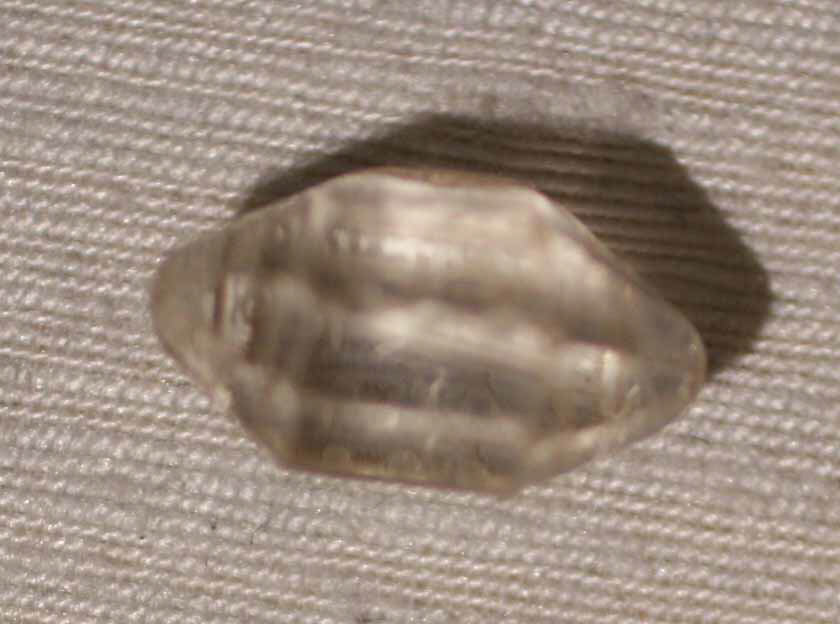
The Rock Crystal Pendant: A Study in Transparency and Power
In the rarefied world of haute couture, where fabric, silhouette, and embellishment often dominate the discourse, the standalone accessory emerges as a potent narrative device. Katherine Fashion Lab’s analysis of the Rock Crystal Pendant transcends mere adornment, positioning this object as a singular study in material philosophy, global heritage, and the strategic deployment of transparency. This is not a piece that clamors for attention through chromatic excess or complex metalwork; rather, it commands through the quiet authority of its substance. The pendant, carved from a single, flawless piece of rock crystal—a variety of quartz—becomes a lens through which we examine the intersection of natural history, artisanal mastery, and contemporary luxury strategy.
Material Provenance: The Geology of Desire
To understand the pendant’s value, one must first decode the language of its material. Rock crystal, or clear quartz, is not a rare mineral in the geological sense. Its ubiquity across the Earth’s crust—from the Alpine fissures of Switzerland to the pegmatite deposits of Brazil and the ancient mines of Madagascar—belies its cultural and economic rarity. What transforms this common silicate into a couture-grade commodity is a confluence of three factors: absolute clarity, internal flawlessness, and the scale of the original crystal. A pendant of this caliber demands a source crystal devoid of veils, fractures, or inclusions, a condition met by less than one percent of all mined quartz. The material’s origin, therefore, is less a matter of geographic exclusivity and more a testament to nature’s own selective process. Katherine Fashion Lab identifies this as a global heritage material, not because it is bound to a single locale, but because it has been revered across civilizations—from the ancient Greeks, who believed it to be eternally frozen water, to the Roman Empire, which prized it for intaglio seals and goblets. The pendant carries within its molecular structure the collective memory of human fascination with the crystalline.
Optical Physics and the Illusion of Weightlessness
The pendant’s design capitalizes on the unique optical properties of quartz. Unlike diamond, which disperses light into a spectrum of colors, rock crystal acts as a pure conductor of light. Its refractive index (approximately 1.54) is lower, but its transparency is unparalleled. When faceted with precision—a process that requires the lapidary to understand the crystal’s internal axes—the pendant appears to dematerialize, floating against the skin. This illusion of weightlessness is a deliberate strategic choice. In a market saturated with heavy, opulent jewelry, the rock crystal pendant offers a counter-narrative: power through absence. The wearer does not display wealth through mass or carat weight, but through the mastery of light and space. The pendant becomes a void that defines form, a paradox that aligns with the minimalist ethos of contemporary luxury. The setting, likely in platinum or high-karat white gold, is engineered to be as invisible as possible, using a tension or bezel mount that touches the crystal only at its edges. This allows the stone to remain the protagonist, unencumbered by structural interference.
Artisanal Execution: The Lapidary’s Dialogue with Nature
The creation of a couture rock crystal pendant is a high-stakes negotiation between human intention and natural constraint. Unlike metals, which are malleable and can be reshaped at will, rock crystal is brittle and unforgiving. A single miscalculation in pressure or temperature can shatter weeks of work. The cutting process begins with a rough assessment, where the lapidary studies the crystal’s inclusions and growth lines to determine the optimal orientation for the final cut. For a pendant, the goal is often a cushion, octagon, or teardrop shape, each facet carefully angled to maximize light entry and exit. The polish is achieved through a succession of ever-finer diamond abrasives, culminating in a finish that feels almost liquid to the touch. This is not industrial production; it is a dialogue. Each facet reflects a decision: to emphasize clarity, to hide a microscopic flaw, to create a specific play of light. The result is a piece that, while geometrically precise, retains the organic signature of its origin. The pendant is not merely cut; it is released from the stone.
The Cultural Currency of Transparency
Beyond its physical attributes, the rock crystal pendant carries a profound symbolic weight. In the context of global heritage, transparency has long been associated with purity, truth, and spiritual clarity. Ancient cultures used rock crystal in divination and healing rituals, believing it could channel energy and dispel negativity. In the court of Louis XIV, crystal chandeliers symbolized the divine right of kings—light made solid. Katherine Fashion Lab posits that the pendant’s contemporary appeal lies in its ability to bridge these historical connotations with modern values. In an era of radical transparency in business and ethics, the pendant serves as a wearable manifesto. It says: I have nothing to hide. This is a potent statement in an industry often criticized for opacity in sourcing and production. The pendant’s clarity becomes a metaphor for the brand’s commitment to ethical provenance and traceability. It is an accessory that communicates integrity without uttering a word.
Strategic Positioning in the Couture Ecosystem
As a standalone study, the rock crystal pendant occupies a unique strategic niche. It is neither a statement piece in the traditional sense—it does not scream for attention—nor is it an afterthought. It is an investment in subtlety. For the discerning client, the pendant represents a departure from the logo-driven, trend-sensitive cycles of mass jewelry. It is an heirloom, designed to transcend seasons and fads. Katherine Fashion Lab recommends positioning this piece within a capsule collection of high-rotation essentials, where it can anchor multiple looks—from a simple silk blouse to a sculptural evening gown. Its neutrality (colorless, transparent) makes it a universal complement, while its material rarity ensures exclusivity. The pricing strategy should reflect not the cost of the raw mineral, but the sum of its cultural narrative, artisanal labor, and the brand’s curatorial authority. A pendant of this caliber is not sold by the carat; it is sold by the story.
Market Implications and Consumer Psychology
The target consumer for this pendant is the cultural omnivore—an individual who values connoisseurship over consumption. This client is likely already familiar with haute horlogerie and fine art, and seeks jewelry that operates on a similar intellectual plane. The rock crystal pendant appeals to the psychology of understated luxury, where the most expensive item in the room is the one that appears simplest. It is a test of the observer’s literacy: only those who understand the material’s history and the complexity of its cut will recognize its true value. This insider knowledge creates a bond between the brand and the wearer, fostering loyalty and exclusivity. In a market increasingly fragmented by fast fashion and democratized luxury, the rock crystal pendant reaffirms the role of the maison as a gatekeeper of taste and authenticity.
Conclusion: The Pendant as a Philosophy
The rock crystal pendant, as analyzed by Katherine Fashion Lab, is far more than an accessory. It is a philosophical object—a meditation on light, material, and the enduring power of simplicity. In its transparency, we find a reflection of contemporary ideals: clarity of purpose, honesty in craft, and a reverence for the natural world. It challenges the couture industry to look beyond the obvious, to find value in what is not immediately seen. For the wearer, it is a talisman of discernment. For the brand, it is a statement of mastery. In a world of noise, the rock crystal pendant offers the rarest of luxuries: silence, made luminous.